
Johann Valentin Andreae
1586 to 1654
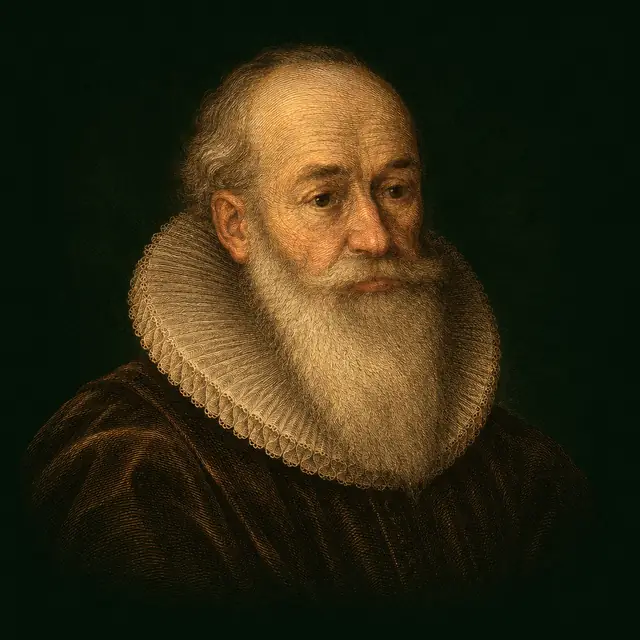
Who was Johann Valentin Andreae, and what is truly known of them?
What is known
German Lutheran pastor and writer, born at Herrenberg in Württemberg, grandson of one of the authors of his church’s creed. He studied at Tübingen, where he belonged to a circle of reforming friends round the lawyer Tobias Hess, and served as deacon at Vaihingen, superintendent at Calw and court preacher at Stuttgart. In his memoir, printed long after his death, he owns The Chymical Wedding of Christian Rosenkreutz, printed without a name at Strasbourg in 1616, as a work of his youth, and calls it a jest. The two Rosicrucian manifestos of 1614 and 1615 came out of the same circle; scholars see his hand in them, and he never claimed them. From 1619 he wrote against the furore they had raised, and his Christianopolis of that year describes a Christian city of craftsmen and scholars.
The teaching
Taught from his own books, above all Christianopolis and Turris Babel (both 1619), with the Chymical Wedding (1616).
The jest of his youth
Andreae's first teaching is told as a play. In the Chymical Wedding the guests who boast of their learning are found too light, the humble man who doubts his own worth is chosen, and the true work is the death and raising of the royal pair, while most of the company is content to make gold; the story and the two manifestos beside it are told part by part on the branch of the Rosicrucians. He called the book a jest, and its moral is plain under the play: the remaking of the soul is the work, and gold is the by-work of those who want no more.
The fraternity set aside
When all Europe began to clamour for the brothers of the Rose Cross, Andreae answered with Turris Babel, the Tower of Babel. In its dialogues every voice is heard at once, believers and mockers, gold-seekers and the hopeful, each sure of what the brotherhood is, until the confusion is its own proof. The book's end gives his teaching: stop waiting for hidden brothers, and follow Christ, whose brotherhood is open to all and needs no vault, no cipher and no secret seal. The reformation the manifestos called for is to begin in each life, in faith shown by love and work.
The voyage to Caphar Salama
Christianopolis is that reformation drawn as a city. Its narrator sets out on the Academic Sea in the ship Fantasy, is wrecked, and is cast ashore on the island of Caphar Salama, the village of peace, where the city stands. He is examined before he may enter, for the city admits no idler, no quack and no deceiver, and it tests a stranger's life and conduct before his learning. Once admitted, he is shown everything, and the book is his account of it.
A city built for its work
The city is square, facing the four quarters of the world, walled and towered, with a round temple at its centre. Its farms and mills lie outside the walls; within, the workshops are set out by trade, and every citizen works, so the working day is short and no one is idle or worn out. No one keeps money of his own. What is made goes to the public stores, and each household draws from them what it needs; the people eat, dress and live simply, and count no honest craft beneath them.
Its craftsmen are educated people and its scholars work with their hands. That is the city's rule: learning cut off from making grows proud and empty, and making cut off from learning stays blind.
The college at the heart
At the heart of the city is its college, and there the study of nature is done by hand. It has a library and a printing press; a laboratory, where the properties of metals, minerals and plants are tested by fire, not for gold but for knowledge and for medicine; a pharmacy; a hall of anatomy, where the body is opened to be understood; a hall of natural history, with pictures of the creatures of the earth, the sea and the air; and a tower of mathematics with instruments for the heavens. Music, painting and the mechanical arts have their rooms too. Nature is God's other book, and to study it with eyes and hands is a form of worship.
The schooling of the young
The city takes education to be its first care. Its children are given to the public schools, boys and girls alike, and taught by teachers chosen for their age and character rather than their need of a post. They learn languages, logic, arithmetic, music and the heavens, with piety through all, and they learn by sight and by hand as well as by books. The aim is not a scholar who can dispute but a person who knows, makes and loves well.
A society of friends
After Christianopolis Andreae drew up a plan for a real fellowship, a Christian society of learned friends. Its members are bound not by oaths or secrets but by love, each bringing his own gift, in scripture, in morals, in the arts of government, in the study of nature or in the crafts, to the service of the others and of the Church. It is the city's pattern on a small scale: learning and faith joined, knowledge shared freely, and every gift put to common use.
Orders and memberships
A Lutheran clergyman all his working life. About 1618 he drew up plans for a Christian society of learned friends, which came to little, and in 1646 he was received into the Fruitbearing Society, a German literary academy. No Rosicrucian brotherhood is documented before the manifestos that announced one.
The legend
That Christian Rosenkreutz lived from 1378 to 1484 and that his vault was opened in 1604: that is the story the manifestos tell. That the order took its rose and cross from the arms of the Andreae family, a St Andrew’s cross with four roses, is a likely guess and not a record.
What was forged, or is false
The Priory of Sion papers, forged in France in the 1960s, which name him a Grand Master.
Their works
- The Chymical Wedding of Christian RosenkreutzNovel, printed 1616
An allegorical romance in seven days: an old man is invited to a royal wedding at a castle, passes trials, sees the king and queen beheaded and raised again by alchemical art, and is made a knight of the golden stone. Printed without a name at Strasbourg, it was owned by Andreae in his memoir as a jest of his youth.
Ask the Oracle about it - ChristianopolisBook, printed 1619
A description of an island city of Christian craftsmen and scholars, with workshops, a laboratory and a college at its heart, where learning and faith serve one another. It is one of the classic ideal commonwealths, beside More and Campanella.
Ask the Oracle about it - Fama FraternitatisBook, printed 1614
The first Rosicrucian manifesto, printed at Kassel, telling of Christian Rosenkreutz, his brotherhood and the opening of his vault, and calling the learned of Europe to a general reformation. It came out of the circle of friends at Tübingen round Tobias Hess.
Scholars see his hand in it with others of his circle; he never claimed it.
Ask the Oracle about it - Turris BabelBook, printed 1619
The Tower of Babel, a set of dialogues in which the many voices raised for and against the Rosicrucians are heard in confusion, until the dream of the fraternity is put aside for Christ. It marks his turning away from the furore.
Ask the Oracle about it - His memoirAccount, before 1654
The account of his life written in Latin in his last years, printed long after his death, where he names The Chymical Wedding as a work of his youth and calls it a jest. It is the chief source for his part in the Rosicrucian story.
Ask the Oracle about it
How the house tells a life
This life is told from the record, with what is documented, what is legend and what was forged kept apart. A membership in an order is stated only where documents show it. A person’s chart explains none of their deeds.
The arts it feeds
Lives near it in time
Lives and legends
Isaac LuriaRudolf IIEdward KelleyHeinrich KhunrathMichael MaierRobert FluddWilliam LillyElias AshmoleIsaac NewtonThe Count of Saint-GermainCourt de GébelinGiacomo CasanovaThe whole tree

