
William Lilly
1602 to 1681
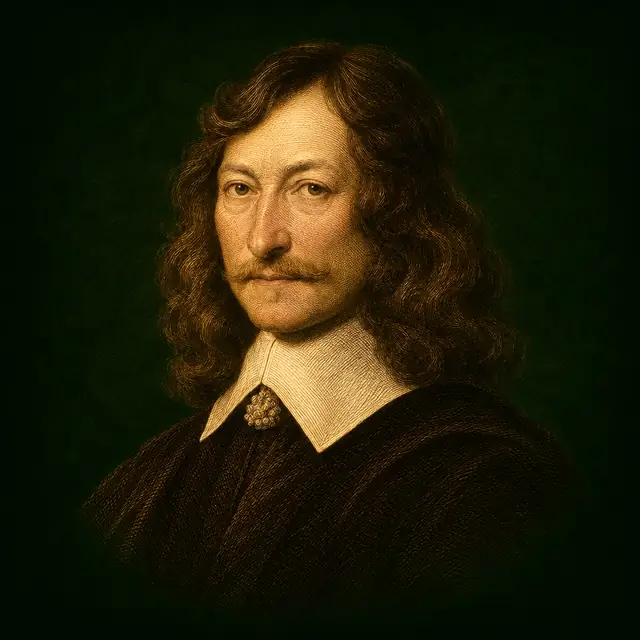
Who was William Lilly, and what is truly known of them?
What is known
English astrologer, born a yeoman’s son at Diseworth in Leicestershire. He came to London in 1620 as a servant, married his master’s widow, and from 1632 studied astrology. His first almanac came out in 1644 and in its best years sold some thirty thousand copies; his Christian Astrology of 1647 was the first full textbook of the art in English and is still the standard work on horary astrology. In the Civil War he wrote for Parliament, yet the king’s friends consulted him on Charles I’s plans of escape. A pamphlet of 1651 carried woodcuts of a city in flames and of the dead being shrouded, and after the Great Fire of 1666 a committee of the Commons called him in, questioned him and let him go. He retired to Hersham in Surrey and wrote his own life for his friend Elias Ashmole.
The teaching
Taught from his Christian Astrology (1647), above all its art of answering questions.
The chart of the question
Lilly teaches that a question sincerely asked can be answered from the heavens at the moment it is put. The astrologer casts the chart for the minute he receives and understands the question, as a nativity is cast for the minute of birth, because the question is the birth of the matter.
The chart is divided into twelve houses, counted from the Ascendant, the degree rising in the east, and each house rules a part of life. The first is the person who asks, the querent, with his life and body; the second his money and goods; the third his brothers, sisters and neighbours, letters and short journeys; the fourth his father, his lands and houses, hidden treasure and the end of every matter; the fifth children, pleasures and messengers; the sixth sickness, servants and small beasts; the seventh marriage, partners, open enemies, the other side in a lawsuit, and thieves; the eighth death and the goods of the dead; the ninth religion, long journeys, learning and dreams; the tenth honour, office, kings and the mother; the eleventh friends and hopes; and the twelfth sorrow, imprisonment, private enemies and great beasts such as horses.
Significators
Every person and thing in the question has its planet. The querent is signified by the lord of the Ascendant, the planet that rules the rising sign, and by the Moon, his fellow significator in every question. The thing or person asked about is signified by the lord of its house: when a woman asks whether she shall marry the man she desires, she is the first house and its lord and he is the seventh and its lord; when a man asks after his lost money, he is the first, and the money is the lord of the second. A planet standing in a house speaks of its matters too. The answer lies in how these planets stand to one another.
Perfection and its hindrances
A matter comes to pass, or is perfected, when its significators come together. The plainest way is by aspect: the quicker planet applies to the slower by conjunction, sextile, square, trine or opposition, and when the aspect is complete the thing is done, easily by sextile or trine, with trouble by square, and by opposition only after strife, or in a way the querent comes to regret. If the significators make no aspect, a third planet may join them. In translation of light a swift planet leaves one significator and goes on to the other, carrying the light between them as a friend carries a message; in collection of light both apply to a weightier planet, which gathers their light into one.
A matter fails when the joining is broken off. Prohibition is when another planet reaches one of the significators first and comes between them; frustration is when the planet being reached joins with another before the aspect is made; refranation is when a significator turns retrograde before the aspect is complete, and the matter falls back.
Dignity and debility
A significator's strength tells the condition of what it signifies. A planet is strong in essential dignity when it stands in its own sign, its exaltation, its triplicity, its term or its face, and Lilly scores these five, four, three, two and one. It is weak in its detriment, the sign opposite its own, scored minus five, and in its fall, the sign opposite its exaltation, minus four; a planet with no dignity at all is peregrine, a wanderer, and also scores minus five.
There are accidental dignities too: to stand in an angle, the first, tenth, seventh or fourth house; to move direct and swiftly; to be free of the Sun's beams. A planet within eight and a half degrees of the Sun is combust, burnt up and weak, but one within seventeen minutes of the Sun's centre is in cazimi, in the heart of the Sun, and strongest of all. A strong lord of the Ascendant shows a querent able to bring his matter about; a weak one shows a man without the means or the standing to do it.
Considerations before judgement
Before he judges, the astrologer asks whether the chart can be trusted. It is radical, fit to be judged, when the lord of the hour and the lord of the Ascendant are one, or of one triplicity, or of one nature. If the first degrees of a sign are rising, it is too early to judge; if its last degrees, the matter is already formed or past help. If the Moon is void of course, making no aspect before she leaves her sign, matters seldom go well, unless she is in Taurus, Cancer, Sagittarius or Pisces. If she is in the via combusta, the burnt way from the middle of Libra to the middle of Scorpio, the judgement is unsafe; and if the seventh house, which in this art stands for the astrologer himself, is afflicted, his judgement may fail him.
Time, theft and the lost
The same chart gives the time. The degrees still to run before the significators perfect their aspect are counted as units of time: short in the angles and the cardinal signs, longer in the succedent houses and the common signs, longest in the cadent houses and the fixed signs, so that the same number may mean days, weeks, months or years.
Questions of theft have their own rules. The goods are signified by the lord of the second and the place where they lie by the fourth; the thief is a peregrine planet in an angle or in the second house, or failing that the lord of the seventh, and his looks, his age and his manner are read from that planet's nature and the sign it stands in. Saturn gives a lean, dark and downcast man, Jupiter a tall and well-made one of good complexion, Mars a bold and ruddy one quick to quarrel, and so on through the planets, each sign altering the picture.
To the student
Lilly opens his book with counsel for the one who would practise it. He is first to consider his Creator and be thankful, and to let no knowledge of nature make him proud or forget the providence of God, for the more holy he is and the nearer to God, the purer the judgement he gives. He is to be courteous and easy of access, and never to afflict the miserable with the terror of a harsh judgement, but to let them know a hard fate by degrees and bid them call on God. He is to give freely to the poor, to let no gain buy a false judgement from him, and to be sparing in judging the commonwealth he lives in or the death of his prince. The art serves the one who asks, and through it the astrologer serves God and his neighbour.
Orders and memberships
No order is documented. He was a leading member of the Society of Astrologers, which met in London for a yearly feast and sermon from the late 1640s. His licence to practise medicine, granted in 1670, came from the Archbishop of Canterbury.
The legend
That he foretold the plague and fire of London to the year: the woodcuts show both and give no date, and he told the committee he had not sought out the year. By his own account he once searched the cloister of Westminster Abbey for treasure with hazel rods, until a wind rose and drove the party out.
Their works
- Christian AstrologyBook, printed 1647
The first full textbook of astrology in English, in three books: the planets and houses, the art of answering questions from the chart of the moment, and nativities. It is still the standard work on horary astrology.
Ask the Oracle about it - Merlinus Anglicus JuniorAlmanac, yearly from 1644
His almanac, which in its best years sold some thirty thousand copies and made him the most famous astrologer in England. During the Civil War it served Parliament, and its forecasts were read as news.
Ask the Oracle about it - Monarchy or No MonarchyBook, printed 1651
A pamphlet with pages of woodcuts he called hieroglyphics, among them a city in flames and the dead being shrouded. After the Great Fire of 1666 a committee of the Commons questioned him about them, and he said he had not sought out the year.
Ask the Oracle about it - History of His Life and TimesAccount, written 1668, printed 1715
His own life written for his friend Elias Ashmole: his coming to London as a servant, his teachers in astrology, the treasure hunt in Westminster Abbey, and many sharp portraits of the astrologers of his day.
Ask the Oracle about it
How the house tells a life
This life is told from the record, with what is documented, what is legend and what was forged kept apart. A membership in an order is stated only where documents show it. A person’s chart explains none of their deeds.
The arts it feeds
Lives near it in time
Lives and legends
Rudolf IIEdward KelleyHeinrich KhunrathMichael MaierRobert FluddJohann Valentin AndreaeElias AshmoleIsaac NewtonThe Count of Saint-GermainCourt de GébelinGiacomo CasanovaMartinez de PasquallyThe whole tree

