
Robert Fludd
1574 to 1637
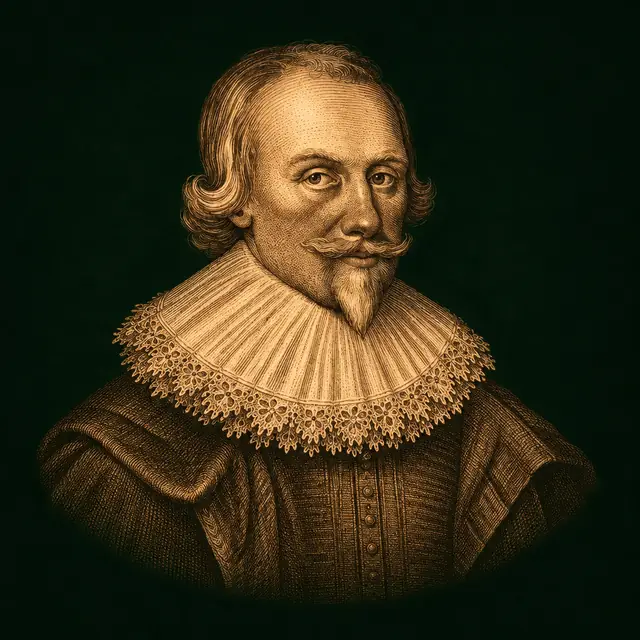
Who was Robert Fludd, and what is truly known of them?
What is known
English physician and writer, born at Bearsted in Kent, son of a treasurer of war to Elizabeth I. After Oxford and six years on the Continent he took his doctorate in medicine in 1605, and the College of Physicians, which had failed him more than once for scorning Galen, admitted him a fellow in 1609. He practised in London with his own apothecary. In 1616 and 1617 he printed two defences of the Rosicrucian brotherhood. His largest work, a history of the two worlds, the greater and the lesser, came out at Oppenheim from 1617 with engravings that picture the universe as a single stretched string and man as its small copy. Kepler, Mersenne and Gassendi wrote against him, and he answered each. He defended the weapon-salve, an ointment put on the blade and not on the wound. He died in London.
The teaching
Taught from his own books, above all the History of the Two Worlds (from 1617) and the Mosaicall Philosophy (1659).
Two worlds on one pattern
Fludd teaches that the great world and the little world of the human being are made on one pattern, so that to know either is to know the other. The great world has three regions. Highest is the empyrean heaven, pure light, where God dwells among the angels; below it is the ethereal heaven of the stars and planets, with the Sun at its heart; and lowest is the elemental world of fire, air, water and earth, where things are born and die.
The human being has the same three. The head is his empyrean, the seat of the mind that knows God; the breast is his ethereal heaven, and the heart in it is his Sun, sending life through the blood as the Sun sends it through the world; the belly is his elemental world, where food is cooked, changed and parted. Whatever is above has its likeness within, and the physician who knows the heavens knows the body.
Light and darkness
Before creation there is God alone, and to human understanding He has two faces. When He wills to act He sends forth light, the active principle that warms, rarefies, moves and gives form; when He withholds His will, darkness remains, the passive principle that cools, thickens, rests and receives. Fludd calls these God's volunty and nolunty, His willing and His not willing. Genesis is read so: the deep was dark, the Word said “Let there be light”, and every pair of opposites in nature, heat and cold, rarefaction and condensation, sympathy and antipathy, comes from that first light and that first darkness.
He shows it with a weatherglass, air sealed above water. Warmed, the air swells and drives the water down; cooled, it shrinks and the water climbs. Heat is light at work, and cold is darkness at rest.
The two pyramids
Between God and the earth Fludd draws two pyramids that pierce each other. The pyramid of form, which is light, has its broad base in the highest heaven and narrows to a point at the earth; the pyramid of matter, which is darkness, has its base at the earth and narrows to a point at the top of the heavens. So every region holds both, in different measure: near God almost all is light, near the earth almost all is matter, and halfway, in the heaven of the Sun, the two are equal. This middle place of balance he calls the region of equality, and the Sun that rules it is the heart of the world, as the heart is the Sun of the body.
The monochord of the world
The universe is a single stretched string. In Fludd's engraving it runs from the highest heaven down to the earth, and a hand reaching from a cloud turns the peg that tunes it: God keeps the world in tune. The string is divided by the regions it passes through, the earth, the waters, the air, the fire, the Moon, the planets, the Sun, the stars and the heavens above them, and the whole spans a double octave.
The lower octave, from the earth to the Sun, is the octave of matter; the upper, from the Sun to the highest heaven, is the octave of form and spirit; and the Sun sounds at the middle, where the two meet. The harmony of the world is the right proportion of light to matter at every step, and the human being has a monochord of his own, strung on the same proportions.
The ape of nature
The human arts imitate nature, and Fludd calls them her ape. In the engraving at the front of his work a chain runs from the hand of God to Nature, a woman with the Sun on her breast, and from her hand a second chain runs down to an ape that sits measuring with compasses: the arts hang on Nature as Nature hangs on God. Arithmetic counts as nature counts, music sounds her proportions, geometry measures her, optics and painting copy her light and forms, and the arts of war, of motion and of timekeeping, the mapping of the earth and the heavens, astrology and geomancy all follow her ways. An art is true in so far as it keeps hold of the chain.
Sympathy, the lodestone and the salve
God works in the world through a single spirit that runs through all things, and by it like draws to like: this drawing is sympathy, and the driving apart of unlike things is antipathy. The lodestone shows it plainly, drawing iron and turning to the pole, and Fludd, after William Gilbert, reads the earth itself as a great magnet.
The weapon-salve is sympathy at work across a distance. The blood left on a blade keeps some of the wounded man's spirit, the ointment laid on the blade works on that spirit, and through the spirit that fills the world it reaches the wound, which meanwhile is kept clean and bound. Fludd argues that this is nature's working, as the lodestone's is. It is taught here as his argument: a wound is for a doctor, and a salve on a blade is no treatment.
Sickness and the winds
Disease, for Fludd, is not only a quarrel of the humours inside the body, as Galen's followers taught, but an invader that comes from outside, borne on the winds. Each of the four winds blows from its quarter under an angel, and by God's leave the winds carry the good or the harm of the heavens into the body's spirit. The physician therefore strengthens the spirit, through which God's light works in the body, and counts prayer as part of healing. This is his doctrine of the body, taught as he held it, and not counsel for the sick.
The substance and the shadow
When Kepler wrote against him, Fludd set out what he held to be the difference between them. The common mathematicians, he says, busy themselves with the shadows of quantity, measuring outward motions; the true philosopher seeks the substance and the causes, the inner proportions of light and matter that the numbers only trace. Measurement has its place, but the harmony of the world is grasped whole, by a mind that knows its source.
Orders and memberships
A fellow of the College of Physicians from 1609 and four times its censor. He defended the Rosicrucians without claiming to be one of them. No Masonic membership is documented, though later Masonic writers claim him.
The legend
That Michael Maier received him into the Rosicrucian order, and that he carried it into English Freemasonry: no record shows that the two men met, or that he joined a lodge.
What was forged, or is false
The Priory of Sion papers, forged in France in the 1960s, which list him among the Grand Masters of an order that did not exist.
Their works
- History of the Two WorldsBook, printed from 1617
His largest work, printed at Oppenheim in volumes, on the greater world and the lesser world of man, with many engravings by the workshop of Johann Theodor de Bry. They picture the universe as a single stretched string, the arts of man as the ape of nature, and man as the small copy of the cosmos.
Ask the Oracle about it - Apology for the Rosicrucian FraternityBook, printed 1616
A short Latin defence of the brotherhood printed at Leiden, answering the critics of the manifestos and asking to be received among the brothers. He never claimed to be one of them.
Ask the Oracle about it - Mosaicall PhilosophyBook, printed 1659
An English version of his Philosophia Moysaica of 1638, grounding natural philosophy on the books of Moses and treating light and darkness, sympathy and antipathy, and the magnet as signs of God’s working in the world.
Ask the Oracle about it - Doctor Fludds Answer unto M. FosterBook, printed 1631
His defence of the weapon salve, an ointment put on the blade that had made a wound and not on the wound, against a clergyman who called it witchcraft. He argued that it worked by natural sympathy, not by any spirit.
Ask the Oracle about it
How the house tells a life
This life is told from the record, with what is documented, what is legend and what was forged kept apart. A membership in an order is stated only where documents show it. A person’s chart explains none of their deeds.
The arts it feeds
The Hermetic principlesSound and mantraAlchemyOrders and mystery schools
Lives near it in time
Lives and legends
John DeeIsaac LuriaRudolf IIEdward KelleyHeinrich KhunrathMichael MaierJohann Valentin AndreaeWilliam LillyElias AshmoleIsaac NewtonThe Count of Saint-GermainCourt de GébelinThe whole tree

