

Mystical systems
Monochord
Direct answer
Monochord: A monochord is an instrument with one string stretched over a sounding box and a movable bridge, made to measure the ratios of the musical intervals.
$0 today, then $19/month after 7 days. Cancel anytime.
At a glance
- Also called
- canon harmonicus, one string instrument
- Found in
- Mystical Systems
- Related
- Tetractys, Quadrivium, Pythagorean Numerology, Sacred Geometry
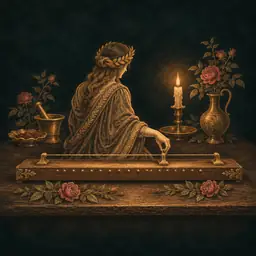

A monochord is an instrument with one string stretched over a sounding box and a movable bridge, made to measure the ratios of the musical intervals.
A lineage map for books and systems; it avoids presenting symbolic traditions as literal fact.
Understand the chapter you are in.
Your life’s turning points, measured from your birth.
Walk through Alex’s whole example first


Prefer to explore first?
 The Road of AgesThe turning points of your whole life, from your own chart
Walk my road
What is a monochord used for?
A monochord has a single string stretched between two fixed bridges over a long box, and a third bridge that slides beneath it. Moving the bridge shortens the sounding part of the string. At half the length the note is an octave above the open string; at two thirds, a fifth; at three quarters, a fourth. The instrument turns hearing into measuring, which is what it was made for.
Greek writers called it the canon, meaning the rule. It was a tool of teachers and theorists more than of players. For some two thousand years it was how students learned the intervals and how organ builders and bell founders set their pitches. Today instruments with many strings tuned alike are sold under the same name for sound sessions.
On the tree of the hidden arts: Sacred geometry.
What sets Monochord apart
It is an instrument made for demonstration and not for music: a ruler that sounds. The sliding bridge lets a length be set by measurement and then judged by ear, so a claim about ratio can be tested on the spot. That made it the standard apparatus of harmonic theory from the Greeks to the seventeenth century, on which scales were laid out, one tuning was compared with another, and choirs were given their notes before keyboards were common.
- Parts: one string, a sounding box, two fixed bridges and one that slides
- Octave: half the string length, ratio 2 to 1
- Fifth: two thirds of the length, ratio 3 to 2
- Fourth: three quarters of the length, ratio 4 to 3
- Oldest treatise: the Division of the Canon, attributed to Euclid
- Greek name: kanon, the rule
Often mistaken for something else: The modern sound-session monochord has many strings tuned to one note and is played for its drone; the classical one has a single string and is there to measure.
The story behind Monochord
Tradition gives its invention to Pythagoras in the sixth century BCE, though no evidence from his own time survives. The oldest treatise on it, the Division of the Canon, is attributed to Euclid, about 300 BCE. Boethius described it for the Latin schools about 500 CE, and Guido of Arezzo taught singers with it in the eleventh century. Robert Fludd drew a cosmic monochord tuned by a divine hand in 1617.
Why Monochord matters
Monochord is the experiment behind the claim that number orders the world: the one place where the Pythagorean idea can be heard.
How to read Monochord
Teachers set its bridge at marked fractions to sound the intervals; theorists worked out and compared tunings on it.
Monochord in practice: an example
A guitarist who touches a string lightly at the twelfth fret, its midpoint, hears the same octave the monochord shows.
Where readings of Monochord go wrong
What it shows is a fact about strings. It does not show that any pitch or interval has an effect on health.
Sources and editorial method
This entry summarizes the tradition in the Almanac's own words; where no source is listed, it is an editorial summary rather than a primary text, and symbolic readings are named as the tradition's, not as fact.
- Source
- The Great Almanac Dictionary
- Category
- Mystical Systems
- Aliases
- monochord instrument, canon harmonicus, pythagorean monochord, one string instrument
- Last updated
- 2026-09-26
See Monochord in your personal almanac
A definition tells you what it is; your own birth chart tells you what it means for you. The Oracle casts your real chart and answers for your love, your work, and your year ahead, in conversation. It opens with the 7-day Oracle trial.
Speak with the OracleRelated terms
More in Mystical Systems
From the reference page to your own chart
Every word here
is in your own chart.
- Your life’s turning points, measured from your birth
- A practical next step to consider
- It opens with 7 days free: the AI Oracle on thirty hidden arts, and your daily horoscope
$0 today, then $19/month after 7 days. Cancel anytime.
Common questions
What is a monochord used for?
It is used to show and measure musical intervals. Sliding its bridge to simple fractions of the string gives the octave, the fifth and the fourth, so the ratios can be both seen and heard.
Did Pythagoras invent the monochord?
Ancient writers say so, but they wrote centuries after him and he left nothing in writing. The oldest surviving treatise on the instrument is the one attributed to Euclid.
What ratio gives a perfect fifth on a monochord?
Three to two. Stopping the string so that two thirds of its length sounds gives a note a fifth above the open string.


