

Mystical systems
Quadrivium
Direct answer
Quadrivium: The quadrivium is the group of four arts of number taught in the medieval schools: arithmetic, geometry, music and astronomy.
$0 today, then $19/month after 7 days. Cancel anytime.
At a glance
- Also called
- four liberal arts of number, arithmetic geometry music astronomy
- Found in
- Mystical Systems
- Related
- Monochord, Tetractys, Timaeus, Sacred Geometry
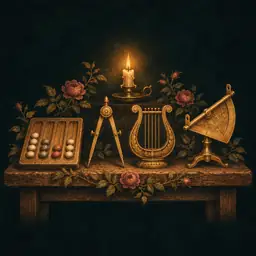

The quadrivium is the group of four arts of number taught in the medieval schools: arithmetic, geometry, music and astronomy.
A lineage map for books and systems; it avoids presenting symbolic traditions as literal fact.
Understand the chapter you are in.
Your life’s turning points, measured from your birth.
Walk through Alex’s whole example first


Prefer to explore first?
 The Road of AgesThe turning points of your whole life, from your own chart
Walk my road
What are the four subjects of the quadrivium?
The quadrivium, Latin for the place where four roads meet, was the upper part of the seven liberal arts. A student first learned the trivium of grammar, logic and rhetoric, the arts of words, and then the quadrivium, the arts of number. Arithmetic was number in itself, geometry number in space, music number in time, and astronomy number in space and time together.
Music here meant the theory of ratios and not performance, and astronomy meant reckoning the calendar and the courses of the Sun, Moon and planets. The scheme carried the Pythagorean conviction that these four are one study. The modern phrase sacred geometry looks back to it, and several recent books on the subject take quadrivium as their title.
On the tree of the hidden arts: Sacred geometry.
What sets Quadrivium apart
What marks it out is the claim that four subjects are one. Arithmetic studies number alone, geometry number at rest in space, music number in motion through time, and astronomy number moving in space. A student who had learned the ratios on a string was expected to meet them again in a triangle and in the calendar. The same conviction lies under sacred geometry, which is in effect the quadrivium remembered without its textbooks.
- Meaning: Latin for the meeting of four roads
- Subjects: arithmetic, geometry, music and astronomy
- Named by: Boethius, about 500 CE
- Companion: the trivium: grammar, logic and rhetoric
- Greek root: the four studies of the guardians in Plato's Republic
- Famous school: Chartres, twelfth century
Often mistaken for something else: The trivium trained a student in words and argument; the quadrivium followed it and trained the same student in number.
The story behind Quadrivium
The grouping goes back to the Pythagoreans and to Plato's Republic, where the four are the training of the guardians. Boethius, about 500 CE, gave it the Latin name and wrote the textbooks on arithmetic and music that the schools used for a thousand years. Martianus Capella and Cassiodorus fixed the list of seven arts. The cathedral school of Chartres taught it in the twelfth century, and the universities after it.
Why Quadrivium matters
Quadrivium explains why older writers treat geometry, music and the sky as one subject, which is the frame sacred geometry inherits.
How to read Quadrivium
Historians of education name it for the mathematical half of the liberal arts; modern writers borrow it as a banner for number lore.
Quadrivium in practice: an example
A twelfth-century student at Chartres who had finished grammar and logic went on to Boethius on number and on music.
Where readings of Quadrivium go wrong
Quadrivium was a school curriculum, not a secret teaching, and its textbooks were public.
Sources and editorial method
This entry summarizes the tradition in the Almanac's own words; where no source is listed, it is an editorial summary rather than a primary text, and symbolic readings are named as the tradition's, not as fact.
- Source
- The Great Almanac Dictionary
- Category
- Mystical Systems
- Aliases
- the quadrivium, four liberal arts of number, arithmetic geometry music astronomy, trivium and quadrivium
- Last updated
- 2026-09-26
See Quadrivium in your personal almanac
A definition tells you what it is; your own birth chart tells you what it means for you. The Oracle casts your real chart and answers for your love, your work, and your year ahead, in conversation. It opens with the 7-day Oracle trial.
Speak with the OracleRelated terms
More in Mystical Systems
From the reference page to your own chart
Every word here
is in your own chart.
- Your life’s turning points, measured from your birth
- A practical next step to consider
- It opens with 7 days free: the AI Oracle on thirty hidden arts, and your daily horoscope
$0 today, then $19/month after 7 days. Cancel anytime.
Common questions
What are the four subjects of the quadrivium?
Arithmetic, geometry, music and astronomy. Together with the trivium of grammar, logic and rhetoric they made up the seven liberal arts of the medieval schools.
Who named the quadrivium?
Boethius, a Roman scholar and statesman, used the word about 500 CE in his book on arithmetic. The grouping of the four arts itself is older and goes back to the Greeks.
Why was music part of the quadrivium?
Because it was studied as the science of ratio. The intervals answer to simple numbers, so music was counted with arithmetic and geometry as a branch of mathematics.


