

Mystical systems
Square and Compasses
Direct answer
Square and Compasses: The square and compasses are two stonemason's tools, a set square and a pair of dividers, laid one over the other as the emblem of Freemasonry.
$0 today, then $19/month after 7 days. Cancel anytime.
At a glance
- Found in
- Mystical Systems
- Related
- Freemasonry, Eye of Providence, Pentagram
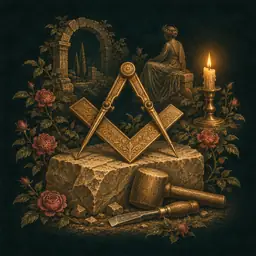

The square and compasses are two stonemason's tools, a set square and a pair of dividers, laid one over the other as the emblem of Freemasonry.
A lineage map for books and systems; it avoids presenting symbolic traditions as literal fact.
Understand the chapter you are in.
Your life’s turning points, measured from your birth.
Walk through Alex’s whole example first


Prefer to explore first?
 The Road of AgesThe turning points of your whole life, from your own chart
Walk my road
What do the square and compasses mean?
The square and compasses are the best known emblem of Freemasonry. Both are working tools: the square with which a mason tests a right angle, and the compasses with which he strikes a circle. The lodges, which grew out of the trade guilds of stonemasons, kept the tools and gave them moral meanings. The square stands for honest dealing, as in the phrase to act on the square, and the compasses for keeping one's desires within bounds.
In many English-speaking lodges a letter G stands between the two tools, read as Geometry, as God, or as both. Lodges elsewhere often leave it out. How the points of the compasses lie, above the square or beneath it, marks the degree being worked.
On the tree of the hidden arts: Symbols.
What sets Square and Compasses apart
Both parts are real tools, and the emblem is read from how they lie. The square is the mason's set square for testing a right angle; the compasses are dividers for striking circles and stepping off lengths. In the first degree both points of the compasses are hidden beneath the square, in the second one point is shown, and in the third both. The letter G in the middle is a habit of English-speaking lodges and is missing from much continental work.
- The square: a set square for testing right angles; read as honest dealing
- The compasses: dividers for drawing circles; read as keeping within bounds
- Letter G: Geometry, or God; found mainly in English-speaking lodges
- First Grand Lodge: London, 1717 by its own account
Often mistaken for something else: The Eye of Providence is a Christian sign that lodges adopted late and share with churches; the square and compasses are the lodges' own emblem.
The story behind Square and Compasses
Tools of the craft appear on the seals and gravestones of working stonemasons in the Middle Ages. After the first Grand Lodge was formed in London, in 1717 by its own account, the lodges of gentlemen who were not builders by trade took the square and compasses as their common badge, and it is printed in Masonic books and engraved on lodge jewels throughout the eighteenth century. The letter G is recorded in English lodges from about 1730. The emblem has never been secret: it is carved over lodge doors and worn openly.
Why Square and Compasses matters
Square and Compasses is the one emblem that reliably marks a Masonic building or object, which makes it the fixed point for telling real lodge signs from guessed ones.
How to read Square and Compasses
Historians date and place lodge buildings, aprons, glassware and gravestones by it, and members wear it on rings and lapel pins.
Square and Compasses in practice: an example
Seeing the two tools carved over a door on a high street, a passer-by can say only that a lodge meets there or once did, and nothing more.
Where readings of Square and Compasses go wrong
Square and Compasses marks membership of a lodge and nothing further: it is no evidence of influence, rank or a hidden purpose.
Sources and editorial method
This entry summarizes the tradition in the Almanac's own words; where no source is listed, it is an editorial summary rather than a primary text, and symbolic readings are named as the tradition's, not as fact.
- Source
- The Great Almanac Dictionary
- Category
- Mystical Systems
- Aliases
- square and compass, masonic square and compasses, freemason symbol, square and compasses meaning
- Last updated
- 2026-09-26
See Square and Compasses in your personal almanac
A definition tells you what it is; your own birth chart tells you what it means for you. The Oracle casts your real chart and answers for your love, your work, and your year ahead, in conversation. It opens with the 7-day Oracle trial.
Speak with the OracleRelated terms
More in Mystical Systems
From the reference page to your own chart
Every word here
is in your own chart.
- Your life’s turning points, measured from your birth
- A practical next step to consider
- It opens with 7 days free: the AI Oracle on thirty hidden arts, and your daily horoscope
$0 today, then $19/month after 7 days. Cancel anytime.
Common questions
What do the square and compasses mean?
They are a stonemason's tools given moral meanings: the square for honest and upright conduct, the compasses for keeping one's desires within due bounds. Together they are the emblem of Freemasonry.
What does the G in the square and compasses stand for?
In lodges that use it, the letter is read as Geometry, which the old Masonic texts call the first of the sciences, as God, or as both. Many lodges outside the English-speaking world do not use the letter at all.
Is the square and compasses a secret symbol?
No. It is displayed openly on lodge buildings, regalia, rings and gravestones, and has been printed in books since the eighteenth century. What lodges keep private is their ritual, not their emblem.


