

Mystical systems
Duat
Direct answer
Duat: The Duat is the realm of the dead in ancient Egyptian religion: a hidden country of gates, caverns and waters that the dead cross and that the Sun travels through each night.
$0 today, then $19/month after 7 days. Cancel anytime.
At a glance
- Also called
- Egyptian underworld, Tuat, Egyptian netherworld
- Found in
- Mystical Systems
- Related
- Ma'at, Osiris, Psychopomp, Hades
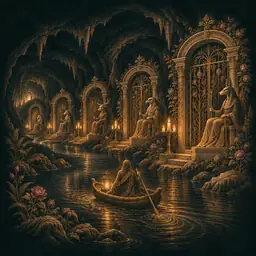

The Duat is the realm of the dead in ancient Egyptian religion: a hidden country of gates, caverns and waters that the dead cross and that the Sun travels through each night.
A lineage map for books and systems; it avoids presenting symbolic traditions as literal fact.
Understand the chapter you are in.
Your life’s turning points, measured from your birth.
Walk through Alex’s whole example first


Prefer to explore first?
 The Road of AgesThe turning points of your whole life, from your own chart
Walk my road
What is the Duat?
The texts describe it as a real country with rivers, fields, lakes of fire, caverns and a series of gates, each kept by guardians whose names the traveller must know. A dead person crosses it to reach the Hall of Two Truths, where the heart is weighed, and hopes to settle afterwards in the Field of Reeds.
The Sun crosses it too. Each night the god Ra sails through the twelve hours of the Duat in his boat, is attacked by the serpent Apophis, joins with Osiris in the deepest hour and rises renewed at dawn. The fate of the dead and the return of daylight were told as one journey.
On the tree of the hidden arts: Death and what follows.
What sets Duat apart
Two things set the Duat apart from other underworlds. It is mapped: the royal tomb books divide it into twelve hours, each with its gate, its guardians and its named dangers, so that the traveller can prepare. And it is shared with the Sun, whose nightly voyage through it, ending in a new dawn, is the pattern the dead hope to follow. It is a place of passage and renewal more than a final dwelling.
- First attested: Pyramid Texts, about 2350 BCE
- Its guidebooks: the Amduat and the Book of Gates, in royal tombs from about 1500 BCE
- Divisions: twelve hours of the night, each closed by a gate
- Chief danger: the serpent Apophis, who attacks the boat of the Sun
- Hoped-for end: the Field of Reeds, a perfected Egypt
Often mistaken for something else: Hades in Homer is a dim holding place with no map and no exit; the Duat is a charted journey that a prepared traveller is meant to complete.
The story behind Duat
The word appears in the Pyramid Texts, about 2350 BCE, where it is linked with the stars and the sky before dawn. In the New Kingdom, from about 1500 BCE, royal tombs in the Valley of the Kings were painted with guidebooks to it: the Amduat, whose name means what is in the Duat, and the Book of Gates. The Book of the Dead gave ordinary buyers their own spells for the crossing.
Why Duat matters
Duat joins two things most religions keep apart, the fate of the dead and the daily course of the Sun, and so made every sunrise an image of hope.
How to read Duat
Egyptologists read the tomb books as maps of it, and readers of myth compare its gates and guardians with the underworlds of other peoples.
Duat in practice: an example
On the wall of a royal tomb a reader follows the boat of the Sun through twelve panels, one for each hour of the night in the Duat.
Where readings of Duat go wrong
Duat is the teaching of a religion no longer practised as it was. The house tells it as that, and places no one there.
Sources and editorial method
This entry summarizes the tradition in the Almanac's own words; where no source is listed, it is an editorial summary rather than a primary text, and symbolic readings are named as the tradition's, not as fact.
- Source
- The Great Almanac Dictionary
- Category
- Mystical Systems
- Aliases
- the Duat, Egyptian underworld, Tuat, Egyptian netherworld
- Last updated
- 2026-09-26
See Duat in your personal almanac
A definition tells you what it is; your own birth chart tells you what it means for you. The Oracle casts your real chart and answers for your love, your work, and your year ahead, in conversation. It opens with the 7-day Oracle trial.
Speak with the OracleRelated terms
More in Mystical Systems
From the reference page to your own chart
Every word here
is in your own chart.
- Your life’s turning points, measured from your birth
- A practical next step to consider
- It opens with 7 days free: the AI Oracle on thirty hidden arts, and your daily horoscope
$0 today, then $19/month after 7 days. Cancel anytime.
Common questions
What is the Duat?
It is the realm of the dead in ancient Egyptian belief, a hidden country that the dead cross to reach judgement and that the Sun god sails through during the twelve hours of the night.
Where did the Egyptians think the Duat was?
The sources do not agree. The oldest texts link it with the sky before dawn; later ones place it beneath the ground, entered in the west where the Sun sets.
What happens in the Duat?
In the Egyptian texts the dead pass gates kept by guardians, using spells buried with them, and come to the weighing of the heart. Those who pass are said to live on in the Field of Reeds.


