

Mystical systems
Hades
Direct answer
Hades is the Greek god who rules the dead, a brother of Zeus and Poseidon, and his name came to stand for the underworld itself.
$0 today, then $19/month after 7 days. Cancel anytime.
At a glance
- Also called
- Greek underworld, Plouton, Greek god of the dead
- Found in
- Mystical Systems
- Related
- Elysium, Styx, Psychopomp, Sheol
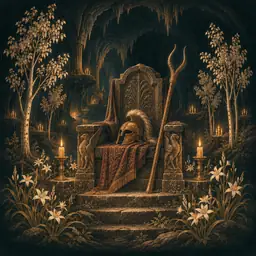

Hades is the Greek god who rules the dead, a brother of Zeus and Poseidon, and his name came to stand for the underworld itself.
A lineage map for books and systems; it avoids presenting symbolic traditions as literal fact.
Understand the chapter you are in.
Your life’s turning points, measured from your birth.
Walk through Alex’s whole example first


Prefer to explore first?
 The Road of AgesThe turning points of your whole life, from your own chart
Walk my road
Is Hades a place or a god?
In Greek myth Hades is one of three brothers who divided the world by lot: Zeus took the sky, Poseidon the sea, and Hades the realm below. He is a stern keeper and not a tempter or a tormentor; his task is to see that the dead stay where they are. The Greeks disliked saying his name and called him Plouton, the rich one, since crops and metals come from under the ground.
The Greeks spoke of the dead going to the house of Hades, and in time the name alone meant the place. In Homer it is a dim land where all the dead go, whatever they did. Later writers divided it into regions of punishment, of reward and of neither.
On the tree of the hidden arts: Death and what follows.
What sets Hades apart
Among the Greek gods Hades stands apart by his absence. He has almost no temples, few stories and no part in the quarrels on Olympus, and worshippers turned their faces away when they sacrificed to him. He is not evil and not a judge: his one concern is that the dead stay and the living keep out. The Greeks softened his name to Plouton, the giver of wealth, and it is under that name that Rome knew him as Pluto.
- Family: son of Cronus and Rhea; brother of Zeus and Poseidon
- His share: the realm below, drawn by lot when the brothers divided the world
- Consort: Persephone, whom he carried off; she spends part of each year above
- Other name: Plouton, the rich one; in Latin, Pluto
- In the Greek Bible: used to translate the Hebrew Sheol
Often mistaken for something else: Tartarus is the deep pit where the Titans and great offenders are held; Hades is the whole realm of the dead, and its king.
The story behind Hades
Hades appears in the Iliad and the Odyssey, set down around the eighth or seventh century BCE, and the Homeric Hymn to Demeter tells how he carried off Persephone. He had very few temples. When Jewish scholars put the Hebrew Bible into Greek in the third century BCE they used his name for Sheol, and the New Testament keeps it, distinct from Gehenna.
Why Hades matters
Hades is the picture behind most Western images of an underworld, and seeing its original plainness shows how much was added later.
How to read Hades
Readers of Greek poetry use the name for both the god and the place, and translators of the Bible keep it where the Greek text has it.
Hades in practice: an example
A reader of the Odyssey notices that the hero does not go down into Hades but stands at its edge and lets the shades come to him.
Where readings of Hades go wrong
Hades is not the devil, and his realm in Homer is not a place of punishment. Reading the Christian hell back into it misreads both.
Sources and editorial method
This entry summarizes the tradition in the Almanac's own words; where no source is listed, it is an editorial summary rather than a primary text, and symbolic readings are named as the tradition's, not as fact.
- Source
- The Great Almanac Dictionary
- Category
- Mystical Systems
- Aliases
- Greek underworld, house of Hades, Plouton, Greek god of the dead
- Last updated
- 2026-09-26
See Hades in your personal almanac
A definition tells you what it is; your own birth chart tells you what it means for you. The Oracle casts your real chart and answers for your love, your work, and your year ahead, in conversation. It opens with the 7-day Oracle trial.
Speak with the OracleRelated terms
More in Mystical Systems
From the reference page to your own chart
Every word here
is in your own chart.
- Your life’s turning points, measured from your birth
- A practical next step to consider
- It opens with 7 days free: the AI Oracle on thirty hidden arts, and your daily horoscope
$0 today, then $19/month after 7 days. Cancel anytime.
Common questions
Is Hades a place or a god?
Both. Hades is first the god who rules the dead. The Greeks spoke of the house of Hades, and the name came to be used for the realm as well.
Is Hades the same as hell?
No. In Homer, Hades holds all the dead, good and bad, as faint shades. Only later Greek writers added regions of punishment and reward, and the Christian hell is a different teaching.
Why was Hades called Plouton?
Plouton means the rich one. The Greeks avoided naming the god of the dead directly, and the wealth of the ground, grain and metal, was thought to be his.


