

Mystical systems
Elysium
Direct answer
Elysium: Elysium, or the Elysian Fields, is the place of ease that Greek myth kept for heroes and those the gods favoured, set apart from the dim land of the ordinary dead.
$0 today, then $19/month after 7 days. Cancel anytime.
At a glance
- Also called
- Elysian Fields, Elysian plain, Isles of the Blessed, Greek paradise
- Found in
- Mystical Systems
- Related
- Hades, Styx, Reincarnation
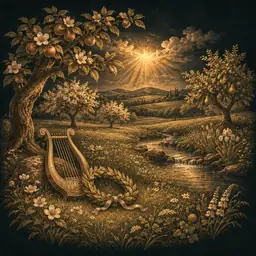

Elysium, or the Elysian Fields, is the place of ease that Greek myth kept for heroes and those the gods favoured, set apart from the dim land of the ordinary dead.
A lineage map for books and systems; it avoids presenting symbolic traditions as literal fact.
Understand the chapter you are in.
Your life’s turning points, measured from your birth.
Walk through Alex’s whole example first


Prefer to explore first?
 The Road of AgesThe turning points of your whole life, from your own chart
Walk my road
What is Elysium in Greek mythology?
Elysium is the Greek picture of a good lot after death. In the Odyssey it is a plain at the ends of the earth where no snow or storm comes, and Menelaus is promised it because he is the husband of Helen and so son-in-law to Zeus. It is a privilege of birth, not a reward for goodness. Hesiod speaks of the Isles of the Blessed, where heroes live untroubled.
Pindar opens it to those who have lived justly, and Virgil sets it inside the underworld as a sunlit country with its own stars, where the good wait before being born again.
On the tree of the hidden arts: Death and what follows.
What sets Elysium apart
Elysium is defined by exclusion: it is where the ordinary dead do not go. What changes over the centuries is the price of entry. In Homer it is kinship with the gods, in Pindar a just life kept through three lifetimes, in Virgil goodness and service. Its place moves as well, from an island or plain in the far west to a walled country inside the underworld. The constants are mild weather, music, games and freedom from toil.
- First mention: Odyssey, book 4: the Elysian plain promised to Menelaus
- Related picture: Hesiod's Isles of the Blessed, about 700 BCE
- Judge named there: Rhadamanthys, in Homer
- In Virgil: a region of the underworld; Aeneid, book 6
- Modern trace: the Champs-Élysées in Paris
Often mistaken for something else: The Asphodel Meadows hold the ordinary dead, who were neither wicked nor notable; Elysium is kept for the few.
The story behind Elysium
The oldest mention is in the fourth book of the Odyssey. Hesiod's Works and Days, about 700 BCE, has the Isles of the Blessed, and Pindar's second Olympian ode of 476 BCE joins them to a judgement of the dead. Virgil's account in the sixth book of the Aeneid became the standard one. Paris named its Champs-Élysées after it.
Why Elysium matters
Elysium’s history shows a paradise slowly turning from a favour for the well-born into a reward for a just life.
How to read Elysium
Poets and translators use the Elysian Fields for any place of perfect rest, and scholars trace through it how Greek ideas of reward changed.
Elysium in practice: an example
A reader notices that Homer gives Elysium to Menelaus for his marriage, and to none of the braver men who died at Troy.
Where readings of Elysium go wrong
Elysium is a country of the poets, different in every telling. The house does not say that anyone has gone there.
Sources and editorial method
This entry summarizes the tradition in the Almanac's own words; where no source is listed, it is an editorial summary rather than a primary text, and symbolic readings are named as the tradition's, not as fact.
- Source
- The Great Almanac Dictionary
- Category
- Mystical Systems
- Aliases
- Elysian Fields, Elysian plain, Isles of the Blessed, Greek paradise
- Last updated
- 2026-09-26
See Elysium in your personal almanac
A definition tells you what it is; your own birth chart tells you what it means for you. The Oracle casts your real chart and answers for your love, your work, and your year ahead, in conversation. It opens with the 7-day Oracle trial.
Speak with the OracleRelated terms
More in Mystical Systems
From the reference page to your own chart
Every word here
is in your own chart.
- Your life’s turning points, measured from your birth
- A practical next step to consider
- It opens with 7 days free: the AI Oracle on thirty hidden arts, and your daily horoscope
$0 today, then $19/month after 7 days. Cancel anytime.
Common questions
What is Elysium in Greek mythology?
It is the place of ease reserved for heroes and those favoured by the gods. Homer sets it at the ends of the earth; Virgil sets it within the underworld.
Who went to Elysium?
In Homer only a favoured few, such as Menelaus, for their ties to the gods. Later poets, Pindar and Virgil among them, opened it to those who had lived justly.
Are Elysium and the Isles of the Blessed the same?
They began as separate pictures, one in Homer and one in Hesiod, and later writers ran them together. Both are happy places set apart from the ordinary dead.


