
Near-death experiences
What people who came close to death report, and why researchers do not agree on it.
What do people report in near-death experiences, and what do researchers make of them?
What the traditions teach about death and what follows it, each teaching given with whose it is, beside what is documented of near-death experiences and of the last days. Nobody knows what follows death, and the house says so. It speaks for none of the dead.
What the traditions teach, and what is known
Ask the OracleWhat do the traditions teach about what follows death, and what is truly known?
Every people has told what follows death, and the tellings differ. The Egyptians pictured a journey through the Duat to a hall where the heart is weighed. The Greeks spoke of Hades, a ferry over the Styx and, for a few, Elysium. The Norse poems tell of Valhalla, Odin's hall for warriors chosen from the slain. Judaism, Christianity and Islam teach a judgement and a world to come; the Indian religions teach rebirth; Tibetan Buddhism describes the bardo, a state between one life and the next. Each is given here as its own tradition gives it, and none is ranked above another.
What can be documented is narrower. People who came close to death report near-death experiences, and those who sit with the dying report deathbed visions and, now and then, terminal lucidity. Researchers have recorded these with care and do not agree on what they show. Nobody knows what follows death, and the house says so plainly. It speaks for none of the dead, and it treats grief as something to be kept company, not solved.
As each tradition in its own books and rites teaches it.
Every teaching in this art begins with a parting. Death, in nearly every tradition, separates what life held together, and what a tradition says comes next follows from what it says a person is. The Hebrew Bible puts the parting in a line of Ecclesiastes: the dust returns to the earth as it was, and the spirit to God who gave it.
The traditions count the parts differently. The Egyptians knew several, each with its own fate, among them the heart that is weighed, the ka that is fed with offerings and the ba that flies out of the tomb by day. In Homer what goes down is the psyche, a shade with the face of the living and none of their strength. Plato teaches an immortal soul, and Jewish, Christian and Islamic teaching a soul that waits to be joined again to its body at the resurrection. The Hindu schools speak of a self, the atman, that leaves one body for the next, carried by a subtle body; the Buddhists of a stream of consciousness and karma with no lasting self in it; and Tibetan teaching describes dying itself as the elements of the body dissolving one into another until the mind's own clear light dawns.
So the first question a student puts to any teaching is what goes on: a shade, a soul, a self or a stream. No question parts the traditions more, and each answer is given on its own page.
Death, in most tellings, opens a journey, and the dead do not make it alone. The Egyptian dead cross the Duat, a hidden country of gates, lakes and guardians, with the spells of the Book of the Dead to answer each keeper. The Greek dead are led down by Hermes and carried over the river by Charon for a coin. The Tibetan dead pass through the betweens for as long as forty-nine days. In Islam the dead wait in barzakh, the barrier, from the grave to the resurrection, and in the oldest books of the Hebrew Bible they go down to Sheol, where great and small lie together.
The one who leads the dead has a name in this art, the psychopomp, the guide of souls. Anubis fills that office in Egypt and Hermes in Greece; in Islam the angel of death takes the soul, and the old Latin Mass for the dead asks that Saint Michael, the standard-bearer, bring the souls into the holy light.
Almost every road leads to a reckoning, and what is weighed is the life itself. In Egypt the heart is set on the scale against the feather of Ma'at, truth and right order, and the one whose heart balances is declared true of voice. In Plato's myth the dead are judged naked, soul looking on soul, so that the judge sees every scar a wrong left behind. Catholic and Orthodox teaching speaks of a judgement of each soul at death and of a last judgement of all; the Qur'an of a Day of Reckoning on which deeds are weighed and nothing is lost, not an atom's weight of good or of evil; the Bardo Thodol of a mirror of karma, before which good and evil deeds are counted out in white and black pebbles.
The measure in each is conduct. The Egyptian dead declare the wrongs they have not done; the Gospel's judgement turns on what was done for the hungry, the stranger, the sick and the prisoner; the Qur'an weighs deeds and sets God's mercy over all things; the Tibetan mirror shows the karma a life has made. That is why the teaching of a judgement after death has always been a teaching for the living.
After the reckoning the traditions give the dead their lots. Egypt gives the justified the Field of Reeds and the heart that fails to the Devourer. The Greeks give the many the pale Asphodel Meadow, the great offenders Tartarus and a favoured few Elysium. The faiths of Abraham speak of heaven and hell, Gan Eden and Gehinnom, the Garden and the Fire, and Catholic teaching adds purgatory, a cleansing for those who die in God's friendship but are not yet ready for heaven. The Indian traditions set heavens and hells within the round of births itself.
Whether a lot lasts is where the teachings differ most. The rabbis taught that Gehinnom cleanses most of those it holds within twelve months. Plato lets the curable wrongdoers out of Tartarus. The Prophet taught that whoever has faith in the heart, even a mustard seed's weight, is brought out of the Fire at last. The heavens and hells of the Buddhist teaching, however long, all end. Christian teaching holds heaven and hell to be for ever, with purgatory a passage toward heaven.
For many traditions the last word is not a place but a return. Judaism, Christianity and Islam teach the resurrection, the dead raised in the body on the last day; the Book of Daniel says that many who sleep in the dust of the earth shall awake. The Indian traditions teach rebirth, each death followed by a birth for as long as karma runs, with release from the round as the goal, and Plato's tale of Er has the souls choose their next lives. The Book of the Dead promises the justified that they come forth by day, the ba flying out into the sunlight and home again at night. Rebirth and karma are taught as an art of their own, past lives and karma.
Every tradition keeps watch at the moment of dying, because it holds that the moment matters. Jews say the Shema with the dying and do not leave them alone; Muslims help them to say that there is no god but God; Hindus give a few drops of Ganges water and speak the name of God; Catholics bring the last rites; and in Tibet a lama or a friend reads the Bardo Thodol aloud, calling the dying person by name and telling them what is coming. The hospice tradition teaches families what the last weeks and hours are like, and to listen when the dying speak of who has come for them.
Beside the teachings stands what people at the threshold have told. Some who came close to death and returned describe a deep quiet, a sense of being outside the body, a passage, a light that is also a presence, the dead they loved, their life seen at once and a border from which they were sent back; a minority describe terror. Many of the dying speak in their last days of a parent or a friend who has died coming for them, and some long lost to confusion have a clear hour near the end. These are given as testimony on the pages of near-death experiences and deathbed visions, beside the teachings and not in their place.
Every tradition gives the living work to do for the dead, and gives grief a shape in time. Jews sit shiva for seven days, keep thirty days and say Kaddish through the months that follow; the Orthodox pray on the third, ninth and fortieth days; Muslims wash, pray over and bury their dead quickly, and ask forgiveness for them; Hindus offer rice balls through the days after the fire; Buddhists in Tibet and East Asia make merit for the dead through seven weeks. The Egyptians carved the offering prayer on their tombs and asked everyone who passed to say it, so that the dead might be fed by the words of the living.
None of these customs says where any one person who has died is now, and none asks a mourner to stop grieving on a date. They are a rail to hold. How the traditions mourn gives each in full.
The teachings about death are given to the living, and their first practice is to remember death for the sake of life. “So teach us to number our days, that we may apply our hearts unto wisdom,” says the psalm. The Rule of Benedict bids the monk keep death daily before his eyes, and the Church taught Christians the art of dying, the ars moriendi, long before they would need it. The rabbis taught that a person should repent one day before death, and since no one knows the day, should repent today. Tibetan teachers reflect that death is certain and its hour uncertain, and the root verse of the between of this life asks the living not to waste the time they have.
In every one of these, remembering death turns a person back toward their life: to amends made, love said and the day used well. If reading of death stirs in anyone a pull toward dying rather than living, the step is to speak to someone today: a doctor, a crisis line or the local emergency number.
Begin with your own. Learn what your tradition, or your family's, teaches of death and asks of the living, from its own books and its own clergy or elders, and keep one of its days: a name said aloud, a candle watched while it burns, a visit to a grave or to a place the person loved. Then read one other tradition as its own people tell it, and notice what it asks of the living, for that is where the traditions meet. If you are called to sit with someone who is dying, the oldest counsel is the plainest: stay, speak calmly, say their name and listen.
The branches fall into three groups. The pictures of the old world come first: the weighing of the heart in Egypt and the Greek underworld. Then the teachings of living faiths: judgement and the world to come in Judaism, Christianity and Islam, and the Tibetan bardo. Last comes what is told from the edge of life and what the living do: near-death experiences, deathbed visions and how the traditions mourn. A reader who is grieving may wish to begin with the last of these.
The Oracle tells what the traditions teach about death and names whose teaching it is. Nobody knows what follows, and it will not tell you where someone you have lost is now. If you are thinking of ending your life, please call your local emergency number or a crisis line now.
Each one is a question you can ask.
What people who came close to death report, and why researchers do not agree on it.
What do people report in near-death experiences, and what do researchers make of them?
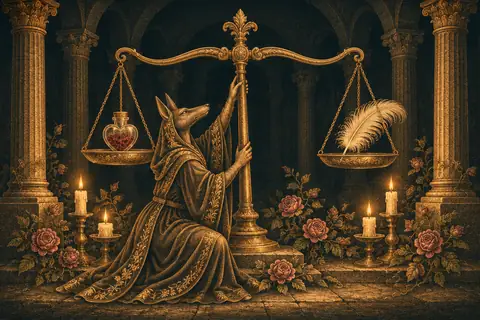
Egypt’s judgement of the dead: the heart on the scale against the feather of truth.
What was the weighing of the heart in the Egyptian Book of the Dead?
Hades, the river and the ferryman: where the Greeks said the dead go.
What did the Greeks say of the underworld and the journey there?
The between-state of Tibetan Buddhism, and the book read beside the dying.
What does Tibetan Buddhism teach about the bardo after death?
What Judaism, Christianity and Islam each teach of judgement and what lies beyond it.
What do Judaism, Christianity and Islam teach of heaven and hell and the world to come?

What the dying are reported to see, and the clear hours some have near the end.
What is known about deathbed visions and terminal lucidity?
Seven days, forty days, the yearly day: how each faith gives grief a shape in time.
How do the traditions mourn, and what do their customs say of the afterlife?
Each opens its page in the dictionary.
 Near-Death Experience
 Terminal Lucidity
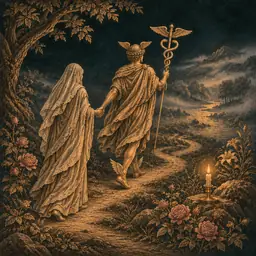 Psychopomp
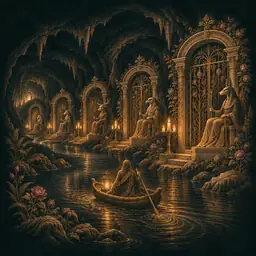 Duat
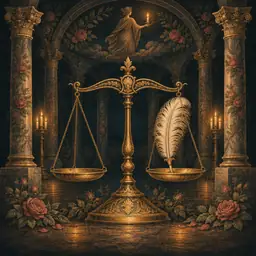 Ma'at
 Hades
 Elysium
 Styx
 Sheol
 Gehenna
 Purgatory
 Barzakh
 Bardo
 Bardo Thodol
 Ars Moriendi
 Memento Mori
The singer of Greek myth whose music moved beasts, trees and the powers of the dead. He goes down to Hades to bring back his wife Eurydice and loses her by looking back before they reach the light; Virgil and Ovid tell it best. Under his name ran the Orphic movement: poems and rites promising the soul a better lot after death, known from thin gold tablets buried with the dead.
Athenian philosopher, pupil of Socrates and teacher of Aristotle, who founded the Academy about 387 BC and wrote in dialogues. The Timaeus describes the cosmos as a living being with a soul, ordered by number; the Republic gives the cave and the three parts of the soul; the Symposium gives the tale of humans split in two who seek their other half. Later Platonists, Plotinus above all, built on him the philosophy the Hermetic and astrological traditions lean on.
American known as “the sleeping prophet”, who gave thousands of readings while in trance on health, past lives and the future; about fourteen thousand were written down. He founded the Association for Research and Enlightenment at Virginia Beach in 1931.
Emanuel SwedenborgAllan KardecAndrew Jackson DavisDaniel Dunglas HomeThe Fox sistersArthur Conan DoyleHarry HoudiniGilgameshIsis and OsirisPersephoneSisyphusDraculaSocratesGerald MasseyWilliam JamesFrederic MyersIan StevensonPadmasambhavaCupid and PsychePaschal Beverly RandolphHenry Steel OlcottW. B. YeatsTiresiasThe Phoenix
Past lives and karmaLost worldsThe spirit realmAstral projectionSacred geometryThe sixth senseSound and mantra
Make today specific
The same sky reaches everyone differently. Your birth details turn a general forecast into one theme, and one thing worth doing about it.
One instrument, one answer. Explore the preview; membership opens every tool.
Read more

