
Orpheus
Greek myth; the Orphic rites are known from the fifth century BC
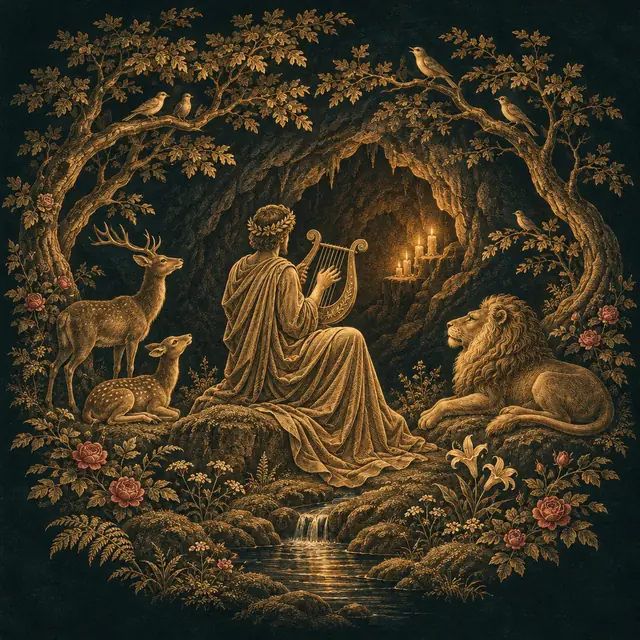
What is the story of Orpheus, and what does it warn of?
The story and its sources
The singer of Greek myth whose music moved beasts, trees and the powers of the dead. He goes down to Hades to bring back his wife Eurydice and loses her by looking back before they reach the light; Virgil and Ovid tell it best. Under his name ran the Orphic movement: poems and rites promising the soul a better lot after death, known from thin gold tablets buried with the dead.
The teaching
Taught from Virgil's Georgics and Ovid's Metamorphoses, with the Orphic gold leaves, the Derveni papyrus and the Orphic Hymns.
The singer
Orpheus is the son of the Muse Calliope and of Oeagrus, a king of Thrace, or of Apollo, who gave him his lyre. When he sings, the wild beasts follow him, the trees and the stones move to hear him, and the rivers stand still. He sails with the Argonauts, and when the ship passes the Sirens he plays so loudly that their song is drowned and only one man leaps overboard. He gave the Greeks their rites, Aristophanes says, and taught them to keep from killing.
Eurydice
In Virgil the story is told by the sea god Proteus. Eurydice, a young bride, running from the shepherd Aristaeus along a river bank, does not see the great water snake in the long grass, and dies of its bite. Orpheus mourns her on his lyre on the lonely shore from dawn to dusk, and then goes down through the jaws of Taenarus, the gate of the dead, to face their king and the hearts that do not know how to soften. The shades come thronging from the depths to hear him, thin as birds in their thousands; the halls of death stand stunned, the Furies with snakes in their hair, Cerberus with his three mouths gaping, and the wheel of Ixion stops in the wind.
In Ovid he sings to the king and queen below that he has not come to see their realm but for his wife, cut off before her time. All of us are owed to them, he says, and sooner or later all come; he asks not a gift but a loan, and if it is refused he will stay and they may rejoice in two deaths. The bloodless shades weep, Tantalus stops reaching for the water, the vultures leave the liver of Tityos, Sisyphus sits down on his stone, and for the first time the cheeks of the Furies are wet.
The backward look
The king and queen grant it on one condition: he must not look back until he has left the valleys of the dead. They climb the steep path in silence through the dark and the mist, and near the edge of the upper world, afraid she may fail him and longing to see her, he looks back. In Virgil a sudden madness seizes the unwary lover, a madness to be forgiven, if the dead knew how to forgive; all his labour is spilled, three times a crash is heard over the marshes of the dead, and she cries: what madness has ruined you and me? Fate calls me back, sleep closes my swimming eyes; farewell, I am carried off wrapped in vast night, stretching out to you hands that are no longer yours. She vanishes like smoke into the air. In Ovid she makes no complaint, for what could she complain of but that she was loved, and she speaks a last farewell that he can scarcely hear. The ferryman will not take him over again.
The death of the singer
For seven months, Virgil says, he weeps under a high cliff by the river Strymon, charming tigers and moving oaks with his song, like a nightingale mourning her lost young, and no love and no marriage can bend his heart. The women of Thrace, scorned, at a night rite of Bacchus tear him limb from limb and scatter him over the fields; and as his head, torn from his neck, is rolled down the river Hebrus, his voice and cold tongue still call Eurydice, poor Eurydice, and the banks echo Eurydice all along the stream. In Ovid the women's stones and spears fall harmless before his music until the shrieks, drums and pipes of their rite drown his lyre. His head and lyre float down to the sea and come to Lesbos, where Apollo turns to stone a snake that strikes at the head, and his shade goes below, finds Eurydice in the fields of the blessed, and walks with her now, sometimes beside her, sometimes ahead, looking back at her in safety.
The Orphic life
Under his name ran poems and rites that promised the soul a better lot. Their teaching, as Plato reports the Orphic poets, is that the soul is paying a penalty and that the body is its prison, or its tomb, in which it is kept safe until the debt is paid. Their poems told how the child Dionysus, son of Zeus and Persephone, was lured by the Titans with toys, a mirror, knucklebones and a ball, and torn apart and eaten; Zeus struck the Titans with his lightning, and from their soot came humankind, part Titan and part god. Those who lived the Orphic life kept themselves pure: they ate no flesh, offering the gods only cakes and fruits, and would not be buried in wool. Plato knew the other side too: begging priests who went to the doors of the rich with a heap of books of Orpheus, promising to wash away the wrongs of the living and the dead with sacrifices and pleasant games.
The gold leaves
The gold leaves laid with the dead give the soul its directions. On the road to the house of Hades it shall find a spring with a white cypress beside it, where the souls of the dead go down to cool themselves, and it must not even go near that spring. Further on is cold water flowing from the lake of Memory, with guards before it, and to them it is to say: I am a child of Earth and of starry Heaven, but my race is of heaven; I am dry with thirst and perishing; give me quickly cold water from the lake of Memory to drink. Then they shall let it drink, and it shall go on along the sacred road that other initiates and Bacchic worshippers walk in glory. Other leaves give the words to speak before the queen below, I come pure from the pure, I have flown out of the heavy, grievous circle, and the answer that the soul is blessed and happy, and shall be a god instead of a mortal.
The theologian of the poets
The Derveni papyrus, burned on a funeral pyre in the age of Plato, preserves a commentary on an Orphic poem of the birth of the gods, in which Zeus swallows the first-born power and so holds all things within him, and makes the world anew: Zeus the head, Zeus the middle, from Zeus all things are made. Its author reads the poem as a riddling account of nature, with Zeus as the air and the mind that orders everything. The Orphic Hymns of Roman times, eighty-seven of them, each name the god or power they praise and the incense to burn for it, and Marsilio Ficino sang them to the lyre in Florence, holding them to be among the oldest theology of the Greeks.
What the story warns of
Virgil's story warns that a love strong enough to move the dead is undone by one moment of forgetting, the lover's longing to see. Boethius, writing in prison, made the backward look a lesson for the mind: the tale is for all who seek to lead the mind up into the day above, for whoever, overcome, turns his eyes back to the pit of the dead loses all the good he was bringing while he looks below. The Christians painted Orpheus with his lyre among the beasts on the walls of the catacombs, a figure of Christ the good shepherd, and Clement of Alexandria called Christ the new singer, who tamed the fiercest beasts of all, human beings.
Who took it up
The Orphic initiations are among the oldest mystery rites known in Greece. Little is certain about how they were organised.
What later tellings added or changed
That he was a historical founder. The ancients themselves doubted it: Aristotle is reported to have said that no such poet existed.
The texts that tell it
- Georgics, Book FourPoem, 29 BC
Virgil ends his poem on farming with the story of Orpheus going down to the dead for Eurydice, charming the shades with his song, and losing her when he looks back at the very edge of the light. He is torn apart by Thracian women, and his head goes on singing her name down the river. It is the telling all others follow.
Ask the Oracle about it - Metamorphoses, Books Ten and ElevenPoem, about AD 8
Ovid gives the descent and the backward look, then lets Orpheus sing a cycle of songs of his own, Pygmalion and Adonis among them, to the trees that gather round him. In the eleventh book the Maenads kill him, and he is joined again to Eurydice among the dead.
Ask the Oracle about it - The Orphic gold tabletsTablets, from about 400 BC
Thin leaves of gold buried with the dead in southern Italy, Crete, Thessaly and elsewhere, inscribed with directions for the soul in the underworld: which spring to avoid, which to drink from, and what to say to the guardians. They are the nearest thing to scripture the Orphic movement left.
Whether all of them are Orphic, or belong to Bacchic or other rites, is debated.
Ask the Oracle about it - The Derveni papyrusPapyrus, about 340 BC
A charred roll found in 1962 in a funeral pyre near Thessaloniki, the oldest Greek book to survive. It is a commentary on a poem of Orpheus about the birth of the gods, read by its unknown author as an account of nature. It shows that Orphic poems were already old and studied in the age of Plato.
Ask the Oracle about it - The Orphic HymnsHymns, 2nd or 3rd century AD
Eighty seven short hymns, each to a god or power and each naming the incense to burn. They seem to belong to a cult group in Asia Minor in Roman times. Marsilio Ficino sang them to the lyre in the Renaissance, and they have been used in ritual and set to music since.
They are written in the name of Orpheus and are not his.
Ask the Oracle about it - L’OrfeoOpera, 1607
Claudio Monteverdi’s fable in music, first given at Mantua, is the earliest opera still often performed. Orpheus wins over Charon with his song, loses Eurydice by looking back, and is taken up by Apollo to see her in the stars. Gluck, Offenbach and many others took up the story after him.
Ask the Oracle about it
How the house tells a life
This is a story, told with its sources and with what later tellings added or changed. What it means for you is yours to judge.
The arts it feeds
Lives near it in time
Stories of forbidden knowledge
PersephoneThe SibylTheseus and the MinotaurCassandraThe PhoenixDionysusEnochKing MidasIcarusNarcissusMithrasCupid and PsycheThe whole tree

