
Narcissus
Greek myth; told by Ovid about AD 8
What is the story of Narcissus, and what has it been taken to mean?
The story and its sources
A beautiful youth who scorns everyone who loves him. In Ovid’s Metamorphoses, about AD 8, the seer Tiresias foretells that he will live long if he never comes to know himself. The nymph Echo, who can only repeat the last words of others, wastes away for him until only her voice is left. Then he sees his own reflection in a pool, falls in love with it, understands at last that it is himself, and pines away beside the water. A flower grows where he lay. A Greek version of the same years, by the mythographer Conon, gives a harsher ending.
The teaching
Taught from Ovid's Metamorphoses, Book Three, with Conon, Pausanias and the Platonists.
If he never knows himself
Narcissus is the son of the river Cephisus and the water nymph Liriope, whom the river caught in his winding stream. When she asks the seer Tiresias whether her child shall live to a long old age, he answers: if he never comes to know himself. For years the saying seems empty. At sixteen the boy is so beautiful that young men and girls alike desire him, but there is so hard a pride in his tender beauty that none of them can touch him.
Echo
Echo is a nymph who cannot speak first and cannot keep silent when another speaks. Juno made her so: when the goddess might have caught Jupiter with the nymphs, Echo kept her talking until they fled, and Juno left her only the last words of what others say. She sees Narcissus driving deer into the nets, follows him, burning, and longs to speak. Is anyone here, he calls, parted from his friends, and she answers, here. Come, he cries, and she calls, come. Why do you run from me, he asks, and hears his own words back. Let us meet here, he says, and, let us meet, she answers with all her heart, and comes out of the woods to throw her arms around his neck.
He runs from her: take your hands away, he cries, I would die before I would give myself to you; and she answers only, I would give myself to you. Scorned, she hides in the woods and caves, and her love only grows with the pain of rejection; her body wastes away, her bones turn to stone, and only her voice is left, heard by everyone and seen by no one.
The pool
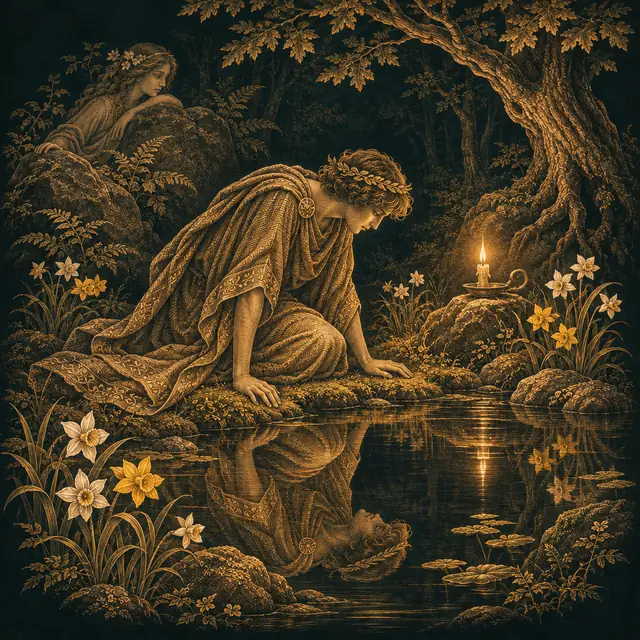
One of those he has scorned lifts his hands to heaven and prays that Narcissus may love in the same way and never win what he loves, and the goddess of retribution hears. There is a clear pool, silver bright, which no shepherd, goat or bird has troubled, nor any falling branch, with grass around it and trees that keep out the sun. Tired from the hunt and the heat, the boy lies down to drink, and as he drinks another thirst grows in him: he sees an image and is taken by its beauty, loves a hope without a body, and thinks that a body which is only water. He lies there without moving, like a statue of Parian marble, gazing at the eyes like twin stars, the hair worthy of Bacchus or Apollo, the smooth cheeks and the ivory neck.
He desires himself without knowing it; he praises and is praised, seeks and is sought, kindles and burns. How often he kisses the deceiving pool, how often he plunges his arms into the water to clasp the neck he sees, and cannot catch himself. Credulous boy, Ovid says to him, why grasp at a fleeting image? What you seek is nowhere; what you see is the shadow of a reflection, which comes with you and stays with you, and would go with you if you could go.
I am he
No hunger and no sleep can draw him away. He asks the woods whether anyone has ever loved more cruelly: no sea, no road, no mountain parts them, only a little water, and the one he loves wants to be held, for whenever he stretches his lips to the water the face lifts its lips to meet him; it smiles when he smiles and weeps when he weeps. Then he knows. I am he; I have felt it, my image does not deceive me. I burn with love for myself; I kindle the flames I suffer. What I want I have, and my riches make me poor. O that I could leave my own body!
Grief takes his strength, and he says that death is not heavy to him, for it ends his grief; he only wishes that the one he loves might live longer, and now the two of them shall die together in one breath. His tears trouble the water and the image blurs, and he cries, where are you going? stay! He beats his breast, which flushes like an apple white on one side and red on the other, and when he sees it in the clearing water he can bear no more.
The flower
As yellow wax melts before a gentle flame, or hoarfrost in the morning sun, he wastes away in the hidden fire of love, and his colour, his strength and the body Echo once loved are gone. Echo, though still angry, grieves, and as often as he cries alas, she answers alas, and gives back the sound of his blows. His last words, as he looks into the pool, are, alas, boy loved in vain, and the place gives back the words; he says farewell, and Echo says farewell. He lays his head on the grass, and death closes the eyes that marvelled at their master's beauty; even in the underworld he gazes at himself in the water of the Styx. His sisters the water nymphs and the nymphs of the trees mourn him and make ready the pyre and the torches, but there is no body: in its place they find a flower, with a yellow heart circled by white petals.
The harsher tellings
Ovid's is the gentlest telling. Conon, writing in the same age, tells of Thespiae in Boeotia, where a young man named Ameinias loved Narcissus and was sent a sword by him; he killed himself with it at the boy's door, calling on the gods to avenge him. Then Narcissus, seeing his own face in a spring, fell in love with it, and, knowing that he suffered justly for his scorn of Ameinias, killed himself, and after that the Thespians honoured Love the more. Pausanias, who saw the spring in Thespian land, thought it foolish that anyone could not tell a person from a reflection, and gave another story: Narcissus had a twin sister whom he loved, and when she died he would come to the spring and look at his own face, knowing it for his, to find some comfort in imagining hers.
What the tellers read in it
Tiresias' riddle sets the god's own counsel against itself: at Delphi Apollo bids every visitor know himself, and here self-knowledge kills. The Platonists read the pool as the world of bodies. Plotinus warned that whoever runs after beautiful bodies, taking the image for the truth, is like the one in the tale who tried to seize his beautiful reflection on the water and sank into the deep current and vanished, and so sinks in soul into the dark; and Marsilio Ficino read Narcissus as the soul that does not look at its own face, its own being and worth, but chases its shadow in the water, the beauty of the body, and so loses itself. Psychology took his name for love turned back on the self, and Freud's essay of 1914 found in it both a stage that every person passes through and a way of loving another for what one is oneself, or once was, or would like to be.
Who took it up
No cult was his. Psychology took his name: Havelock Ellis used it for self-love in 1898, and Freud’s essay of 1914 made “narcissism” a term of the clinic. That use is modern and is not in the myth.
What later tellings added or changed
That he was simply vain. In Ovid he does not know the face is his own until late, and the story turns on being shut in with oneself, with Echo as the other half: one who has only herself and one who has only others.
The texts that tell it
- Metamorphoses, Book ThreePoem, about AD 8
Ovid joins Narcissus to the nymph Echo, who can only repeat the last words of others and fades to a voice for love of him. Tiresias has foretold that the boy will live long if he never knows himself. At a still pool he falls in love with his reflection, knows at last that it is himself, and wastes away; a flower is found in his place.
Ask the Oracle about it - NarrationsMyth, about 1st century BC
Conon, a Greek mythographer of the age of Augustus, told a harsher version: a young man named Ameinias, rejected by Narcissus, kills himself at his door, and the gods punish Narcissus with love for his own image, and he kills himself by the spring. Conon’s book survives only in a summary made by Photius in the ninth century.
Ask the Oracle about it - Description of Greece, Book NineBook, 2nd century AD
Pausanias, the traveller, visiting the spring of Narcissus near Thespiae, tells the usual story and finds it foolish that anyone could not tell a reflection from a person. He gives another account: Narcissus had a twin sister whom he loved, and after her death he looked in the water to see her face in his own.
Ask the Oracle about it - On Narcissism: An IntroductionEssay, 1914
Sigmund Freud took up the term, already used by Havelock Ellis and others, and made narcissism a stage of every person’s growth, in which love is first turned on oneself before it reaches out to others. Through him the youth of the myth entered the language of psychology.
Ask the Oracle about it
How the house tells a life
This is a story, told with its sources and with what later tellings added or changed. What it means for you is yours to judge.
The arts it feeds
Lives near it in time
Stories of forbidden knowledge
The PhoenixDionysusOrpheusEnochKing MidasIcarusMithrasCupid and PsycheHermes TrismegistusSolomon and the demonsLilithMerlinThe whole tree

