
Lilith
Jewish legend; told in the Alphabet of Ben Sira, about AD 700 to 1000
What is the story of Lilith, and where does it come from?
The story and its sources
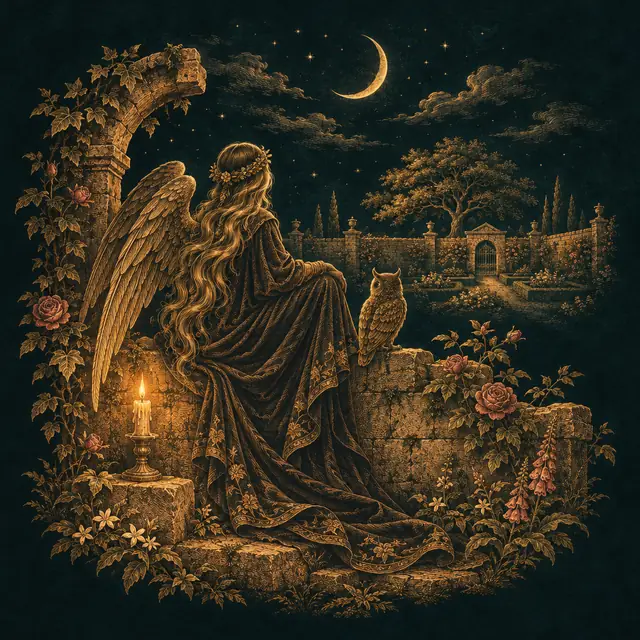
A night spirit of Jewish folklore. The name comes from a class of Mesopotamian demons, and it appears once in the Hebrew Bible, in Isaiah, in a list of creatures haunting a ruined land. The Talmud mentions her as a long-haired, winged spirit. The story that she was Adam’s first wife, made from the earth as he was, who would not be ruled and flew away, is first told in the Alphabet of Ben Sira, a medieval work, partly satirical, written between about AD 700 and 1000. Genesis itself knows nothing of her.
The teaching
Taught from Isaiah, the Talmud, the incantation bowls, the Alphabet of Ben Sira and the Zohar.
The demon of the waste places
Isaiah names her among the creatures that will haunt Edom when thorns grow in its palaces, the wild beasts of the desert and the satyr crying to his fellow: “the screech owl also shall rest there, and find for herself a place of rest”, as the King James Version gives the verse. The Talmud knows her as a demon of the night, and rules that a woman who miscarries a child in her likeness, winged, is unclean as after any birth, for it is still a child.
The bowls under the floor
In Mesopotamia, from about the fifth century to the eighth, families buried clay bowls upside down beneath the floors of their houses, the inside written in a spiral of Aramaic spells round a drawing of a demon in chains. Many name the liliths, male and female, who haunt the bedroom and the birth, and some send Lilith away with a bill of divorce in the very form a husband gives a wife: the house is no longer hers, and she must go and not come back. The bowl is a trap and a seal at once, holding the spirit down beneath the home.
Adam's first wife
The story that made her famous is told in the Alphabet of Ben Sira. The son of King Nebuchadnezzar falls ill, and the sage Ben Sira, ordered to heal him, writes an amulet with the names of three angels, Senoi, Sansenoi and Semangelof, and their likenesses, their wings, hands and feet. Asked who they are, he tells the king a tale.
When God made Adam and saw that it was not good for the man to be alone, he made him a woman from the earth, as he had made Adam, and called her Lilith. At once they quarrelled. She would not lie beneath him, and he would not lie beneath her, for he said that she was fit to be below and he above; she answered that they were equal, since both were made from the earth. Neither would listen to the other, and Lilith spoke the ineffable Name of God and flew away into the air.
The oath at the sea
Adam complained to his Creator that the woman had fled, and God sent the three angels after her: if she would return, well, and if not, a hundred of her children must die every day. They found her in the sea, in the mighty waters where the Egyptians were one day to drown, and told her God's word, and she would not return. When they threatened to drown her, she said she had been made only to bring sickness to newborn children, with power over a boy until his eighth day and over a girl until her twentieth.
But at last she swore to them by the name of the living God that wherever she saw them, or their names or their likenesses on an amulet, she would do the child no harm, and she accepted that a hundred of her children should die each day. So, Ben Sira ends, a hundred demons die every day, and the angels' names are written on the amulets of little children; when Lilith sees them she remembers her oath, and the child recovers.
The amulets of the birth room
Jewish households took the tale at its word. Over the bed of a woman in childbirth and the cradle of her child, until a boy's circumcision on his eighth day, families hung amulets bearing the three angels' names, often with the words Adam and Eve, out Lilith, and some drew a circle round the bed. The Book of Raziel, printed at Amsterdam in 1701, carried such an amulet, and copies of it went from house to house. The night before a circumcision was kept as a night of watching, with study and prayer beside the child.
The other side
In the Zohar she has her place in the order of the worlds, the bride of the other side as the holy presence is the bride of the Holy One. While Eve was not yet made, the Zohar says, Lilith was with Adam; when Eve was made, she fled to the sea, and from there she goes out to do harm. By night she takes the form of a beautiful woman to lead men astray and to get demon children from what they spill in their sleep, and she seeks out young children.
What the story teaches
The Alphabet turns an old puzzle of Genesis, whose first chapter says “male and female created he them” before the second builds Eve from Adam's rib, into a quarrel about equality, and its readers have heard it in two ways ever since. The folk tradition heard a terror and a remedy: the death of children in their first days given a name and a face, and the angels' names set against it at every cradle.
Jewish feminists of the 1970s heard a woman who would not be ruled. In Judith Plaskow's midrash of 1972, Eve climbs over the garden wall, meets Lilith, and the two women who had been set against each other talk until they become sisters, and go back to the garden together to make it new.
Who took it up
Medieval Kabbalah, the Zohar above all, made her a queen of the demonic side. Amulets against her were hung in birth rooms into modern times. Since the 1970s Jewish feminists have reclaimed her as a figure of independence, and a magazine took her name in 1976.
What later tellings added or changed
That she is in Genesis, or was cut out of it. The idea of a first wife was a way of reconciling the two accounts of creation in its opening chapters. In astrology “Lilith” names points in a chart, a use that began in the twentieth century.
The texts that tell it
- Book of IsaiahScripture, first millennium BC
In the thirty fourth chapter of Isaiah the word lilith appears once, among wild creatures that haunt a ruined land, after a Mesopotamian name for a class of night demons. Translators have rendered it screech owl, night monster and night hag. It is her only place in the Hebrew Bible.
Ask the Oracle about it - Babylonian TalmudTeaching, about AD 500
The Talmud speaks of Lilith a handful of times, as a spirit with long hair and wings, and warns a man not to sleep alone in a house lest she seize him. It knows nothing of her as Adam’s first wife.
Ask the Oracle about it - Incantation bowlsInscription, about AD 500 to 800
Clay bowls from Mesopotamia written in Aramaic with spells against liliths and other demons, often with a drawing of a bound female demon, buried under the floors of houses. They show how widely she was feared in daily life, and some give her a bill of divorce to drive her out.
Ask the Oracle about it - Alphabet of Ben SiraLegend, about AD 700 to 1000
A medieval Hebrew work, partly satire, in which the sage Ben Sira tells the king of Babylon that Lilith was Adam’s first wife, made from the earth as he was, who would not lie beneath him and flew away. It is the first telling of the story most people now know, and gives the names of the angels on the amulets against her.
Its date and purpose are argued, and it was probably meant in part as parody.
Ask the Oracle about it - The ZoharScripture, late 13th century
The great book of the Kabbalah makes Lilith a queen of the demonic side, mate of the demon Samael and a mirror of the holy presence. Its pages fixed her place in later Jewish mysticism and folklore.
It was written in Castile and put in the name of an ancient sage.
Ask the Oracle about it
How the house tells a life
This is a story, told with its sources and with what later tellings added or changed. What it means for you is yours to judge.
The arts it feeds
Lives near it in time
Stories of forbidden knowledge
IcarusNarcissusMithrasCupid and PsycheHermes TrismegistusSolomon and the demonsMerlinMorgan le FayThe Holy GrailOdinLokiFaustThe whole tree

