
The Holy Grail
Medieval romance; first told by Chrétien de Troyes, about 1185
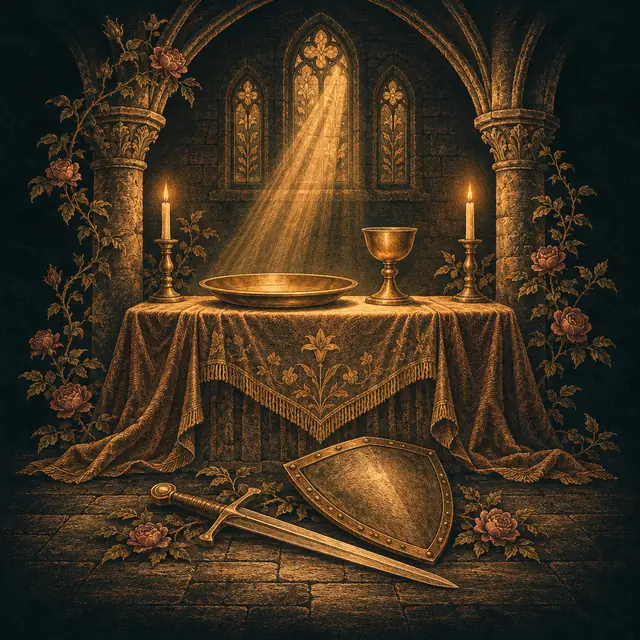
What is the legend of the Holy Grail, and what is truly known of it?
The story and its sources
The Grail enters literature in Perceval, an unfinished French romance by Chrétien de Troyes, about 1185. There it is “a grail”, a wide serving dish carried through the hall of the wounded Fisher King; the young knight fails to ask what it means, and the poem breaks off. Robert de Boron, about 1200, made it the cup of the Last Supper in which Joseph of Arimathea caught the blood of Christ. Wolfram von Eschenbach made it a stone. In the later cycles the pure knight Galahad achieves it and it is taken from the world.
The teaching
Taught from Chrétien's Perceval, Robert de Boron, Wolfram's Parzival, the Quest of the Holy Grail and Wagner's Parsifal.
The procession in the Fisher King's hall
Chrétien de Troyes begins with a boy raised by his widowed mother in a waste forest, kept from all knowledge of knighthood because it killed his father and brothers. He meets knights in the wood, takes them for angels, and rides to Arthur's court in his rough Welsh clothes. An old knight, Gornemant, teaches him arms and gives him a piece of advice: not to talk too much. So he comes at evening to a castle by a river, where he is welcomed by a lord he saw fishing from a boat, lamed by a wound through the thighs so that he cannot ride and goes fishing instead: the Fisher King.
As they sit at supper a squire passes through the hall carrying a white lance, and from its tip a drop of blood runs down to his hand. Two squires follow with candlesticks of gold, then a maiden holding a grail of gold set with precious stones, which shines so that the candles pale like stars when the sun rises, and after her a maiden with a silver carving dish. At each course the grail passes again into an inner room. The boy longs to ask what the lance means and whom the grail serves, remembers the advice, and keeps silent. In the morning the castle is empty, and the bridge rises behind him as he rides out.
The question he did not ask
A cousin he meets in the forest tells him what he lost: had he asked, the king would have been healed and his land restored. His silence came from a sin, his mother's death, for she died of grief when he left her. A hideous damsel on a mule rides into Arthur's court and curses him before all: because he did not ask, ladies will lose their husbands, lands will be laid waste, maidens left orphans and knights die. He vows never to rest two nights in one place until he learns whom the grail serves and why the lance bleeds.
Five years he wanders and forgets God, until on Good Friday he comes to a hermit, his uncle, who tells him that the grail serves the Fisher King's father, a holy man who lives on a single wafer of the Mass brought to him in it, so holy a thing is the grail. Here the poem turns to Gawain, and breaks off unfinished.
The cup of the Last Supper
Robert de Boron told where the grail came from. It is the vessel in which Christ made his sacrament at the Last Supper; Joseph of Arimathea, given leave by Pilate to take down the body, caught in it the blood that flowed from the wounds as he washed it. Thrown into a dark prison for his love of Christ, Joseph is visited there by the risen Christ, who gives him the vessel and teaches him its words, and he lives on in the dark for years until he is freed.
With his sister's husband Bron and their company he goes into exile. When famine comes because of a sin among them, he sets the vessel on a table made in memory of the Last Supper, with one seat left empty for the place of Judas, and the righteous who sit there are filled with sweetness while the sinners feel nothing. Bron catches a fish for the table and becomes the Rich Fisher, keeper of the vessel, and the company turns west, towards the vales of Avaron.
The stone and its brotherhood
Wolfram von Eschenbach made it a stone, which he calls lapsit exillis, brought to earth by the angels who took neither side when Lucifer fell. Only a pure maiden, the queen Repanse de Schoye, may carry it. Every Good Friday a dove lays a white wafer from heaven upon it, and from that it gives every food and drink anyone desires; whoever sees it cannot die within the week, and by its power the phoenix burns to ash and rises again. Names written on the stone call those, children among them, whom it chooses for its service. Its king, Anfortas, lies in agony from a poisoned wound, taken in seeking a love the Grail had not given him, and can be healed only when a knight comes unbidden and asks him, out of pity, what ails him.
Parzival fails the first time, as in Chrétien, and turns in bitterness against God, until the hermit Trevrizent, his mother's brother, teaches him humility on Good Friday. At last he returns with his half-brother Feirefiz, the son of his father's marriage in the East, asks the question, and the king is healed; Parzival becomes king of the Grail.
Galahad and the quest
The Quest of the Holy Grail makes the search a journey of the soul. At Pentecost Galahad, the son of Lancelot, takes the Siege Perilous, where no one could sit unharmed, and the Grail enters the hall veiled in white samite, carried by no visible hand, fills it with sweetness, feeds each knight with the food he most desires, and is gone. Gawain vows to seek it for a year and a day, the fellowship vows with him, and Arthur weeps, knowing the Round Table is broken. On the quest hermits explain every adventure: the Grail is the grace of God, and no prowess of arms wins it. Gawain, who will not confess, finds no adventures at all. Lancelot lies in a stupor while the Grail heals a sick knight before his eyes, because of his love for the queen; he confesses and does penance, and at the castle of Corbenic he glimpses the Grail through a door and lies as one dead for twenty-four days.
Three achieve it: Galahad, pure and perfect; Perceval, a virgin; and Bors, humble and steadfast. They sail in the ship of Solomon, and at Corbenic Galahad heals the maimed king with the blood of the lance, and Christ comes forth from the Grail and gives them the sacrament. They carry the Grail to the holy city of Sarras in the East, where Galahad is made king; after a year he looks into the vessel, sees what no tongue can tell, and asks to die, and a hand comes down from heaven and takes the Grail and the lance away, and no one since has seen it. Bors alone comes home to tell the tale.
Parsifal and compassion
Wagner makes compassion the whole of the question. The Grail king Amfortas, seduced in the magic garden of the sorcerer Klingsor, lost to him the holy spear that pierced Christ's side and took from it a wound that will not close, and an oracle promises healing only by a pure fool made wise by pity. Parsifal, an innocent who has shot a swan, watches the Grail unveiled, understands nothing and is turned out. In Klingsor's garden Kundry's kiss teaches him at last: he feels Amfortas's wound in his own heart and refuses her, and when Klingsor hurls the spear it hangs in the air above his head; he takes it and makes the sign of the cross, and the garden falls to ruin. Years later, on Good Friday, he returns and closes the king's wound with the spear that made it.
What the Grail teaches
Whatever the vessel is, its tellers agree on a few things. The Grail is not won by strength: in Chrétien and Wolfram it waits on one question, asked out of care for a suffering man, and in the Quest on purity and grace. Its keeper is wounded, and his land with him, and the healing of the one is the healing of the other. It is offered freely, and refused by silence, pride or a divided heart.
Jessie Weston read the wounded king and the waste land as the memory of an old rite for the fertility of the land, and T. S. Eliot built The Waste Land on her book; the psychologists of Jung's school read the quest as the search for the wholeness of the self. For the monks behind the Quest the meaning was simpler: the Grail is the grace of God in the sacrament, and to see it plainly is the end of the journey and of life.
Who took it up
The Church has never ruled that any cup is the Grail, though several are shown as it, and the one at Valencia has been used at Mass by two popes. Wolfram had already given it a brotherhood of knights, which Wagner’s Parsifal of 1882 put on the stage. The claim that the Templars or the Cathars guarded it was first made in the nineteenth and twentieth centuries.
What later tellings added or changed
That the Grail is a bloodline of Jesus and Mary Magdalene: that reading dates from a book of 1982 and a novel of 2003. That the Celts had a Grail: they had tales of magic cauldrons, which may lie behind the dish, and that is as far as the evidence goes.
What was forged, or is false
The “Priory of Sion” papers that underlie the bloodline story were placed in the national library in Paris in the 1960s by Pierre Plantard and his associates, who later admitted the invention.
The texts that tell it
- Perceval, the Story of the GrailRomance, about 1185
Chrétien de Troyes’s unfinished French romance, in which the young Perceval sees a grail, a wide serving dish shining with light, carried through the hall of the wounded Fisher King and fails to ask whom it serves. The poem breaks off, and every later Grail story grows from its unanswered question.
Ask the Oracle about it - Joseph of ArimatheaRomance, about 1200
Robert de Boron’s French poem, which first makes the Grail the vessel of the Last Supper in which Joseph of Arimathea caught the blood of Christ, and tells how its keepers carried it west towards Britain. It turned a mysterious dish into a holy relic.
Ask the Oracle about it - ParzivalRomance, about 1200 to 1210
Wolfram von Eschenbach’s German romance, in which the Grail is a stone that gives food and lasting youth, kept by a brotherhood of knights at the castle of Munsalvaesche. Wolfram says he had the tale from a Provençal named Kyot, of whom nothing else is known. It is the source of Wagner’s Parsifal.
Ask the Oracle about it - The Quest of the Holy GrailRomance, about 1220s
The French prose romance in which the pure knight Galahad achieves the Grail, Lancelot fails for his love of the queen, and the Grail is taken up from the world. Written in the spirit of the Cistercian monks, it made the quest a journey of the soul.
Its author is unknown.
Ask the Oracle about it - Le Morte d’ArthurRomance, 1485
Thomas Malory’s English telling of the Arthurian story, printed by Caxton, whose books of the quest follow the French Quest closely. Galahad’s achievement of the Grail marks the beginning of the end of the round table, and through Malory the story reached English readers.
Ask the Oracle about it - ParsifalOpera, 1882
Richard Wagner’s last opera, drawn from Wolfram, in which the innocent fool Parsifal learns compassion and heals the wounded king of the knights of the Grail. Wagner called it a festival play to consecrate the stage, and it made the brotherhood of the Grail a modern legend.
Ask the Oracle about it
How the house tells a life
This is a story, told with its sources and with what later tellings added or changed. What it means for you is yours to judge.
The arts it feeds
Lives near it in time
Stories of forbidden knowledge
Cupid and PsycheHermes TrismegistusSolomon and the demonsLilithMerlinMorgan le FayOdinLokiFaustThe Monkey KingThe GolemChristian RosenkreuzThe whole tree

