
Loki
Norse myth; written down in Iceland in the 13th century
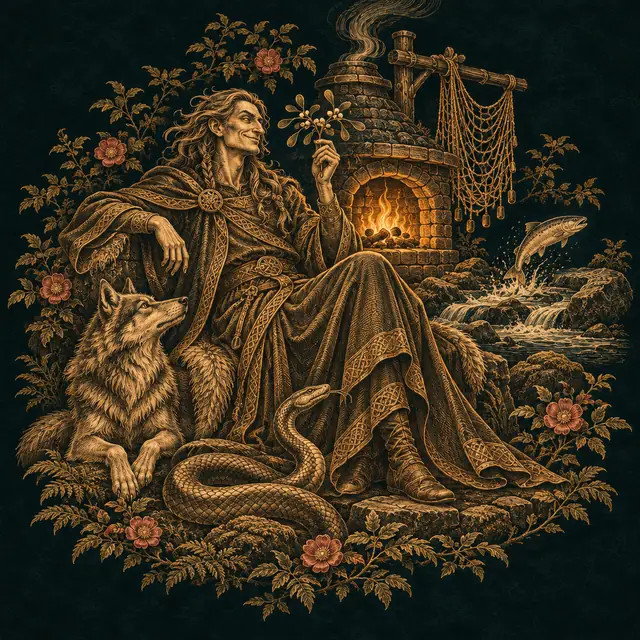
What is the story of Loki in the Norse myths, and what has it been taken to mean?
The story and its sources
The trickster among the Norse gods: a giant’s son who lives with them as a sworn companion, changes shape, and both causes their troubles and gets them out. He is the father of the wolf Fenrir, the world serpent and Hel, who rules the dead. In Snorri Sturluson’s Edda, written in Iceland about 1220, he brings about the death of the god Baldr with a dart of mistletoe and is bound under the earth with venom dripping on him until the end of the world, when he leads the enemies of the gods. The poem Lokasenna has him insult every god at a feast.
The teaching
Taught from the Poetic Edda, Thjodolf's Haustlöng and Snorri Sturluson's Edda.
The giant's son among the gods
Snorri describes him plainly: Loki, also called Lopt, son of the giant Farbauti and of Laufey, handsome and fair of face, evil in character and very changeable in his ways. He has more cunning than anyone, and a trick for every need; he often brings the gods into the worst of trouble, and as often gets them out of it by his wiles. He is reckoned among the gods, and Odin long ago mixed blood with him in sworn brotherhood. His wife is Sigyn, and with the giantess Angrboda he has three children: the wolf Fenrir, the serpent Jörmungand and Hel.
The apples of youth
The oldest poem about him, Haustlöng, tells how Odin, Hœnir and Loki, travelling, could not cook their ox while an eagle in the tree above them held back the heat. The eagle, the giant Thjazi in disguise, demanded a share; Loki struck at him with a pole, which stuck fast to the bird and to his hands, and he was dragged over stones and trees until he swore to bring Thjazi the goddess Idunn and her apples, which keep the gods young.
He lured her into a wood, and the giant carried her off; the gods grew grey and old, and threatened Loki with death until he borrowed Freyja's falcon shape, flew to the giant's hall and brought Idunn home, in Snorri's telling as a nut in his claws. Thjazi followed as an eagle, and the gods lit a fire on the wall of Asgard that burned his feathers, and killed him.
The treasures of the gods
His mischief brings the gods their greatest goods. When he cut off the golden hair of Thor's wife Sif, Thor would have broken every bone in him, so he went to the dwarfs, who made Sif hair of gold that grew like her own, with Odin's spear and Frey's folding ship besides. Then he wagered his head that two other dwarf brothers could make nothing as good, and as a fly he stung the one working the bellows to spoil the work; still they made a golden boar, the ring that drops eight rings like itself every ninth night, and Thor's hammer, whose handle came out short. The gods judged the hammer best, and when the dwarf came for Loki's head, Loki said the neck was not in the bargain, and the dwarf sewed his lips together instead.
When a giant offered to build the wall of Asgard for the sun, the moon and Freyja, Loki turned himself into a mare and lured away the giant's stallion, so that the wall was left unfinished; from that meeting he bore Sleipnir, Odin's horse with eight legs.
The bride and her maid
In the Lay of Thrym he is Thor's helper. Thor's hammer is stolen, and Loki, flying in Freyja's feather cloak, learns that the giant Thrym has buried it eight leagues under the earth and will give it back only for Freyja as his bride. Freyja refuses in a fury, so Thor is dressed as the bride, veiled, with keys at his belt and the great necklace on his breast, and Loki goes with him as the maid. At the wedding feast the bride eats a whole ox and eight salmon and drinks three casks of mead, and Loki explains that Freyja was so eager for the wedding she had eaten nothing for eight nights; the bride's eyes burn under the veil, and Loki says she has not slept for eight nights either. When the hammer is laid in the bride's lap to hallow the marriage, Thor takes it and kills the giants.
The death of Baldr
Then his malice turns deadly. Baldr the good dreamed of danger, and his mother Frigg took oaths from fire and water, iron and stone, earth and trees, sicknesses, beasts, birds and serpents never to harm him, and the gods made a game of throwing things at him and seeing him unhurt. Loki, in the shape of an old woman, learned from Frigg that one young shoot growing west of Valhalla, the mistletoe, had seemed too young to ask. He pulled it, went to Baldr's blind brother Höd, who had nothing to throw, and guided his hand; the mistletoe passed through Baldr and he fell dead.
Hel promised to let Baldr go if everything in the world wept for him, and everything wept, men and beasts, stones and trees, except a giantess in a cave called Thökk, who said let Hel keep what she has; and she, the gods believed, was Loki.
The quarrel and the binding
Lokasenna sets him at a feast of the gods, which he enters uninvited, and one by one he shames them all: Odin for unmanly sorcery and for giving victory to cowards, Frigg and Freyja for their lovers, Tyr for the hand the wolf bit off, Frey for giving away his sword to win a bride, and to Frigg he boasts that he is the reason Baldr never rides home. Only Thor's hammer drives him out.
He hid then in a waterfall as a salmon; the gods netted him, and Thor caught him by the tail as he leapt, which is why the salmon tapers there. They bound him across three stones with the guts of his own son, and the giantess Skadi hung a serpent over him to drip venom on his face. His wife Sigyn stands beside him holding a bowl to catch it, and when she goes to empty it the venom falls on him and he writhes so hard that the whole earth shakes: that is an earthquake. There he lies until the end of the world, when he breaks loose and comes with the hosts of Hel against the gods, and he and Heimdall kill each other.
What the story teaches
Loki is the outsider the gods cannot do without and cannot trust. Their hammer, Odin's horse and spear, the ring and the boar all come to them through his tricks, and the same quickness that gets them out of trouble gets them into it, until a jest becomes a murder. The tellers bind him rather than kill him: the disorder he stands for is held down under the earth and shakes it from below, and it breaks loose only at the end of the world.
Snorri, writing as a Christian two centuries after the conversion, calls him the slanderer of the gods and the shame of gods and men, and his binding under dripping venom has put readers in mind of Satan chained in the pit and of Prometheus on his rock. Modern followers of the old gods still argue whether he should be honoured at all.
Who took it up
No trace of worship survives: no place is named for him and no rite is recorded. Modern Norse pagan groups disagree about whether to honour him. Most people now know him from Marvel’s comics and films, where he is made a brother of Thor, which he is not in the myths.
What later tellings added or changed
That he is the Norse devil. The sources were written by Christians two centuries after the conversion, and how far they darkened him is argued. In the older poems he is a nuisance and a helper as often as an enemy.
The texts that tell it
- HaustlöngPoem, about 900
A skaldic poem by Thjodolf of Hvinir describing scenes painted on a shield, which tells how Loki was forced to lure the goddess Idunn and her apples of youth to a giant, then won them back in the shape of a falcon. It is among the oldest sources for him.
Ask the Oracle about it - LokasennaPoem, written down about 1270
Loki’s Quarrel, a poem of the Poetic Edda in which he comes uninvited to a feast of the gods and insults each in turn with their shames, until Thor drives him out. A prose ending tells of his binding.
Ask the Oracle about it - ÞrymskviðaPoem, written down about 1270
The Lay of Thrym, a comic poem in which Loki helps Thor win back his stolen hammer from a giant by dressing Thor as the bride Freyja and going with him as a maid. It shows Loki as helper and quick tongue.
Ask the Oracle about it - Prose EddaMyth, about 1220
Snorri Sturluson’s book of the myths, which tells of Loki’s children, the death of Baldr by a dart of mistletoe, his binding with venom dripping over him, and his part at Ragnarök. Most of his story as people know it comes from it.
Ask the Oracle about it - Marvel comicsComics, from 1962
Marvel’s comics of Thor, where Loki is made Thor’s adopted brother and a scheming villain, later the hero of his own films and series. Most people now know him from them, though in the myths he is not Thor’s brother.
Ask the Oracle about it
How the house tells a life
This is a story, told with its sources and with what later tellings added or changed. What it means for you is yours to judge.
The arts it feeds
Lives near it in time
Stories of forbidden knowledge
Solomon and the demonsLilithMerlinMorgan le FayThe Holy GrailOdinFaustThe Monkey KingThe GolemChristian RosenkreuzHiram AbiffThe Sorcerer’s ApprenticeThe whole tree

