
What is the legend of Hiram Abiff, and where does it come from?
The story and its sources
The central figure of the third degree of Freemasonry. The Bible names a Hiram of Tyre, a worker in bronze whom King Solomon employed on the Temple, and says nothing of his death. In the Masonic drama he is the master builder who holds the master’s word; three workmen demand it from him at the three gates, he refuses each, and he is struck down and buried. The lodge acts out the search for him and his raising. The story first appears in print in Samuel Prichard’s exposure Masonry Dissected, London, 1730, a few years after the degree itself was devised.
The teaching
Taught from the Books of Kings and Chronicles, the Masonic exposures of 1730 and the 1760s, and Nerval's Queen of the Morning.
The widow's son of Tyre
Scripture gives the craftsman and his work. “And king Solomon sent and fetched Hiram out of Tyre. He was a widow's son of the tribe of Naphtali, and his father was a man of Tyre, a worker in brass: and he was filled with wisdom, and understanding, and cunning to work all works in brass.” Chronicles makes his mother a woman of Dan, adds gold, silver, iron, stone, timber and fine dyed cloth to his skills, and calls him Huram my father's, the words from which the Masons drew the name Abiff.
He casts the two pillars of the porch, Jachin and Boaz, eighteen cubits high, with capitals of lily work and rows of pomegranates; the great molten sea, ten cubits from brim to brim, standing on twelve oxen, three looking to each quarter; and the lavers, the pots, the shovels and the basins, all cast in the clay ground of the Jordan plain between Succoth and Zarthan. Then he makes an end of all the work, and the Bible says no more of him.
The master struck down
The Masons' legend begins where scripture stops. The oldest printed telling, in Masonry Dissected of 1730, says that three ruffians, thought to be fellow crafts, posted themselves at the three entrances of the Temple at high noon, when the workmen had gone to refresh themselves. As Hiram came out, the first demanded the master's word; he answered that he had not received it so, but that time and a little patience would bring the man to it. He was struck, went to the next gate and gave the same answer, and was struck harder, and at the third he was killed. The murderers carried his body out of the west door and hid it under rubbish until midnight, and then buried it in a grave on the brow of a hill.
The search and the sprig
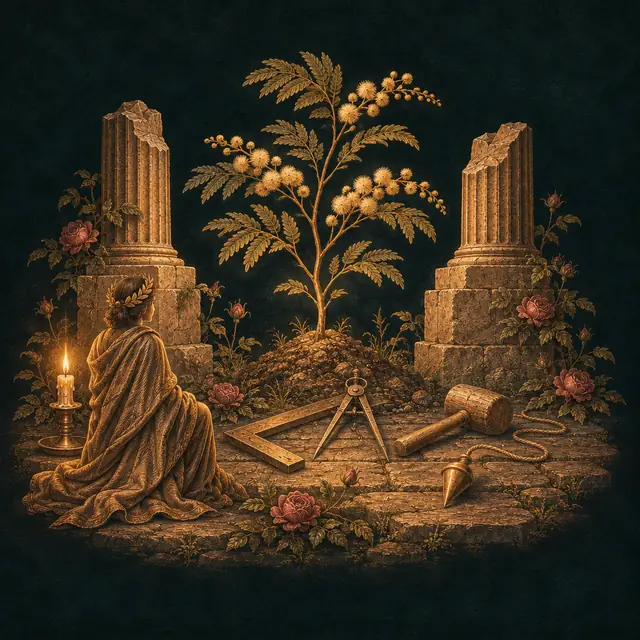
Fifteen loving brothers, by Solomon's order, went out of the west door and spread out in a line within call of one another, agreeing that if they did not find the word on him or about him, the first word spoken should be the master's word. One, more weary than the rest, sat down and caught hold of a shrub, which came up easily, and saw that the ground had been broken. They found the master in a decent grave covered with green moss and turf, so that they gave thanks to God that he had a mossy house; they set a sprig of cassia at the head of the grave and went to tell the king, and the master was raised and laid at last within the Temple, in the holy of holies.
The fuller drama
In the exposures of the 1760s the drama is fuller. Fifteen fellow crafts conspire to force the word from the master; twelve repent and confess to the king, and three persist, and strike him at the east, south and west doors with a gauge, a square and a heavy maul. The twelve who repented go out in parties to search, and near Joppa one of them, resting by the cliffs above the sea, hears the murderers in a cleft of the rock lamenting what they have done, each wishing he had suffered a terrible death rather than share in it. They are taken, confess before Solomon and die by the dooms they called down on themselves, and the body is found on the side of a hill and raised.
Adoniram and the Queen of the Morning
Gérard de Nerval made the legend a romance of fire. His master of the works, Adoniram, is a solitary genius of the race of Cain, the children of fire, who serve no king, while Solomon is a son of Adam and of the clay. When Balkis, the Queen of Sheba, comes to Jerusalem, Solomon wants her for his wife. She asks to see the workmen, and Adoniram, standing on a block of granite, traces a T in the air with his arm, and the thousands range themselves like an army; when he traces the same sign for her bird, the hoopoe, which will own no master but the husband destined for her, it alights on his fist.
Three jealous workmen tamper with the casting of the bronze sea; the metal breaks loose, Adoniram throws water on it, and it bursts into the air as a rain of fire. In the night Adoniram's ancestor Tubal-cain leads him down to the centre of the earth, to Cain and the fathers of his race, and gives him back his courage. Balkis gives herself to him, and the three workmen, with the jealous king's connivance, kill him at the gates for the master's word, which he will not give. Gounod's opera carried the same tale to the stage.
What the legend teaches
For the craft, Hiram is the pattern of fidelity: a man who keeps the trust given him at the cost of his life, so that the Master Mason learns from his death to keep faith and from his raising to hope beyond the grave, and goes on seeking the word that was lost; the lessons of the degree are taught on the branch The Freemasons. The other figures of the legend teach with him. The ruffians would seize by force what is given only to time and a little patience, and the sprig at the head of the grave is the evergreen hope of the soul.
Nerval's reading is a romantic one, and his own: the artist and the workman, children of fire, set against the kings and priests who use their genius and fear it.
Who took it up
The legend belongs to the Freemasons, who present it as an allegory of fidelity and not as history. It is not found in the medieval stonemasons’ charges, which tell instead of Noah and of Euclid, and no document carries it back before the 1720s.
What later tellings added or changed
That it preserves a murder at Solomon’s Temple, or the rites of Egypt, or the death of the last Templar master. Each has been claimed by Masonic writers since the eighteenth century, and none has any evidence behind it.
The texts that tell it
- The Books of Kings and ChroniclesScripture, biblical
The Bible names a Hiram of Tyre, son of a widow, a worker in bronze whom Solomon brought to make the pillars and vessels of the Temple. It tells of his work and says nothing of his death.
Ask the Oracle about it - Masonry DissectedAccount, printed 1730
Samuel Prichard’s exposure of the Masonic degrees, printed in London, the first text to tell the drama of the master builder struck down by three workmen for the master’s word, and his finding and raising.
Ask the Oracle about it - Three Distinct KnocksAccount, printed 1760
An exposure of the rituals of the Ancients, the rival grand lodge, which gives a fuller version of the Hiramic drama as worked in its lodges and was used by many as a ritual guide.
Ask the Oracle about it - The Story of the Queen of the MorningLegend, printed 1851
Gérard de Nerval’s tale in his Journey to the Orient, in which Adoniram, the master of Solomon’s works, wins the love of the Queen of Sheba and is killed by three jealous workmen. It made the Masonic legend a romantic myth.
Ask the Oracle about it - La Reine de SabaOpera, 1862
Charles Gounod’s opera drawn from Nerval’s tale, first staged in Paris, with the casting of the great bronze sea and the murder of the master by his workmen. It carried the Masonic legend onto the opera stage.
Ask the Oracle about it
How the house tells a life
This is a story, told with its sources and with what later tellings added or changed. What it means for you is yours to judge.
The arts it feeds
Lives near it in time
Stories of forbidden knowledge
The Holy GrailOdinLokiFaustThe Monkey KingThe GolemChristian RosenkreuzThe Sorcerer’s ApprenticeFrankensteinJekyll and HydeDorian GrayDraculaThe whole tree

