
Jekyll and Hyde
The novella by Robert Louis Stevenson, 1886
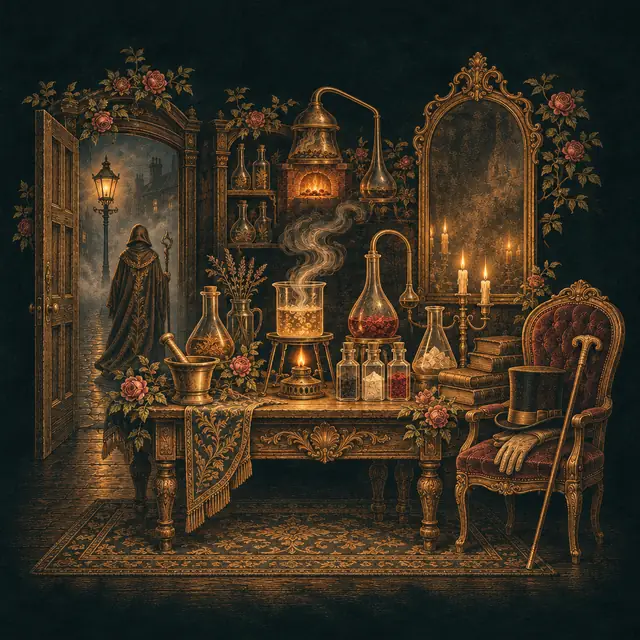
What is the story of Dr Jekyll and Mr Hyde, and what does it warn of?
The story and its sources
A novella by Robert Louis Stevenson, published in January 1886 and written, by his own account, after a dream. Henry Jekyll, a respected London doctor, compounds a drug that separates the part of him that wants to do wrong and gives it a body of its own: the small, younger, repellent Edward Hyde. At first he changes at will and enjoys it. Then the change begins to come unasked, the drug loses its power, and Hyde commits murder. The book is told as a mystery from outside, and the truth comes only at the end, in Dr Lanyon’s letter and Jekyll’s own statement.
The teaching
Taught from Robert Louis Stevenson's novella of 1886 and his Chapter on Dreams.
The door in the by-street
The story is told from outside, by a lawyer, Mr Utterson, a dry, lean, lovable man who would rather help the fallen than condemn them. Walking one Sunday with his kinsman Enfield, he hears of a door in a London by-street. At three one winter morning Enfield saw a small man walk straight into a girl at a corner and trample calmly over her body, leaving her screaming. Collared, the man paid her family a hundred pounds to avoid a scandal, going in at that door and coming out with ten pounds in gold and a cheque for the rest, signed with the name of a man everyone respects. The man who trampled her is called Hyde, and everyone who sees him loathes him without being able to say why.
Mr Seek
Utterson has in his safe the will of his old friend Dr Henry Jekyll, which leaves everything to Edward Hyde, not only at Jekyll's death but if he should disappear for more than three months. If he is Mr Hyde, Utterson thinks, I shall be Mr Seek, and he waits by the door until Hyde comes: pale and dwarfish, giving an impression of deformity without any nameable malformation, with a husky, whispering, broken voice. The door turns out to be the back way into Jekyll's laboratory.
A year later a maid at her window sees Hyde, in a sudden fury, club to death an old gentleman, Sir Danvers Carew, who had stopped to speak to him; the broken stick is one Utterson gave Jekyll. Jekyll swears he is done with Hyde and shows a letter in Hyde's hand, which Utterson's clerk sees is Jekyll's own hand, sloped the other way.
The last night
Jekyll comes out into society again for two months, then shuts his door, and his friend Dr Lanyon, who has seen something that has shaken him to death, dies within weeks, leaving a sealed letter. One night Jekyll's butler, Poole, comes to Utterson in terror: for a week the voice behind the door of the cabinet has not been his master's, and it sends out notes demanding a certain drug from the chemists and rejects every packet as impure. Utterson and Poole break down the door with an axe. Inside lies Hyde, dead by his own hand, in clothes far too large for him, a crushed phial in his fingers. Of Jekyll there is no trace, only a will that now names Utterson, and two documents, which tell the truth at last.
Lanyon's narrative
Lanyon tells how a letter from Jekyll begged him to fetch a drawer from the cabinet and give it at midnight to a man who would call. The man came, small, and dressed in clothes much too big for him, and mixed salts with a red liquid that brightened, effervesced and turned to purple and then to a watery green. He offered Lanyon a choice: to let him go, or to see what would open to him a new province of knowledge. Lanyon chose to see. The man drank, reeled and gasped, and changed before his eyes, and there stood Henry Jekyll, pale and shaken, like a man restored from death. What Jekyll told him in the next hour, Lanyon writes, he cannot bring himself to set down; his life is shaken to its roots.
The two in one
Jekyll's own statement explains. He was born to wealth and good parts, fond of the respect of the wise and good, and with an impatient gaiety of disposition that he hid; so he came to lead a double life, and to see that “man is not truly one, but truly two”. He dreamed of housing the two in separate bodies, so that the unjust might go his way, delivered from the aspirations of his upright twin, and the just walk steadfastly upward, no longer exposed to disgrace by the evil beside him.
The drug he compounded made nothing new; it only shook the doors of the prison house of his nature. What came out was smaller and younger than he, because that side of him had been less exercised, and when he looked at it in the glass he felt no repugnance, only a leap of welcome. This, too, was himself.
The change that comes unasked
At first he changed at will and enjoyed it, a respected man by day who could slip on Hyde like a cloak and answer for nothing. Then one morning he woke in his own bed and saw on the sheet not his own large, white, comely hand but Hyde's, lean, corded and dusky: the change had come in his sleep. He resolved to give Hyde up and kept to it for two months, and then, in an hour of weakness, drank again, and Hyde came out roaring and killed Carew for the joy of it.
Again he resolved, and lived well, until on a bench in Regent's Park, pleased with his own goodness and thinking himself better than his neighbours, he felt the change come over him in daylight. After that it came at any hour, and only doubled and tripled doses brought Jekyll back. His first supply of salt ran out, and no new supply would work, for the first had held some unknown impurity. He writes his statement under the last of the old powder, and lays down the pen: here, he says, he brings the life of that unhappy Henry Jekyll to an end.
What the story teaches
Stevenson's teaching is not that Jekyll was good and Hyde evil. Jekyll was a mixture, and what he wanted was to keep his pleasures and lose the blame; the drug only let out what he chose to free, and each time he freed it the way back was harder, until, as he writes, he was slowly losing hold of his better self and becoming one with the worse. The habit, not the potion, is the true transformation.
Stevenson said in his Chapter on Dreams that the little people of his sleep gave him the scene at the window and the change made in the presence of pursuers, and that the rest he made awake. Readers since have taken the two names for any divided life, and Jung's followers for the shadow, the part of the self a person will not own, which grows darker the more it is denied.
Who took it up
No order took it up; psychology did. The title became the common phrase for a divided character, and Jung’s account of the shadow, the part of oneself one will not own, is often explained by it. Stage versions from 1887 added the fiancée and the good-against-evil shape the films keep.
What later tellings added or changed
That Jekyll is the good man and Hyde the bad. In the book Jekyll is a mixture who wants his pleasures without the blame, and says so; Hyde is only what he chose to set free. It is also not a tale of two personalities taking turns unknown to each other: Jekyll remembers everything.
The texts that tell it
- Strange Case of Dr Jekyll and Mr HydeNovel, 1886
Robert Louis Stevenson’s novella, written after a dream and published in January 1886. A London doctor makes a drug that sets free the part of him that wants to do wrong, and gives it the body of Edward Hyde. The truth is told only at the end, in Lanyon’s letter and Jekyll’s own statement.
Ask the Oracle about it - Dr Jekyll and Mr Hyde, on the stagePlay, 1887
The stage version by Thomas Russell Sullivan for the actor Richard Mansfield, first played in Boston and later in London. It added a fiancée for Jekyll and the shape of good against evil that later versions kept. Mansfield’s change from one man to the other before the audience made the play famous.
Ask the Oracle about it - Dr Jekyll and Mr Hyde, the filmFilm, 1931
Rouben Mamoulian’s film with Fredric March, who won an Academy Award for the double part. Its long transformation scenes, made with coloured filters, became famous. It made Hyde more brutal and sensual than Stevenson had, and that picture has lasted.
Ask the Oracle about it - Mary ReillyNovel, 1990
A novel by Valerie Martin telling the story through the eyes of a housemaid in Jekyll’s household. It gives a voice to a woman who has no place in Stevenson’s book. It was made into a film in 1996.
Ask the Oracle about it
How the house tells a life
This is a story, told with its sources and with what later tellings added or changed. What it means for you is yours to judge.
The arts it feeds
Lives near it in time
Stories of forbidden knowledge
The Holy GrailOdinLokiFaustThe Monkey KingThe GolemChristian RosenkreuzHiram AbiffThe Sorcerer’s ApprenticeFrankensteinDorian GrayDraculaThe whole tree

