
The Sorcerer’s Apprentice
Ballad by Goethe, 1797, from a tale told by Lucian about AD 150
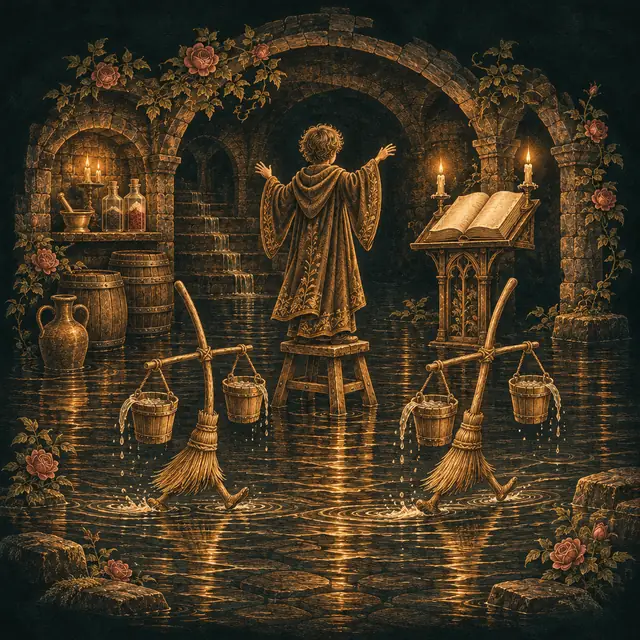
What is the story of the Sorcerer’s Apprentice, and what does it warn of?
The story and its sources
A ballad by Goethe, Der Zauberlehrling, written in 1797. Left alone, an old sorcerer’s pupil speaks the spell that makes a broom fetch water, and finds he does not know the word that stops it. He splits the broom with an axe; both halves fetch water, and the house floods until the master returns and ends it with a word. Goethe took the plot from Lucian, a Greek writer of about AD 150, in whose Lover of Lies an Egyptian magician’s companion animates a pestle. Paul Dukas set it to music in 1897, and Disney’s Fantasia of 1940 gave the part to Mickey Mouse.
The teaching
Taught from Lucian's Lover of Lies and Goethe's ballad of 1797, with Dukas and Disney after them.
Pancrates and the pestle
Lucian tells the oldest form inside a satire. In the house of a sick man named Eucrates, learned men trade tales of wonders, and Eucrates tells his own. As a young man in Egypt, sailing up the Nile, he met Pancrates, a sacred scribe of Memphis, shaven and dressed in linen, who had lived twenty-three years underground in the shrines learning magic from Isis, and who rode on crocodiles. At every inn where they stopped, Pancrates would take the bar of the door, or a broom, or the pestle, dress it in clothes and say a spell over it, and it would walk like a man, draw water, buy food and wait on them, and when they had no more need of it another spell made it wood again.
Half a spell
Eucrates longed to learn it, but Pancrates kept the spell to himself, until one day Eucrates, standing in a dark corner, overheard it: three syllables. When Pancrates went to the market he took the pestle, dressed it, spoke the syllables and told it to fetch water. It brought a full jar. Enough, he said, be a pestle again; but it would not stop, and went on carrying water until the house was flooded. In despair he took an axe and split it in two, and each half took up a jar and fetched water, so that now he had two servants instead of one.
Pancrates came home, saw what had happened, turned them back into wood, and went away and was never seen again. To this day, says Eucrates, he can make the pestle carry water, but he cannot undo it.
Goethe's broom
Goethe moved the tale into a sorcerer's workshop and gave it to the pupil left alone. The old master has gone out for once, and the apprentice, who has noted his words and works, means to make the spirits do his own will. He dresses the old broom in rags, sets it on two legs with a head on top, and sends it to the river with a pail, and the broom runs and pours and runs again until the basin is full and the floor is awash. Then he finds he has forgotten the word that stops it. He threatens, he begs, and at last seizes an axe and splits the broom in two, and both halves rise up as servants and fetch water twice as fast. As the master comes in he cries out: “Die ich rief, die Geister, werd ich nun nicht los”, the spirits that I called I cannot now be rid of.
The master's word
The master ends it in a breath: into the corner, broom, broom, be what you were. Dukas set the ballad to music a century later, and Disney gave the apprentice's part to Mickey Mouse, who falls asleep in the master's hat dreaming that he commands the stars and the sea, and wakes to find the water rising round his chair.
What the story teaches
Lucian told it to laugh at credulity: his teller is a man of standing and of philosophy who believes every wonder, and the one guest in the room who doubts goes home saying that against such tales the antidote is truth and sound reason. Goethe kept the wonder and changed the lesson, and his last lines give it: the spirits come forth as spirits only at the call of the old master, and only for his purpose. The apprentice had the words and lacked both the purpose and the end, the knowledge of what the power was for and how to send it back.
The books of ritual magic make the same point as a rule: no operation in them is complete until the spirit has been given its licence to depart, and the apprentice knew how to call and not how to dismiss.
Who took it up
No order claimed it, but teachers of magic and of every other craft have used it since: the apprentice has the words of power and none of the understanding. It is quoted today of any tool that carries out an order faster than its user can take it back.
What later tellings added or changed
That it warns against knowledge. The master’s knowledge does no harm at all; the trouble is a half-learned art used without him. The German line about spirits one has summoned and cannot be rid of has become a proverb.
The texts that tell it
- The Lover of LiesDialogue, about AD 150
A satire by the Greek writer Lucian in which credulous men swap tales of wonders. One tells how the Egyptian magician Pancrates made a pestle fetch water, and how he, overhearing half the spell, could not stop it and split it in two. It is the oldest telling of the tale.
Ask the Oracle about it - Der ZauberlehrlingPoem, 1797
Goethe’s ballad, which moved the tale into a sorcerer’s workshop and gave it to the pupil left alone. The broom split by the axe and the master’s word that ends the flood made it the version the world knows.
Ask the Oracle about it - L’Apprenti sorcierMusic, 1897
A symphonic scherzo by Paul Dukas that follows Goethe’s ballad, with the bassoons as the broom. It made the tale famous in the concert hall. Its rising theme, passed from instrument to instrument as the water spreads, is one of the most famous in French music.
Ask the Oracle about it - FantasiaFilm, 1940
Walt Disney’s film set to orchestral music, in which Mickey Mouse plays the apprentice to Dukas’s scherzo. It fixed the picture of the tale for most people living today.
Ask the Oracle about it
How the house tells a life
This is a story, told with its sources and with what later tellings added or changed. What it means for you is yours to judge.
The arts it feeds
Lives near it in time
Stories of forbidden knowledge
The Holy GrailOdinLokiFaustThe Monkey KingThe GolemChristian RosenkreuzHiram AbiffFrankensteinJekyll and HydeDorian GrayDraculaThe whole tree

