
The Monkey King
Chinese novel; Journey to the West, printed 1592
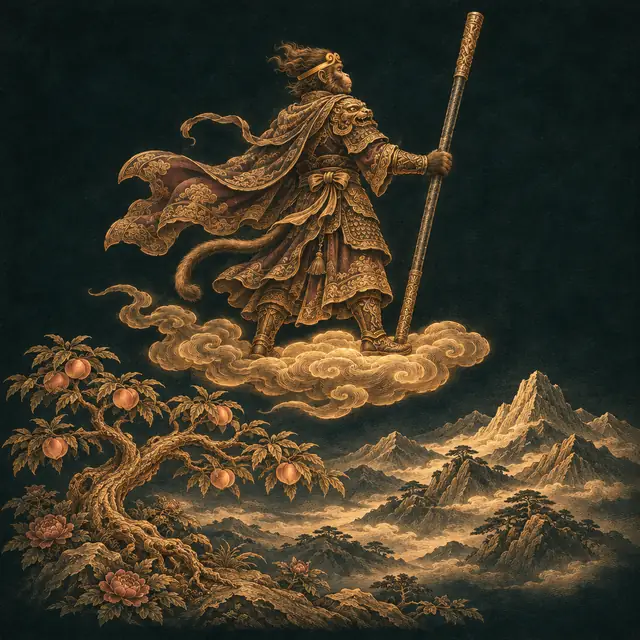
What is the story of the Monkey King, and what has it been taken to mean?
The story and its sources
Sun Wukong, hero of the Chinese novel Journey to the West, printed in 1592 and usually credited to Wu Cheng’en. Born from a stone, he learns from a Taoist master to change into seventy-two shapes and to leap across the sky, wipes his name from the register of the dead, eats the peaches of immortality and fights the armies of heaven to a standstill. The Buddha traps him under a mountain for five hundred years. Freed, with a band on his head that tightens when he rebels, he guards the monk Tripitaka on the road to India to fetch the scriptures.
The teaching
Taught from the hundred chapters of Journey to the West, with its Buddhist and Taoist readers.
The stone monkey
On the Mountain of Flowers and Fruit, in a land beyond the eastern sea, a stone that has drunk in the essences of heaven and earth since the world began splits open and gives birth to a stone egg, and from the egg comes a monkey, whose eyes flash golden beams up to the palace of the Jade Emperor. He finds a cave behind a waterfall and becomes king of the monkeys. But one day at a feast he weeps: however happy they are, King Yama of the dead will take them in the end. So he sets out alone on a raft over the sea to find an immortal who can teach him to escape death.
The master of the mind
After years of wandering he finds the patriarch Subhuti on the Mountain of the Mind, in the Cave of the Slanting Moon and Three Stars, both of which are riddles for the written sign of the heart and mind. The master names him Sun Wukong, Awakened to Emptiness. He refuses every way that does not lead to life everlasting, and when the master strikes him three times on the head and walks inside with his hands behind his back, he alone understands: come at the third watch, by the back door. In the night the master teaches him the way of long life, and later the seventy-two transformations and the cloud somersault that carries him a hundred and eight thousand li in a single leap. But when he shows off before the other pupils by turning into a pine tree, the master sends him away, forbidding him ever to say whose pupil he was.
Havoc in heaven
Home again, he takes from the Dragon King of the Eastern Sea a pillar of divine iron that once fixed the depths of the waters, a rod that grows or shrinks at his word until he keeps it as a needle in his ear. When the summoners of the dead come for his soul, he fights his way into the halls of the underworld and strikes his name and the names of all monkeys out of the register of life and death.
Heaven tries to tame him with office. He is made keeper of the heavenly horses, and when he learns how low the post is he goes home, calls himself the Great Sage Equal to Heaven, beats the armies sent against him, and is given the empty title. Set to guard the garden of the peaches of immortality, he eats them; he drinks the wine of the Queen Mother's feast, and eats Laozi's pills of elixir as well.
Five hundred years under the mountain
Heaven's hundred thousand soldiers cannot take him; only the god Erlang, matching him change for change, and a ring that Laozi drops on his head bring him down. Blades and thunderbolts cannot hurt him now, and forty-nine days in Laozi's furnace only give him fiery golden eyes. He breaks out and fights his way to the throne room of heaven, and the Jade Emperor sends for the Buddha.
The Buddha offers him a wager: if he can leap out of the palm of his right hand, heaven is his. Monkey leaps to the end of the world, where five pink pillars stand, writes on one that the Great Sage Equal to Heaven was here, and relieves himself at the foot of another; then he leaps back to claim his prize, and the Buddha shows him the writing on his own middle finger. The Buddha's hand becomes the Mountain of the Five Elements, and Monkey lies pinned beneath it for five hundred years, fed on iron pellets and molten copper.
The band of gold and the road west
The Buddha wants his scriptures carried to China, and the bodhisattva Guanyin chooses the monk Tripitaka to fetch them and gathers his guardians along the road: a pig spirit who was once a marshal of heaven, called Pigsy, a sand monster who was once a general of heaven, called Sandy, and a dragon prince who becomes the monk's white horse. To Monkey she promises freedom if he will serve the monk.
Tripitaka lifts the seal from the mountain, and Monkey's first deed is to kill six robbers whose names are the six senses; scolded, he flies off in a temper. So Guanyin gives the monk a cap with a band of gold and a spell. Monkey puts on the cap, the band takes root in his head, and whenever the monk recites the spell it tightens until Monkey rolls on the ground in pain. With it the journey begins: fourteen years, eighty-one ordeals, and demon after demon who wants to eat the monk's flesh for long life, each seen through by Monkey's fiery eyes.
The scriptures and the vanished band
Twice the monk drives Monkey away for killing, once when the victims were a demon in three human disguises that only Monkey could see through, and each time the pilgrims fall into worse trouble without him. Once a false Monkey appears, his exact double, and neither gods nor guardians can tell the two apart until the Buddha names the impostor. Below the Vulture Peak the pilgrims cross a river in a bottomless boat, and the monk sees his own dead body float away downstream: he has left his mortal shell behind.
The first scrolls they are given are blank, because they brought no gift. The Buddha tells them that the blank scrolls are the true scriptures, but that the people of the East are too foolish to read them, and gives them written ones. When it is over Monkey is made a Buddha, Victorious in Strife, and when he asks Tripitaka to take off the band, he finds that it has already gone of itself.
The monkey of the mind
The novel's readers have always taken its monkey for the mind. Its own chapter titles call him the Mind Monkey, from a Buddhist saying that pairs the restless mind, a monkey that never stops leaping, with the will, a horse that bolts; his master lives on the Mountain of the Mind; his band is tightened by a spell for settling the mind; and his name means awakened to emptiness, the teaching of the Heart Sutra that the monk recites on the road.
Read so, the story is a training. The mind's powers are vast and can storm heaven itself, but until they are given to a purpose beyond the self they bring only chaos and five hundred years under a mountain; joined to the slow, patient pilgrim, they carry him through every ordeal, and the band that held them falls away when it is no longer needed. Taoist commentators read the same pages as a book of inner alchemy, with the chapter titles calling Monkey the Metal Squire, Pigsy the Wood Mother and Sandy the Yellow Dame, names of the ingredients of the inner elixir, and the long journey as the refining of the body's own essence.
Who took it up
The novel draws on the real journey of the monk Xuanzang to India in the seventh century and on centuries of storytelling. Readers in China have long taken the monkey for the restless mind that must be trained, and temples in south China and Southeast Asia honour him as a god.
What later tellings added or changed
That he is the Hindu god Hanuman under another name. A link has been argued since the 1920s and is not settled. That the authorship is certain: the first printings were anonymous, and Wu Cheng’en’s name was proposed by scholars of the Qing and made standard in the 1920s.
The texts that tell it
- Journey to the WestNovel, printed 1592
The hundred chapter novel in which the stone born monkey Sun Wukong learns his arts from a Taoist master, storms heaven, is trapped by the Buddha under a mountain and is freed to guard the monk Tripitaka on the road to India. It is one of the four classic novels of China.
The first printings were anonymous; the credit to Wu Cheng’en was proposed by later scholars.
Ask the Oracle about it - Great Tang Records on the Western RegionsBook, 646
The account of the lands he passed through, dictated by the monk Xuanzang after his journey of sixteen years to India for the Buddhist scriptures, and written up by his disciple Bianji. It is the real journey behind the novel, with no monkey in it.
Ask the Oracle about it - The Tale of Tripitaka Fetching the ScripturesLegend, 13th century
A short storyteller’s text printed in the Song dynasty, the oldest surviving telling in which a monkey guide, a scholar in a white robe, helps the monk on his road. It shows the legend growing for three centuries before the novel.
Ask the Oracle about it - MonkeyTranslation, printed 1942
Arthur Waley’s shortened English translation, which kept about a third of the chapters and much of the comedy, and made the Monkey King known to readers in the West. A complete English translation by Anthony Yu followed from 1977.
Ask the Oracle about it - Havoc in HeavenFilm, 1961 and 1964
The animated film made in two parts by the Shanghai Animation Film Studio, telling the monkey’s rebellion against heaven in the colours and music of Peking opera. It remains among the best loved Chinese films.
Ask the Oracle about it
How the house tells a life
This is a story, told with its sources and with what later tellings added or changed. What it means for you is yours to judge.
The arts it feeds
Lives near it in time
Stories of forbidden knowledge
MerlinMorgan le FayThe Holy GrailOdinLokiFaustThe GolemChristian RosenkreuzHiram AbiffThe Sorcerer’s ApprenticeFrankensteinJekyll and HydeThe whole tree

