
Morgan le Fay
Arthurian legend; first told by Geoffrey of Monmouth, about 1150
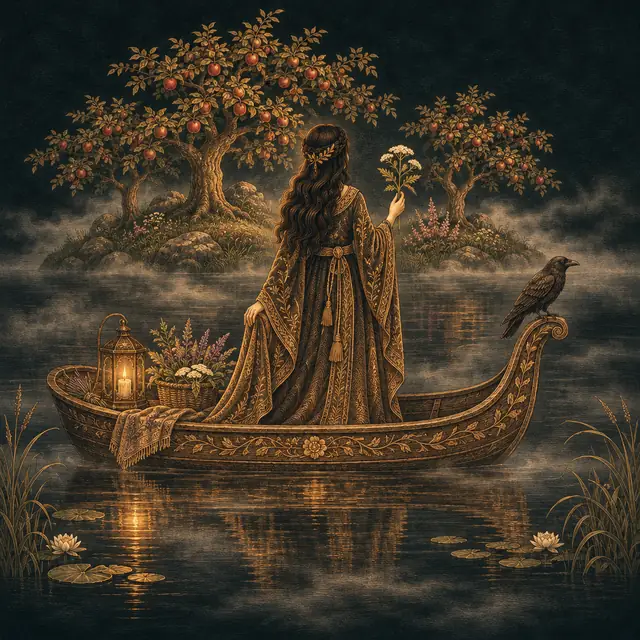
What is the story of Morgan le Fay, and how has it changed?
The story and its sources
The enchantress of the Arthurian stories. She first appears in Geoffrey of Monmouth’s Life of Merlin, about 1150, as the chief of nine sisters who rule the Isle of Apples, a healer who can change her shape and who receives the wounded Arthur. Poets of the late twelfth century make her Arthur’s sister; in the French prose romances of the thirteenth she is his half-sister, learns magic, and turns against him and Guinevere. In Sir Gawain and the Green Knight she is behind the whole test. Yet in Malory, in 1485, she is still among the queens who carry Arthur away in the barge.
The teaching
Taught from Geoffrey's Life of Merlin, Chrétien, the French prose cycles, Sir Gawain and the Green Knight and Malory.
The Isle of Apples
In Geoffrey's Life of Merlin the bard Taliesin tells of the Isle of Apples, called the Fortunate Isle, where the fields need no plough, grain and grapes grow of themselves, and people live a hundred years or more. Nine sisters rule it, and Morgen is the first of them, the fairest and the most skilled: she knows the healing virtues of every herb, can change her shape and fly through the air on new wings to Brest, Chartres or Pavia, and has taught the reckoning of the stars to her sisters.
After the battle of Camlann, Taliesin says, he and the pilot Barinthus brought the wounded Arthur there. Morgen laid him on a golden bed in her chamber, uncovered the wound with her own hand and looked at it long, and said that she could heal him if he stayed with her a long while and let her treat him.
Arthur's sister
The poets of the next generation bring her into Arthur's family. In Chrétien de Troyes she is Morgan the Fay, Arthur's sister, whose ointment heals the deepest wounds, and whose friend is Guingamar, lord of the Isle of Avalon. In the French prose cycles of the thirteenth century she is the daughter of Igraine and her first husband, the duke of Tintagel, sent as a girl to a nunnery, where she learns the seven arts and the stars, and later learns enchantment from Merlin.
There the healer becomes an enemy. Her love for a knight, Guiomar, is broken off by Guinevere, and she hates the queen ever after. She sets a valley of enchantment from which no lover false to his lady can escape, until Lancelot, the most faithful, breaks it; she holds Lancelot prisoner, and he, longing for the queen, paints the whole story of his love on the walls of his room, which Morgan later shows to Arthur.
The test of the Green Knight
In Sir Gawain and the Green Knight her hand is hidden until the end. At New Year a knight all green, on a green horse, rides into Arthur's hall with a holly bough and a great axe and offers a game: any man may strike him one blow, if he will take one in return in a year and a day. Gawain takes the axe and cuts off his head; the knight picks it up by the hair, and the head speaks, summoning Gawain to the Green Chapel.
A year later, lodging at a castle on his way, Gawain plays another game with its lord: each day the lord hunts and Gawain rests, and each evening they exchange what they have won. Three mornings the lady of the castle comes to his bed to tempt him, and he gives the lord her kisses, but on the third day he keeps back the green silk girdle she has given him, which she says keeps whoever wears it from being slain.
Morgan's purpose
At the Green Chapel the knight swings three times: once Gawain flinches, once the axe is held back, and the third time it barely nicks his neck, for the two honest days and the one when he hid the girdle out of love for his life. Then the knight names himself, Bertilak, Gawain's host, and names the one behind it all: the old lady honoured in his castle, Morgan the goddess, who learned her craft from Merlin, Arthur's half-sister and Gawain's own aunt. She sent him in that shape to try the pride and renown of the Round Table, and to frighten Guinevere to death.
Gawain goes home wearing the girdle as the mark of his fault, and the court, laughing kindly, takes up a green band for his sake. The meaning of his shield, the golden star of five points, is taught on the branch The pentagram.
The queen in the barge
Malory gathers all of this into one figure. His Morgan is the wife of King Uriens and the mother of Uwain, and Arthur's deadliest enemy. She steals Excalibur and arms her lover Accolon with it against Arthur, who barely survives the fight; she steals the scabbard, which kept its wearer from losing blood, and throws it into a lake, and escapes the king's pursuit by turning herself and her men into great stones; she sends him a rich mantle that bursts into flame on the damsel made to try it on.
Yet when Arthur lies dying after his last battle, a barge comes to the shore with fair ladies in black hoods, and among them three queens, and Morgan is one. They take him aboard, she lays his head in her lap and mourns that he has stayed away from her so long and let his wound take cold, and they bear him away to the vale of Avalon to be healed.
What the story teaches
Morgan's story teaches by its change. The same powers, the knowledge of herbs and stars and the changing of shape, belong first to a healer who waits for the wounded king and later to the enemy who plots his death, and the change comes as the romances give her book learning and Merlin's arts and set her against Guinevere. In the Gawain poem she is a tester rather than a destroyer, the one whose game shows the court its pride and the best of its knights his single fault. Malory keeps both faces and lets the healer have the last word.
Modern goddess movements, and Marion Zimmer Bradley's novel, read her as a priestess of an older faith whose story her enemies told, and give her back the Isle of Apples.
Who took it up
No medieval cult was hers. Scholars have linked her with the Welsh Modron and the Irish Morrígan, without proof. Modern pagan and goddess movements took her up, helped by Marion Zimmer Bradley’s novel The Mists of Avalon, 1983, which tells the story from her side.
What later tellings added or changed
That she was always the villain. For her first decades in the stories she is a healer, and the darkening comes with the prose cycles of the thirteenth century, whose authors are unknown. That she and Morgause are one person is a modern blending.
The texts that tell it
- Life of MerlinPoem, about 1150
Geoffrey of Monmouth’s Latin poem, where Morgan first appears as the chief of nine sisters on the Isle of Apples, a healer learned in the stars who can change her shape and fly, and who takes in the wounded Arthur to heal him.
Ask the Oracle about it - Erec and EnideRomance, about 1170
Chrétien de Troyes’s romance, among the first to call Morgan the sister of Arthur and to name a healing ointment as her gift. It joins her to his family, the first step towards her later part.
Ask the Oracle about it - The Vulgate CycleRomance, 13th century
The French prose romances of Lancelot and the Grail, where she is Arthur’s half sister, learns magic from Merlin, and turns against Arthur and Guinevere, trying to expose the queen and Lancelot. Here the healer becomes an enemy.
Their authors are unknown.
Ask the Oracle about it - Sir Gawain and the Green KnightPoem, late 14th century
The English poem of the late fourteenth century in which the Green Knight’s beheading challenge to Arthur’s court turns out, at the very end, to be her doing, sent to test the pride of the round table and to frighten Guinevere.
Ask the Oracle about it - Le Morte d’ArthurRomance, 1485
Malory’s telling, where she plots against Arthur and steals the scabbard of Excalibur, yet is one of the queens who carry him to Avalon in the barge at the end.
Ask the Oracle about it - The Mists of AvalonNovel, 1983
Marion Zimmer Bradley’s novel, which tells the whole Arthurian story from Morgaine’s side, as a priestess of an old goddess faith. It made her a heroine for many readers and for modern goddess movements.
Ask the Oracle about it
How the house tells a life
This is a story, told with its sources and with what later tellings added or changed. What it means for you is yours to judge.
The arts it feeds
Lives near it in time
Stories of forbidden knowledge
MithrasCupid and PsycheHermes TrismegistusSolomon and the demonsLilithMerlinThe Holy GrailOdinLokiFaustThe Monkey KingThe GolemThe whole tree

