
Cupid and Psyche
Roman tale; told by Apuleius about AD 160
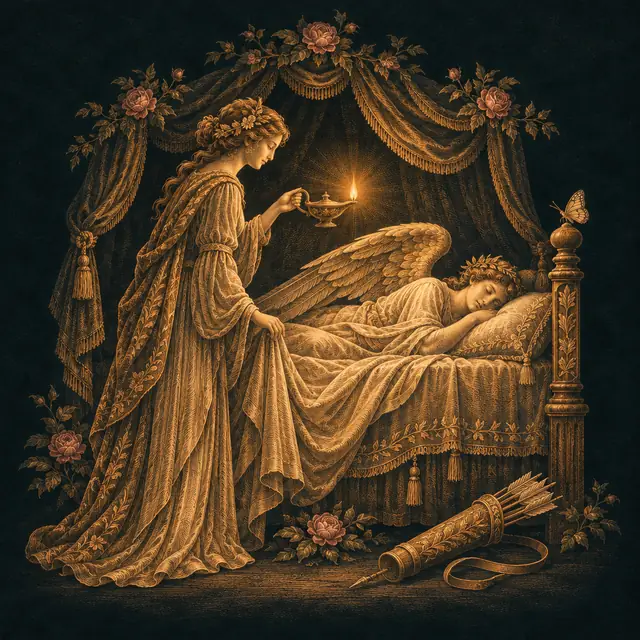
What is the story of Cupid and Psyche, and what has it been taken to mean?
The story and its sources
A tale set inside The Golden Ass, a Latin novel written by Apuleius about AD 160, and the only ancient telling. Psyche, a king’s daughter so beautiful that Venus grows jealous, is carried to a palace where a husband comes to her only in the dark and forbids her to look at him. Urged on by her sisters she lights a lamp, sees the god Cupid, and a drop of hot oil wakes him; he leaves. Venus sets her four tasks, the last a descent to the underworld for a box she is told not to open. She opens it. Cupid rescues her, and Jupiter makes her immortal.
The teaching
Taught from Apuleius's tale in The Golden Ass, with the readings of Fulgentius and Erich Neumann.
Psyche and the anger of Venus
An old woman tells this tale in a robbers' cave to a girl carried off from her wedding, and Lucius, turned into an ass and stabled there, wishes he had a tablet to write it down. A king and queen have three daughters, and the youngest, Psyche, is so beautiful that people worship her as Venus walking the earth, and the goddess's own temples stand empty. Venus, mother of nature, will not be outshone by a mortal girl. She charges her son Cupid, the winged boy who roams at night with torch and arrows, to make Psyche burn with love for the lowest and most wretched of men.
The oracle and the unseen husband
Admired by all and wooed by none, Psyche sits at home hating her beauty. Her father asks the oracle of Apollo at Miletus, which answers that the girl must be set on a high crag, dressed for a marriage of death, to wed no mortal but a savage evil like a serpent, flying on wings, before whom Jupiter himself and the waters of the Styx tremble. So the wedding is held as a funeral, and Psyche is left alone on the rock.
The gentle West Wind lifts her down into a valley of flowers, where she finds a palace built by no human hand, with columns of gold and floors of gems. Voices without bodies serve her, and an unseen lyre plays at her meals. At night her husband comes to her in the dark and is gone before dawn. He warns her that her sisters will come mourning her, and when she begs to see them he lets them visit, but tells her again and again never to be persuaded to look for his face, or she will lose him and all her happiness.
The sisters and the lamp
The sight of so much gold turns the sisters' grief to envy, and when Psyche, now with child, tells them two different tales of what her husband looks like, they guess that she has never seen him. They tell her he is a monstrous serpent fattening her and the child to devour them, and that she must hide a razor and a covered lamp by the bed and cut off his head as he sleeps. Hating the beast and loving the husband in the one body, she makes ready.
That night she uncovers the lamp and lifts the blade, and sees the gentlest and sweetest of all wild things: Cupid himself, golden-haired, dewy wings at his shoulders, his bow at the foot of the bed. The razor falls from her hand. Trying the point of one of his arrows on her thumb, she pricks herself and falls in love with Love. As she bends to kiss him, the lamp lets fall a drop of burning oil on his shoulder.
The flight of Love
The god wakes, sees her broken faith and flies from her arms. From a cypress he tells her that he came to her himself, against his mother's orders, and wounded himself with his own arrow, and that she took him for a beast; her sisters will pay, and her own punishment is only his flight. Psyche throws herself into a river, which lays her gently on its bank, and the god Pan tells her to win back the great god by prayer and service. Her sisters she pays back in kind: she tells each that Cupid means to marry that sister in her place, and each leaps from the crag for the wind to carry her down, and is dashed to pieces.
The tasks of Venus
Venus learns from a gull that her son lies wounded and that the world has gone without love, and she hunts the girl everywhere; Ceres and Juno pity Psyche but will not help her, and at last she gives herself up at Venus's door, where Habit drags her in by the hair and Worry and Sadness whip her. Then the tasks begin. Venus pours seven kinds of grain and seed into one heap and orders it sorted by nightfall, and the ants, pitying the wife of the great god, sort it grain by grain. Psyche must bring golden wool from savage sheep, and a green reed, breathing a soft music, tells her to wait until the heat of the day has passed and they rest, then gather the wool caught on the briars. She must fill a crystal jar from the black spring that feeds the Styx, on a crag guarded by serpents, whose very waters cry out to her to turn back, and Jupiter's eagle fills it for her.
The box from the underworld
Last, Venus sends her with a box to Proserpina, queen of the dead, to ask for a little of her beauty. Psyche climbs a tower to throw herself down, and the tower speaks and teaches her the way: go down at Taenarus with a barley cake soaked in honeyed wine in each hand and two coins in her mouth; give the ferryman a coin each way and the dog Cerberus a cake each way; pass by in silence the lame driver who asks for help with his load, the dead man who begs to be drawn into the boat and the old women at their loom, for they are snares to make her drop a cake; sit on the ground before Proserpina and ask only for plain bread; and never open the box.
She does it all, but in the daylight again she thinks it foolish to carry the beauty of the gods and take none for herself, to please her lover. She opens the box, the sleep of the underworld pours out over her, and she falls on the road like a corpse.
The wedding among the gods
Cupid, healed, slips out through a window, wipes the sleep from her face and shuts it back in the box, and wakes her with a harmless prick of his arrow, telling her that once more curiosity has nearly destroyed her. He flies to Jupiter, who grants his prayer, calls the gods to council and declares that the boy's wild youth shall be bridled by marriage. Mercury brings Psyche up to heaven, and Jupiter hands her a cup of ambrosia: drink, Psyche, and be immortal, and this marriage shall last for ever. Apollo plays at the wedding feast, the Muses sing and Venus herself dances, and in time a daughter is born to them, whom people call Pleasure.
The soul and Love
Psyche is the Greek word for the soul, and Plato had given the soul wings and made love the power that lifts it towards the divine; so the Platonists read the tale as the soul's fall from the dark happiness of the palace, its wandering and its labours, and its return to the gods. Fulgentius set the reading out piece by piece. The elder daughters are the flesh and free will, born first because the soul is given to the body after it is formed; Venus is lust, which envies the soul, and Cupid is desire, which can love the good as well as the bad. The soul is forbidden to see the face of desire; urged on by the flesh and the will, she brings the lamp out from its cover as the hidden flame of desire is brought into the open, and the oil burns him because desire burns hotter the more it is loved.
Apuleius set the tale at the heart of his novel, where it mirrors the story around it. Lucius too is ruined by curiosity about what is forbidden, and saved at last not by his own effort but by a goddess, Isis, whose initiation closes the book and is told on the branch The ancient mysteries.
The growth of a soul
Erich Neumann read the tale as a woman's growth. The dark palace is a paradise of unknowing, a marriage that is also a death; the lamp and the blade are the first act of consciousness, in which she sees what she loves and is parted from it; and each task wins a power without being destroyed by it: to sort and order, to take a little of a dangerous strength at the right hour, to hold a measure of the stream of life in a vessel, and on the road below to keep to her purpose and refuse a pity that would undo her. Even her last failure, opening the box to be beautiful for her lover, he reads as the choice of love that brings Love down to save her, and the child born of it is joy.
C. S. Lewis drew another lesson from the elder sister, whose love for Psyche is a devouring love that cannot bear her happiness: the gods' answer to her complaint is that no one can meet them face to face until they have a true face of their own.
Who took it up
Her name is the Greek word for the soul, and Platonists from late antiquity read the tale as the soul’s fall and return. Erich Neumann, a pupil of Jung, read it in 1952 as a woman’s growth. Beauty and the Beast is its best known descendant.
What later tellings added or changed
That it is an old Greek myth. No telling older than Apuleius survives, though works of art show the pair earlier. Whether he meant an allegory or only a good story inside his novel is still argued.
The texts that tell it
- The Golden Ass, Books Four to SixTale, about AD 160
An old woman tells the tale to a captive girl in a robbers’ cave: Psyche in the palace with the unseen husband, the lamp and the drop of oil, the four tasks of Venus, the box from the underworld, and the wedding among the gods. It is the only telling from antiquity and sits at the centre of Apuleius’s novel.
Whether Apuleius meant it as an allegory of the soul or only as a tale is still argued.
Ask the Oracle about it - MythologiesAllegory, about AD 500
Fulgentius, a Latin writer of North Africa, read the story as a figure of the soul: the king and queen as God and matter, the sisters as flesh and free will, Cupid as desire. His allegory taught the Middle Ages to read Psyche as the human soul.
Ask the Oracle about it - The Loggia of Cupid and PsychePainting, 1517 to 1518
Raphael designed the ceiling of the loggia of the Villa Farnesina in Rome, painted by his workshop: the council of the gods and the wedding feast, framed in garlands of fruit and flowers. It is the most famous Renaissance picturing of the tale.
Ask the Oracle about it - Psyche Revived by Cupid’s KissSculpture, 1787 to 1793
Antonio Canova carved Cupid alighting to wake Psyche from the deadly sleep of the box she opened, the two forming a ring of arms. Now in the Louvre, it is one of the best loved sculptures of the age.
Ask the Oracle about it - Ode to PsychePoem, 1819
John Keats wrote the first of his great odes to Psyche, the latest born of the gods, who came too late for temples and hymns, and promised to build her a shrine in his own mind. He knew the tale from Apuleius in an English translation of the sixteenth century.
Ask the Oracle about it - Till We Have FacesNovel, 1956
C. S. Lewis retold the myth through Orual, the elder sister, who loves Psyche, does not believe in her palace, and writes her book as a complaint against the gods, only to find it answered. He thought it his best book.
Ask the Oracle about it
How the house tells a life
This is a story, told with its sources and with what later tellings added or changed. What it means for you is yours to judge.
The arts it feeds
Lives near it in time
Stories of forbidden knowledge
OrpheusEnochKing MidasIcarusNarcissusMithrasHermes TrismegistusSolomon and the demonsLilithMerlinMorgan le FayThe Holy GrailThe whole tree

