
Solomon and the demons
Legend; the Testament of Solomon dates from about AD 100 to 400
What is the legend of Solomon and the demons, and where does it come from?
The story and its sources
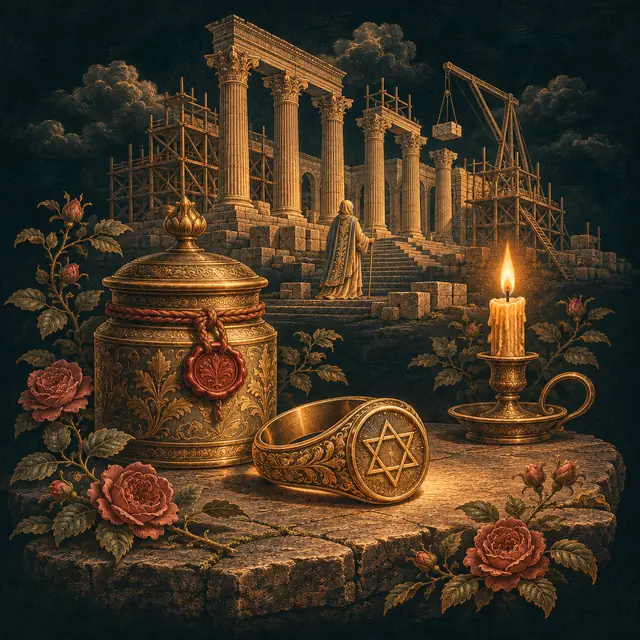
In the Bible Solomon is the king of Israel who builds the Temple at Jerusalem and is famed for wisdom; it says nothing of magic. The legend grows later. Josephus, about AD 94, says exorcists used his name. The Testament of Solomon, a Greek work of the first centuries AD, tells that the archangel Michael brought him a ring with a seal, by which he questioned the demons one by one and set them to work on the Temple. In the Qur’an God gives him command of the wind and of the jinn. The Thousand and One Nights has him seal rebel jinn in jars.
The teaching
Taught from the Books of Kings, the Wisdom of Solomon, Josephus, the Testament of Solomon, the Talmud and the Qur'an.
The wise king
The Books of Kings tell the reign the legends grow from. At Gibeon God appears to the young king in a dream and bids him ask what he will, and Solomon asks for neither long life nor riches but for “an understanding heart to judge thy people, that I may discern between good and bad”; God gives him that, and riches and honour besides. Two women come before him with one living child and one dead, each claiming the living; he calls for a sword to divide it, and knows the true mother by her cry to give the child to the other rather than see it killed.
His wisdom excels the wisdom of all the east: he speaks three thousand proverbs and a thousand and five songs, and he speaks of trees, from the cedar of Lebanon to the hyssop that springs out of the wall, and of beasts, birds, creeping things and fishes. He builds the Temple of stone made ready at the quarry, so that no hammer, axe or tool of iron is heard in the house while it is building, and the queen of Sheba comes to prove him with hard questions and leaves saying that the half had not been told her. But when he is old his many wives turn his heart after other gods, and God tells him that the kingdom will be torn from his son.
The knowledge of spirits and of roots
The Wisdom of Solomon, written in his voice, gives him a knowledge of all creation: how the world was made and the working of the elements, the turning of the sun and the change of the seasons, the courses of the stars, the natures of living things and the tempers of wild beasts, “the violence of winds”, words that can also be read the powers of spirits, “and the reasonings of men: the diversities of plants and the virtues of roots”.
Josephus says God taught him the art against demons for the healing of men, and that he composed incantations against sickness and left forms of exorcism by which demons are driven out never to return. Josephus saw it done himself: a Jew named Eleazar, before Vespasian and his officers, held to a possessed man's nose a ring with a root under its seal, of a kind Solomon had named, drew the demon out through the nostrils, and, speaking Solomon's name and his incantations, forbade it to come back; to show that it had gone, he bade it overturn a basin of water set nearby, and it did.
The ring and the demons who built the Temple
The Testament of Solomon, the king's own story of his power, begins in the building. A demon named Ornias torments a boy among the workmen, stealing half his wages and his food and sucking the thumb of his right hand, until Solomon prays and the archangel Michael brings him a ring with a seal engraved on its stone. With it he binds Ornias, then Beelzeboul the prince of the demons, and through them the rest, one by one, and makes each tell its name, its work, its star and the angel who thwarts it.
Then he sets them to labour: they cut and carry stone, spin hemp for the ropes and do the heavy work of the building, and when no one can lift the great cornerstone, a wind demon of Arabia, caught by a boy in a leather flask, raises it into its place. The demons of the book are taught one by one on the branch Demons in the old books.
The fall of the king
The Testament ends with his fall. He loves a woman of the Jebusites, and her people's priests will give her to him only if he sacrifices to their gods; he refuses, until they ask only that he crush five locusts in his hand in the name of Moloch. He does it, and the spirit of God departs from him, and he becomes a laughing stock to the idols and the demons he had ruled. He writes his testament, he says, so that those who read it may pray and look to the last things rather than the first, and find grace for ever.
Ashmedai and the shamir
The Talmud tells how the Temple could be built without iron. Moses had cut the stones of the high priest's breastplate with the shamir, a creature that splits stone, and only the demons could say where it was. So Solomon sent Benaiah with a chain and a ring engraved with the Name, and wool and wine, to the mountain well of Ashmedai, king of the demons, who went up each day to study in the academy of heaven; Benaiah drained the well, filled it with wine, and chained the demon king while he slept drunk. Ashmedai told where the shamir was kept, and the Temple rose.
But one day Solomon asked him what made demons greater than men, and Ashmedai answered that he would show him if Solomon took off the chain and lent him the ring. Solomon did. The demon flung him four hundred parasangs away and sat on his throne in his likeness, and the king went begging from door to door, saying, I, Koheleth, was king over Israel in Jerusalem, until the sages tested his word, gave him back a ring and a chain engraved with the Name, and the demon fled at the sight of him.
Sulayman in the Qur'an
In the Qur'an Sulayman is a prophet whom God has taught the speech of birds. The wind runs at his command, a month's journey in a morning and a month's in an evening, a spring of molten brass flows for him, and the jinn work before him by his Lord's leave, making places of prayer, statues, basins as large as cisterns and cauldrons fixed in place. Marching with his armies he hears an ant warn the others to go into their dwellings, lest Sulayman and his hosts crush them unknowing, and he smiles at her words and thanks God.
The hoopoe brings him news of a queen in Sheba whose people bow to the sun; he sends her a letter in the name of God, and one who has knowledge of the Book brings her throne to him in the blink of an eye. Seeing it, he says that this is of the bounty of his Lord, to try him whether he is grateful. He dies leaning on his staff, and the jinn go on labouring until a creature of the earth gnaws through the staff and he falls; then they see that if they had known the unseen they would not have stayed in their humbling toil.
The jinni in the jar
The tellers of the Thousand and One Nights remember his seal on the jars. A poor fisherman draws up in his net a jar of brass stopped with lead and stamped with the seal of Sulayman. He opens it, and a smoke rises to the sky and gathers into a towering ifrit, one of the rebel jinn the prophet had shut in the jar and cast into the sea. In the first hundred years of his prison, the ifrit says, he vowed to make his rescuer rich, in the next to open to him the treasures of the earth, then to grant him three wishes, and at last, in his rage, to kill whoever set him free. The fisherman makes him swear by the greatest Name, then says he cannot believe so vast a being ever fitted in so small a jar; the ifrit turns to smoke to show him, and the fisherman stops the jar again.
What the legend teaches
Every teller of the legend keeps one rule: the king's power over spirits is lent, not his own. In the Testament the demons obey the seal and the angels' names, not the man; in the Talmud the ring taken from his hand leaves him a beggar; in the Qur'an his command of wind and jinn is a gift and a trial of his gratitude, and the book says plainly that it was not Sulayman who disbelieved, but the devils, who taught people sorcery. The books of magic took up the first half of the lesson, setting the magician where Solomon stood, armed with God's names inside his circle, as the branch The grimoires teaches. The scriptures keep the second: wisdom is a gift asked for and given, and the heart that receives it can still turn.
Who took it up
The grimoires borrowed his name: the Key of Solomon, known from the fifteenth century, and the Lesser Key of the seventeenth, with its list of seventy-two spirits. Freemasonry builds its ritual on his Temple, and the six-pointed figure was long called the seal of Solomon.
What later tellings added or changed
That the king wrote any of these books. All were composed many centuries after his time and put under his name to lend them authority. The ring itself is a storyteller’s device, and no scripture describes it.
The texts that tell it
- Books of KingsScripture, first millennium BC
The books of the Hebrew Bible that tell Solomon’s reign: his prayer for wisdom, his judgement between two mothers, the building of the Temple, the visit of the queen of Sheba, and the foreign wives who turned his heart in age. They say nothing of magic. Every later legend grows from their praise of his wisdom.
Ask the Oracle about it - Wisdom of SolomonScripture, 1st century BC
A Greek book written in Solomon’s voice, probably at Alexandria, and counted in the Catholic and Orthodox Bibles. In it he says God taught him the order of the world, the natures of animals, the powers of spirits and the virtues of roots. It is the first text to give the king a knowledge of spirits.
It was written long after Solomon and put in his voice.
Ask the Oracle about it - Jewish AntiquitiesHistory, about AD 94
Josephus’s history of the Jews, which in its eighth book says Solomon composed healing spells and forms of exorcism, and tells of a Jew named Eleazar who drew a demon out of a man before the future emperor Vespasian, using a ring and a root and Solomon’s name. It shows the legend already in use among exorcists.
Ask the Oracle about it - Testament of SolomonLegend, about AD 100 to 400
A Greek book in which Solomon tells how the archangel Michael brought him a ring with a seal, by which he questioned the demons one by one, learned the angel who could thwart each, and set them to build the Temple. It ends with his fall through love of a foreign woman. It is the mother text of the magic of Solomon.
It is written in Solomon’s name centuries after him, and its date is argued.
Ask the Oracle about it - The Qur’anScripture, 7th century
In the Qur’an God gives Solomon, Sulayman, command of the wind and of the jinn, who labour for him, the speech of birds and ants, and a throne brought from Sheba in the blink of an eye. Islamic tales of his ring and his sealed jars of jinn, retold in the Thousand and One Nights, grow from these verses.
Ask the Oracle about it - The Key of SolomonGrimoire, 15th to 16th century
A book of magic in Latin and Italian manuscripts, later in many languages, with prayers, pentacles and rules for the tools and days of conjuring, all set in Solomon’s name. The Lesser Key of the seventeenth century, with its list of seventy two spirits, took up the same name. MacGregor Mathers put the Key into English in 1889, and his version of the Goetia, the first part of the Lesser Key, was published by Aleister Crowley in 1904; they remain the best known grimoires.
Neither has anything to do with the historical king; both were composed many centuries after him.
Ask the Oracle about it
How the house tells a life
This is a story, told with its sources and with what later tellings added or changed. What it means for you is yours to judge.
The arts it feeds
Lives near it in time
Stories of forbidden knowledge
King MidasIcarusNarcissusMithrasCupid and PsycheHermes TrismegistusLilithMerlinMorgan le FayThe Holy GrailOdinLokiThe whole tree

