
Icarus
Greek myth; best known from Ovid, about AD 8
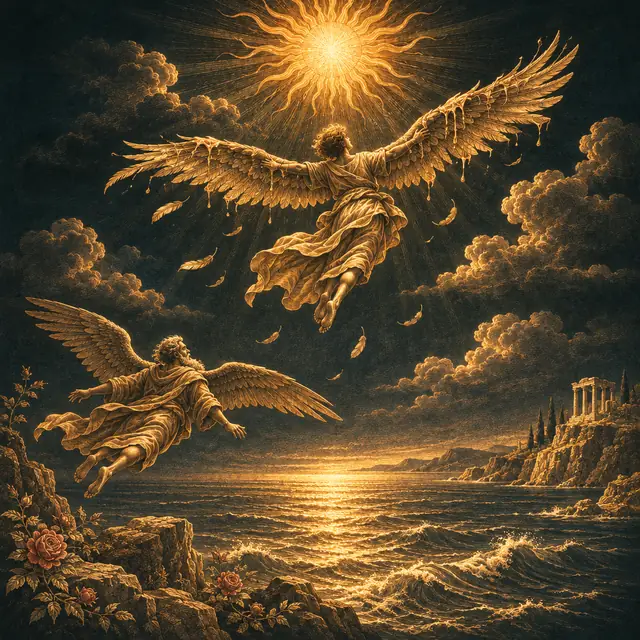
What is the story of Icarus, and what does it warn of?
The story and its sources
Son of the craftsman Daedalus, who built the Labyrinth of Crete. To escape the island Daedalus makes wings of feathers and wax, and warns his son to fly neither too low, where the sea will wet them, nor too high, where the sun will melt them. Icarus climbs, the wax softens, and he falls into the sea that takes his name. Ovid tells it in the Metamorphoses.
The teaching
Taught from Ovid's Metamorphoses and Art of Love, with Virgil and Pausanias, Bruegel's picture and Auden's poem.
The prisoner of Crete
Daedalus the craftsman, who built the Labyrinth, is kept on Crete by King Minos, sick of his long exile and longing for his own country, but shut in by the sea; Apollodorus says that Minos shut him and his son in the Labyrinth itself for showing Ariadne the way out. Minos may block the land and the waves, Daedalus says, but the sky at least is open, and that is the way we shall go: he may own everything, but he does not own the air. And he sets his mind to arts unknown, and changes the laws of nature.
The wings
He lays feathers in rows, beginning with the smallest, each a little longer than the one before, so that they seem to grow on a slope, as the old shepherd's pipe rises reed by reed; he binds them in the middle with thread and at the base with wax, and bends them gently into the curve of a bird's wing. The boy Icarus stands by, not knowing he is handling his own danger, laughing and catching at the feathers the breeze carries off, softening the yellow wax with his thumb, and getting in the way of his father's wonderful work. When it is done the craftsman balances himself on his wings and hangs in the beaten air.
The middle way
Then he teaches his son. Keep the middle course, Icarus, he tells him: too low, and the sea will weigh the feathers down; too high, and the sun will burn them; fly between the two. Do not look to the Herdsman or the Bear or the drawn sword of Orion, but follow where I lead. As he gives his counsel and fits the wings to the boy's shoulders, the old man's cheeks are wet and his hands tremble. He gives his son kisses that will never be given again, rises on his wings and flies ahead, afraid for the one behind, like a bird that leads its young from the high nest into the air, urging him to follow, teaching him the fatal art, beating his own wings and looking back at his son's. A fisherman with his quivering rod, a shepherd leaning on his crook and a ploughman on the handle of his plough look up and stand amazed, and take them for gods who can travel the sky.
The fall
Juno's Samos is on their left, Delos and Paros already behind them, Lebinthos and Calymne, rich in honey, on their right, when the boy begins to delight in his bold flight, leaves his guide and, drawn by longing for the sky, climbs higher. The nearness of the scorching sun softens the scented wax that binds the feathers; the wax melts, and he beats his bare arms, but without feathers they catch no air, and calling his father's name he is swallowed by the dark blue sea, which takes its name from him. The unhappy father, a father no longer, cries Icarus, Icarus, where are you, where shall I look for you, sees the feathers on the waves, curses his own arts, and buries the body in a tomb, and the land is called after the one buried there.
The partridge
As Daedalus lays his son in the tomb, a partridge watches from a muddy ditch and claps its wings and sings for joy, and Ovid tells why. Daedalus' sister had given him her son to teach, a boy of twelve with a quick mind, who took the backbone of a fish for his pattern, cut teeth in a strip of iron and invented the saw, and was the first to join two iron arms at a point so that one stands still while the other draws the circle. Daedalus, jealous, threw him headlong from Athena's citadel and said he had fallen; but the goddess caught him and made him a bird, the partridge, which keeps his old name and his quickness, and flies low and builds its nest in hedges, for it remembers its fall and fears high places.
Other tellings
Ovid had told the flight before, in the Art of Love, as a lover's jest: if Minos could not hold a man with wings, how can a lover hope to hold the winged boy Cupid? Virgil has Daedalus carve the whole Cretan story on the doors of Apollo's temple at Cumae, but twice he tried to shape his son's fall in gold, and twice his father's hands fell. Pausanias heard a plainer telling: Daedalus fled Crete in small boats he had built, inventing sails to outrun the oars of the king's ships, and Icarus, a clumsy helmsman, capsized and drowned; his body washed up on an island off Samos, where Heracles found and buried it, and the island and the sea took his name.
What the story warns of
The father's counsel is the old Greek rule of the mean, nothing in excess, and it has two halves. Francis Bacon, reading the myth in The Wisdom of the Ancients, made it the middle way in conduct, and added that if one must fail one way or the other, excess at least has something of greatness in it and a kinship with the sky, like a bird, while defect crawls on the ground like a creeping thing. Ovid lays a share of the blame on the maker himself, who teaches a fatal art and whose old crime the partridge remembers. And the painting in Brussels of the ploughman, the shepherd and the ship going about their business while a boy's legs vanish into the sea gave Auden his poem on the old masters: suffering takes place to one side, while others work or sail past, and the world that may have heard the cry goes on about its business.
Who took it up
No order claimed him; painters and poets did, from Bruegel to Auden.
What later tellings added or changed
That the story warns only against flying high. The father’s warning has two halves: too low is as fatal as too high.
The texts that tell it
- Metamorphoses, Book EightPoem, about AD 8
Ovid tells how Daedalus, kept on Crete by Minos, binds feathers with thread and wax, warns his son to keep the middle way between sea and sun, and kisses him before they fly. A fisherman, a shepherd and a ploughman look up and take them for gods. Icarus soars, the wax melts, and he falls calling his father’s name.
Ask the Oracle about it - The Art of Love, Book TwoPoem, about 2 BC
Ovid had told the story before, at length, as a playful example in his handbook of seduction: if Minos could not hold a man with wings, how can a lover hope to hold Cupid? The father’s speech and the fall are told much as he would tell them again in the Metamorphoses.
Ask the Oracle about it - Landscape with the Fall of IcarusPainting, about 1560
A painting in Brussels in which a ploughman, a shepherd and a fisherman go on with their work and a ship sails on, while in a corner of the sea two small legs show where Icarus has fallen. It is the best known picture of the myth and the subject of famous poems.
Long given to Pieter Bruegel the Elder, it is now mostly thought to be an early copy of a lost painting of his.
Ask the Oracle about it - Musée des Beaux ArtsPoem, written 1938
W. H. Auden wrote the poem after seeing the Bruegel picture in Brussels. It speaks of how the old masters understood suffering, that it takes place while others are eating or walking dully along, and how in the painting everything turns away from the disaster. It is among the most quoted poems of the century.
Ask the Oracle about it
How the house tells a life
This is a story, told with its sources and with what later tellings added or changed. What it means for you is yours to judge.
The arts it feeds
Lives near it in time
Stories of forbidden knowledge
CassandraThe PhoenixDionysusOrpheusEnochKing MidasNarcissusMithrasCupid and PsycheHermes TrismegistusSolomon and the demonsLilithThe whole tree

