
The Phoenix
Greek and Roman legend; first described by Herodotus, about 430 BC
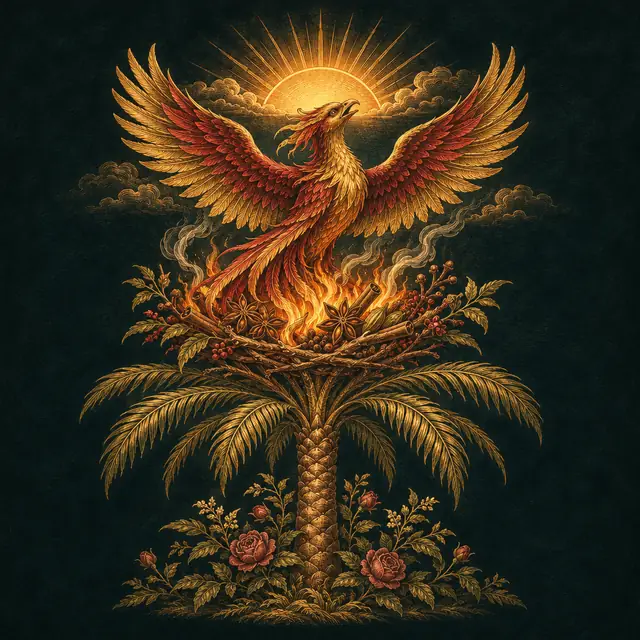
What is the story of the phoenix, and what has it been taken to mean?
The story and its sources
A bird of which there is only ever one. Herodotus, about 430 BC, says he saw only pictures of it in Egypt: red and gold, the size of an eagle, coming once in five hundred years to bury its father in myrrh at the temple of the Sun. He does not believe all of it, and there is no fire in his account. The burning nest and the rebirth from the ashes come from Roman writers some five centuries later. The Egyptian bennu, a heron linked with the Sun and with Osiris, probably stands behind the Greek bird.
The teaching
Taught from Herodotus, Ovid and Pliny, the letter of Clement, the Latin poem On the Phoenix Bird and the Old English Phoenix.
The bird of Heliopolis
Herodotus heard of it from the people of Heliopolis in Egypt and saw it only in paintings: in shape and size like an eagle, its plumage partly gold and partly red. It comes, they told him, once in five hundred years, when its father dies. It shapes an egg of myrrh as large as it can carry, tries its weight, hollows it out, lays its father inside and seals the opening with more myrrh, so that the egg weighs the same as before, and carries it from Arabia to the temple of the Sun and buries it there. He tells the tale and says he does not believe it. The bird behind the tale is most likely the Egyptian bennu, a heron, the soul of the Sun, which the dead in the Book of the Dead claim to be: the great bennu of Heliopolis, keeper of the reckoning of all that exists.
The nest of spices
In Ovid, Pythagoras, teaching that all things change, names one bird that renews itself: the Assyrians call it the phoenix, and it lives not on grain or grass but on drops of frankincense and the juice of spices. When it has lived five hundred years it builds a nest in the top of a swaying palm with its claws and beak, lines it with cassia, spikenard, cinnamon and yellow myrrh, and ends its life there among the scents. From the father's body a little phoenix is born, to live as many years, and when it is strong it lifts the nest, its own cradle and its father's tomb, carries it through the air to the city of the Sun, and lays it before the doors of his temple.
The great year
Pliny gathers what a Roman senator, Manilius, wrote of it: it is the size of an eagle, with a gleam of gold about the neck and the rest purple, a blue tail marked with rose-coloured feathers, and a crest on its head; no one has ever seen it eat; it lives five hundred and forty years, and from its bones and marrow a small worm is born that grows into the young bird, whose first act is to carry the nest to the city of the Sun. Manilius tied its life to the great year, at whose end the seasons and the stars come back to their first places. Tacitus, recording that a phoenix was seen in Egypt under Tiberius, says that some gave it fourteen hundred and sixty-one years, and that the young bird carries its father's body to the altar of the Sun and burns it there.
Fire and ashes
The Latin poem On the Phoenix Bird, given to Lactantius, tells it whole with the fire. Far in the east, where the great gate of the eternal sky stands open, lies the grove of the Sun on a high plain, out of reach of sickness, old age, death, fear, crime and greed, where no storm comes and a living spring floods the grove month by month. The phoenix is its one dweller and the Sun's attendant. At dawn it bathes in the spring, flies to the top of the tallest tree and greets the rising Sun with a song sweeter than the nightingale's or any lyre.
When a thousand years have passed it flies to Syria, to the land of Phoenicia that bears its name, builds its nest of spices in a high palm and sings itself to death, and the Sun's rays kindle the nest so that the bird burns. From the ashes comes a thing like a seed, then a creature like a worm, then the bird again; it gathers what is left of its old body into a ball of myrrh, carries it to the city of the Sun and lays it on the altar, while all the birds gather to escort it. It is its own offspring, the poem says, its own father and its own heir, its own nurse and its own nursling; female or male or neither, it is happy, for it keeps no bond of love, and death is its only desire.
The sign of rising
The Christians read the bird as a promise. The letter of Clement of Rome to the Corinthians, to show that God will raise the dead, tells of the bird of Arabia that, when its time to die draws near, makes itself a tomb of frankincense and myrrh and other spices, enters it and dies; as the flesh decays a worm is born that grows wings, takes up the tomb with its parent's bones, carries it to Heliopolis, lays it on the altar of the Sun in open day and flies home, and the priests find in their records that five hundred years have passed. If the Maker shows by a bird the greatness of his power to keep his promise, the letter asks, is it so great a thing that he should raise those who have served him?
The Physiologus, the early Christian book of beasts, made the phoenix a figure of Christ, who had power to lay down his life and to take it again, and so it came into the bestiaries. The Old English Phoenix of the Exeter Book follows the Latin poem and then reads the bird as the faithful soul and as Christ, the grove as the paradise Adam lost, and the fire as the burning of the Last Judgement, from which the blessed rise.
The rabbis' phoenix
The rabbis knew the bird by the name chol, from Job's hope to multiply his days as the chol, which the King James Bible renders as the sand. When Eve gave the fruit to every creature, the midrash says, this bird alone refused, and so it was given life: it lives a thousand years, and then fire comes out of its nest and burns it, and as much as an egg is left, from which it grows again. The Talmud adds that in the ark Noah found it lying quiet in the hold, and when he asked why it had not asked to be fed, it answered that it had seen how busy he was and would not trouble him, and Noah blessed it that it should never die.
What the tellers read in it
Egypt saw in the bennu the soul of the Sun rising over the first waters, the beginning made new. Rome saw the great year and the age renewed, and its emperors set the bird on their coins with words of a golden age or of happy times restored. The Church saw the rising of the dead and of Christ. The alchemists drew it at the end of the Work, when the matter reddens and is fixed, the bird reborn from its own fire beside the red king and the rose; that stage is taught under Alchemy, in The four stages. And cities that burned and rose again, Atlanta and San Francisco among them, took it for their seal. Each telling keeps the same strange rule: the bird is its own heir, and its death is the only way it has to be born.
Who took it up
Early Christians took it as a sign of resurrection: the letter of Clement, about AD 96, uses it so. Alchemists drew it for the last, red stage of the work, and it has stood since for cities and societies that rebuilt after a fire.
What later tellings added or changed
That the tale is Egyptian in the form we know. The Egyptian bennu does not burn. Every detail that is now most familiar is Roman or later, and the ancient writers who passed it on mostly said they had it by hearsay.
The texts that tell it
- Histories, Book TwoHistory, about 430 BC
Herodotus, writing of the sacred animals of Egypt, says he saw the phoenix only in paintings: in plumage partly gold and partly red, like an eagle in shape and size. The priests of Heliopolis told him it came once in five hundred years, carrying its father in an egg of myrrh to bury in the temple of the Sun. He says he does not believe it.
Ask the Oracle about it - Natural History, Book TenBook, about AD 77
Pliny the Elder gathers what earlier writers said of the bird, from a senator named Manilius, and its long life tied to the great year of the heavens. He reports that one was brought to Rome under Claudius and shown in the Forum, and adds that nobody doubted it was a fake.
Ask the Oracle about it - The First Letter of ClementLetters, about AD 96
A letter from the church of Rome to the church of Corinth, by tradition written by its bishop Clement. To show that God will raise the dead, it tells of the phoenix that dies and from whose flesh a worm is born that grows wings. It is the first Christian use of the bird as a sign of resurrection.
Ask the Oracle about it - On the Phoenix BirdPoem, about AD 300
A Latin poem in some 170 lines on the phoenix in its paradise in the east, its nest of spices, its burning and its rising again from the ashes. It joins the Roman tale of fire to the Christian hope of rebirth and was much copied in the Middle Ages.
It is attributed to Lactantius, and the attribution is usual but not certain.
Ask the Oracle about it - The PhoenixPoem, copied about 970
An Old English poem in the Exeter Book that retells the Latin poem on the phoenix and then reads the bird as a figure of Christ and of the faithful raised at the Last Judgement. It is one of the finest pieces of Anglo Saxon religious verse.
Ask the Oracle about it
How the house tells a life
This is a story, told with its sources and with what later tellings added or changed. What it means for you is yours to judge.
The arts it feeds
Lives near it in time
Stories of forbidden knowledge
PrometheusPandoraPersephoneThe SibylTheseus and the MinotaurCassandraDionysusOrpheusEnochKing MidasIcarusNarcissusThe whole tree

