
Cassandra
Greek myth; her curse is told by Aeschylus, 458 BC
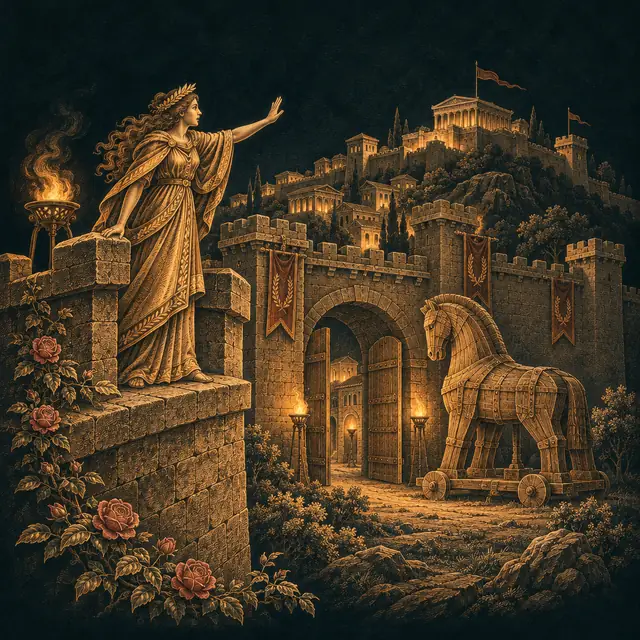
What is the story of Cassandra, and what has it been taken to mean?
The story and its sources
A daughter of Priam, king of Troy. Homer calls her the fairest of his daughters and tells of her death, but says nothing of prophecy. The story of her gift comes from Aeschylus, whose Agamemnon was staged in 458 BC: Apollo gave her true sight of what is to come, she refused him, and he turned the gift so that nobody would believe her. She foresees the fall of Troy and warns in vain against the wooden horse. Carried to Argos as a captive, she sees her own death and that of Agamemnon before she walks into the house.
The teaching
Taught from Aeschylus' Agamemnon, with Homer, Euripides' Trojan Women and the Alexandra.
The fairest of Priam's daughters
In Homer she is a princess of Troy, the fairest of Priam's daughters, like golden Aphrodite. A young man, Othryoneus, comes to the city to win her, asking no bride price but promising to drive the Greeks from Troy, and falls in battle to Idomeneus, who mocks him for the bride he will not have. In the last book of the Iliad it is she who first sees from the citadel her father bringing home the body of Hector, and she wakes the city with her cry: come, men and women of Troy, and look on Hector, if ever you rejoiced when he came home alive from the fighting. And in the Odyssey the shade of Agamemnon remembers her cry as Clytemnestra killed her over his body.
Apollo's gift
The story of her gift Cassandra tells herself in Aeschylus. Apollo loved her and gave her the art of prophecy, and she promised herself to him and broke the promise; since then, she says, she has persuaded no one of anything. Later writers explain that a god's gift could not be taken back, so Apollo left her the sight and took away belief: she sees truly, and nobody believes her. Another late tale says that as children she and her twin brother Helenus were left one night in Apollo's temple, and snakes licked their ears, so that they heard what was to come.
The horse
So she warns Troy and is not heard. When Paris sets sail for Sparta she foretells what will come of it; when the wooden horse stands inside the walls she cries that it is full of armed men, and Virgil says that her lips were opened then for the fates to come, lips that by the god's command the Trojans never believed. In the late epic of Quintus of Smyrna she runs at the horse with a blazing pine torch and a double axe, and the Trojans drive her off and go back to their feasting. On the night of the sack she clings to the image of Athena, and Ajax, son of Oileus, drags her from it by force, pulling the image down with her; the goddess's anger at that outrage wrecks the Greek fleet on its way home.
At the door of Agamemnon
Aeschylus gives her the scene by which she is remembered. She comes to Argos in Agamemnon's chariot, his captive and his prize, and when Clytemnestra bids her come into the house she sits silent, as though she knew no Greek. Then, alone with the old men of the chorus, she breaks into cries to Apollo, her destroyer, and begins to see. This house hates the gods, she cries; it is a slaughterhouse of men, its floor wet with blood; she hears children wailing over their own slaughter and the roasted flesh their father ate. Then she sees what is being made ready inside: a bath, a net, a robe in which a man is caught, the cow striking the bull with her black horn; and her own death under the blade, a harder fate than the nightingale's, to whom the gods at least gave wings. The old men understand the old crimes and cannot take in the new, though she tells them plainly that they shall see Agamemnon dead.
She foresees too the son who shall come back to avenge his father, and then, seeing that her gift has brought her only mockery and death, she breaks her prophet's staff and tears off her sacred bands and tramples them, for it is Apollo himself, she says, who is stripping her of his robes. At the door she recoils at the smell of blood, and the old men tell her it is only the smell of the sacrifice. Her last words are for all mortals: in good fortune a shadow can overturn them, and in bad a wet sponge wipes the picture out, and this she pities more than her own end. She goes in, and the cries of the king are heard from within.
The torch at Troy
Euripides shows her after the fall. The women of Troy are being shared out as slaves, and Cassandra, given to Agamemnon, comes out of the tent dancing with a torch and singing her own wedding song, while her mother Hecuba weeps. Then, standing for a moment outside her frenzy, she argues that Troy is happier than its conquerors: the Greeks died far from home for one woman and lie unburied by their own, while the Trojans died for their country and were buried by their families. She foretells Odysseus' ten years of wandering and her own death and her master's, and goes to the ships saying that she shall come to the dead as a victor, having destroyed the house of Atreus.
The Alexandra and Christa Wolf
The poem called Alexandra, after her other name, is her whole prophecy as the guard set over her reports it to Priam: the fall of Troy, the sufferings of every Greek captain on his way home, the descendants of Aeneas who shall found in Italy a power ruling land and sea, and the long war of Europe and Asia, all in words so dark and riddling that few readers can follow them. In 1983 Christa Wolf gave her a voice of her own on the day of her death at Mycenae, thinking back on a Troy whose leaders made war for a Helen who, in this telling, was never in the city at all, and refusing to flee with Aeneas because she will not love a man who must become a hero.
What the tellers read in her
Aeschylus sets her between two kinds of knowing. His old men sing that Zeus has made it a law that we learn by suffering, and they hear Cassandra tell them the truth and cannot learn it until the cries come from the house: knowledge given before its hour is not received. Euripides makes her the clearest mind in a ruined city, speaking sense in the dress of madness. And her name passed into speech for one who warns and is not heard, a seer whose sight is perfect and whose word is useless, because a truth that no one will believe changes nothing.
Who took it up
No order was hers. Her name passed into speech for one who warns and is not heard, and psychology has borrowed it: Gaston Bachelard spoke of a “Cassandra complex” in 1949.
What later tellings added or changed
That she was mad. In Aeschylus she is exact, and the people around her cannot take in what she says. The tale is about not being believed, and it claims no power to change what is seen.
The texts that tell it
- AgamemnonPlay, 458 BC
In the first play of Aeschylus’ Oresteia Cassandra arrives at Argos as Agamemnon’s captive. Long silent, she breaks into prophecy: the old crimes of the house, the murder that waits inside for the king and for herself. The chorus cannot take in what she says, and she walks into the palace knowing her death.
Ask the Oracle about it - The IliadEpic, about 750 BC
Homer calls her the fairest of Priam’s daughters and tells of a suitor who came to Troy to win her and was killed. In the last book she is the first to see her father bringing home the body of Hector, and wakes the city with her cry. Of prophecy he says nothing.
Ask the Oracle about it - The Trojan WomenPlay, 415 BC
Euripides shows the women of Troy after its fall, waiting to be shared out as slaves. Cassandra, given to Agamemnon, comes on dancing with a torch and sings a wild wedding song, then foretells the wanderings of Odysseus and the death that she will bring on the house of her new master.
Ask the Oracle about it - AlexandraPoem, Hellenistic age
A long Greek poem in which a guard reports to Priam the prophecy of Cassandra, here called Alexandra, about the fall of Troy and the troubles of both Greeks and Trojans after it. It is written in a deliberately dark and difficult style, full of rare words and riddles.
It is handed down under the name of Lycophron, and its author and date, 3rd or early 2nd century BC, are disputed.
Ask the Oracle about it - CassandraNovel, 1983
Christa Wolf, writing in East Germany, gave Cassandra a voice of her own on the last day of her life, before the gate of Mycenae, thinking back on Troy and its war. It reads the old story as one of a woman not listened to and a city destroyed by its own leaders, and was published with lectures on how she came to write it.
Ask the Oracle about it
How the house tells a life
This is a story, told with its sources and with what later tellings added or changed. What it means for you is yours to judge.
The arts it feeds
Lives near it in time
Stories of forbidden knowledge
TiresiasPrometheusPandoraPersephoneThe SibylTheseus and the MinotaurThe PhoenixDionysusOrpheusEnochKing MidasIcarusThe whole tree

