
Enoch
Hebrew scripture; the Book of Enoch dates from about 300 BC to the first century AD
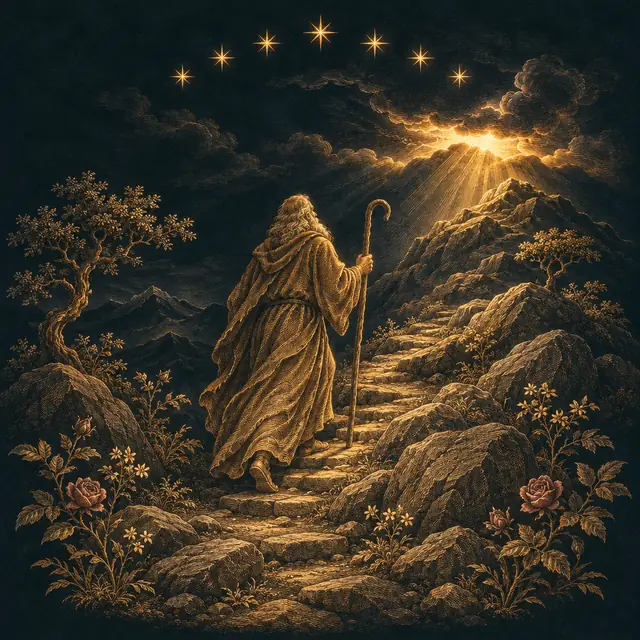
What is the story of Enoch, and what does the Book of Enoch tell?
The story and its sources
In Genesis Enoch is the seventh from Adam, father of Methuselah, who “walked with God” and was taken by him at the age of 365; the book says no more. Between about 300 BC and the first century AD Jewish writers composed the books gathered as 1 Enoch, in which he is shown the heavens, the calendar of the Sun and the fall of the angels called Watchers. Fragments in Aramaic were found among the Dead Sea Scrolls, and the letter of Jude quotes it. Only the Ethiopian and Eritrean Orthodox churches keep the book in their Bible; James Bruce brought copies to Europe in 1773.
The teaching
Taught from Genesis, the books of 1 Enoch, 2 Enoch and 3 Enoch, and the letter of Jude.
He walked with God
Genesis gives him a few lines in the list of the generations from Adam to Noah, and they are unlike any other lines in it. Enoch is the seventh from Adam, the son of Jared and the father of Methuselah, and where every other man in the list lives and dies, of him it says, in the King James words: “And Enoch walked with God: and he was not; for God took him.” His years number three hundred and sixty-five, the days of a year of the sun. The letter to the Hebrews reads the lines as faith rewarded, for he pleased God and was carried away without seeing death, and Ben Sira calls him an example of repentance to every generation.
The scribe of righteousness
The first part of 1 Enoch, the Book of the Watchers, tells why the world needed the flood. In the days of Jared two hundred angels, the Watchers, came down on Mount Hermon, took human wives and taught forbidden arts, and their sons the giants devoured the earth; the angels and what they taught are set out under Forbidden knowledge, in What they share. Enoch's own part begins after. He is the scribe of righteousness, already hidden among the holy ones, and he is sent to tell the Watchers their sentence. They beg him to write a petition for their forgiveness, and he reads it by the waters of Dan, near Hermon, until he falls asleep, and in a vision he is carried up to heaven to hear the answer.
The house of fire
Clouds and mist summon him, the courses of the stars and the lightnings hurry him, and the winds lift him up. He comes to a wall of crystal ringed with tongues of fire, and within it a great house of crystal, its ceiling like the paths of the stars and the lightning, with fiery cherubim, hot as fire and cold as ice. Beyond it stands a second house, greater, built of flames, and in it a lofty throne like crystal, with wheels like the shining sun and streams of flaming fire pouring from beneath it. On it sits the Great Glory, whose robe is brighter than the sun and whiter than any snow; none of the angels may come near or look on his face, and ten thousand times ten thousand stand before him. The Lord calls Enoch near and gives him the answer: go, tell the Watchers that they should have pleaded for men, and not men for them; they left the high and holy heaven for the earth, and they shall have no peace.
The journeys
Then the angels lead him to the ends of the earth. He sees the storehouses of the winds and the cornerstone of the earth, the seven mountains of precious stones, and beyond the end of the earth a waste with no sky above it and no ground beneath, where seven stars burn in bonds, punished for not rising at their appointed times. In the west he is shown a high mountain with hollow places where the spirits of the dead are kept until the day of judgement, the righteous apart, beside a bright spring of water, and the sinners apart. He sees the tree of life, whose fragrance passes every other and whose fruit shall be given to the righteous after the judgement, and in the garden of righteousness the tree of wisdom, from which the first man and his wife ate and learned, and were driven out.
The book of the lights
The Astronomical Book is the teaching of the angel Uriel, who shows Enoch the law of every light in heaven. The sun rises through six gates in the east and sets through six in the west, moving from gate to gate through the year, and the year has three hundred and sixty-four days exactly, fifty-two weeks, with a day added at the head of each of the four seasons. The moon waxes and wanes by fourteenths of its light, the winds come out of twelve gates, and the stars keep their stations under their leaders. Those who leave out the four added days reckon the year wrongly, Uriel warns, and in the days of the sinners the years shall be shortened, the moon shall change its order and the stars go astray. Enoch writes it all down for his son Methuselah, to hand on to the generations of the world.
The Son of Man and the dreams
In the Parables Enoch sees the Head of Days, whose head is white like wool, and with him one whose face is like a man's and full of grace, the Son of Man, the Chosen One, whose name was named before the sun and the stars were made, and who shall sit on the throne of glory and judge the kings and the mighty of the earth. At the end of the Parables Enoch himself is raised to heaven and told, as the Ethiopic text has it, that he is that Son of Man, born to righteousness.
The Dream Visions tell all history as a dream of beasts: Adam a white bull, the fallen Watchers stars that drop among the cattle, Israel a flock of sheep handed to seventy shepherds who destroy more than they were told, until a great horn grows on a ram, a white bull is born at the end, and all the beasts become white bulls. The Epistle closes the book with woes on the rich and the violent, the hope of the righteous, and the strange birth of Noah, whose body is white as snow and whose eyes light up the house like the sun, so that Methuselah goes to the ends of the earth to ask Enoch what it means.
The seven heavens
The Slavonic book called 2 Enoch takes him through seven heavens. Two men taller than any on earth, with faces shining like the sun and wings brighter than gold, come to his bed and carry him up. In the first heaven he sees the angels who rule the stars and the storehouses of snow and dew; in the second, fallen angels kept weeping in darkness; in the third, paradise with the tree of life, and to the north a place of terror for the wicked; in the fourth, the courses of the sun and moon, and the flying creatures that go with the sun's chariot, the phoenixes and chalkydri; in the fifth, the Watchers' brothers, silent with grief, whom he urges to take up their worship again; in the sixth, the archangels who keep the order of the world; and in the seventh, the Lord on his throne. There he is anointed and clothed in glory and becomes like one of the glorious ones. He writes three hundred and sixty-six books at an angel's dictation, hears from the Lord himself how the world was made out of nothing, and is sent back for thirty days to teach his sons before he is taken for ever.
Metatron
The Hebrew book called 3 Enoch tells the end of his story. Rabbi Ishmael, rising through the palaces of heaven, is met by the angel Metatron, Prince of the Presence, who tells him that he was once Enoch, son of Jared. When the generation of the flood sinned, God took him up to be a witness against them, and changed him: his flesh became flame, his sinews fire, his bones coals of juniper, his eyelashes lightning and his eyes torches. He was made as great as the world in length and breadth, given seventy-two wings and a throne like the throne of glory, crowned, and called the lesser YHWH, for, the Lord says, my name is in him. When the sage Elisha ben Abuyah saw him enthroned and cried that there must be two powers in heaven, Metatron was made to stand and was struck with sixty lashes of fire.
What the tellers read in him
His tellers read in him the righteous man taken alive into heaven, and so the first mortal to see what others see only after death. To the authors of 1 Enoch he is the witness who answers where evil came from, not from Adam alone but from the Watchers' descent and their broken knowledge, and who shows that heaven keeps its order, its calendar and its judgement while the earth is in disorder. The letter of Jude quotes him by name, in the King James words: “Behold, the Lord cometh with ten thousands of his saints, to execute judgment upon all.” For the mystics of the heavenly palaces he is the pattern of a man made into an angel, and Muslim tradition knows him as Idris, the truthful prophet whom God raised to a high place, the first to write with the pen.
Who took it up
Later Jewish mystical books, 3 Enoch among them, tell that he was changed into the angel Metatron. The angelic speech John Dee and Edward Kelley recorded in the 1580s was later named “Enochian”, because Dee held that Enoch was the last to speak it; it has nothing to do with the old book, which Europe did not then possess.
What later tellings added or changed
That the Church hid the book. It dropped out of use in most churches by the fourth century and was simply lost in Greek and Latin. That it records visitors from the stars is a modern reading; the text speaks of angels.
The texts that tell it
- 1 EnochScripture, about 300 BC to 1st century AD
Five books gathered under Enoch’s name: the Book of the Watchers, on the fall of the angels who came down to women and taught forbidden arts; the Parables; the Astronomical Book, on the courses of Sun and Moon; the Dream Visions; and the Epistle. It survives whole only in Ge’ez, the old language of Ethiopia, where it is still read as scripture.
Written in Enoch’s name by Jewish authors centuries after the figure of Genesis.
Ask the Oracle about it - Genesis, Chapter FiveScripture, about 6th century BC
The list of generations from Adam to Noah gives Enoch, the seventh, a life of 365 years and says that he walked with God and then was no more, because God took him. These few lines, unlike any said of the others in the list, are the seed of everything later written about him.
The date of the passage is uncertain; many scholars put the final shaping of Genesis in the 6th or 5th century BC.
Ask the Oracle about it - The Aramaic Enoch fragments of QumranManuscript, 2nd century BC onward
Pieces of eleven or more copies of the Enoch books in Aramaic, found from 1952 in the caves near the Dead Sea and published by Józef Milik in 1976. They proved that the books were older than had been thought, and widely read among the Jews of that age.
Ask the Oracle about it - The Letter of JudeLetters, late 1st century AD
A short letter in the New Testament warning against false teachers. It quotes a prophecy from 1 Enoch by name, as the words of Enoch the seventh from Adam. It is the reason Christians long argued over whether the Enoch book belonged in the Bible.
Ask the Oracle about it - 2 EnochScripture, disputed
A book surviving only in Old Church Slavonic, sometimes called the Secrets of Enoch, in which he is carried up through seven heavens, sees the angels and the places of reward and punishment, and returns to teach his sons before he is taken for ever.
Its date is much disputed, from the 1st century AD to the Middle Ages, and its original language is unknown.
Ask the Oracle about it - 3 EnochScripture, about 5th to 6th century AD
A Hebrew book of the heavenly palaces in which Rabbi Ishmael rises to heaven and meets the angel Metatron, who tells him he was once Enoch son of Jared, taken up and turned to flame. It belongs to the Jewish mystical writing of the palaces and the chariot.
The date is disputed, and the book was attributed to Rabbi Ishmael, not written by him.
Ask the Oracle about it
How the house tells a life
This is a story, told with its sources and with what later tellings added or changed. What it means for you is yours to judge.
The arts it feeds
Lives near it in time
Stories of forbidden knowledge
The SibylTheseus and the MinotaurCassandraThe PhoenixDionysusOrpheusKing MidasIcarusNarcissusMithrasCupid and PsycheHermes TrismegistusThe whole tree

