
Dionysus
Greek myth; the Bacchae of Euripides, 405 BC
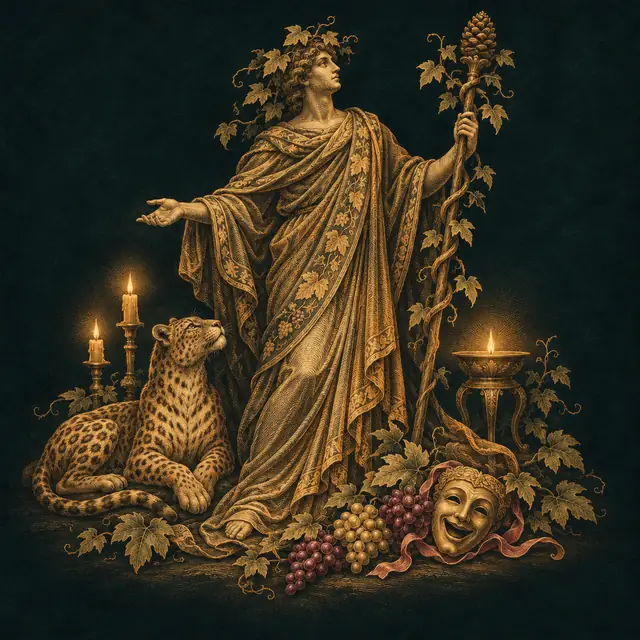
What is the story of Dionysus, and what has it been taken to mean?
The story and its sources
The Greek god of wine, ecstasy and the theatre, son of Zeus and the mortal Semele; the Romans called him Bacchus. His name is already on clay tablets from Pylos of about 1250 BC, so he was no late arrival. In the Bacchae of Euripides, staged in 405 BC, he comes to Thebes in disguise; King Pentheus refuses to honour him, spies on the women in the hills and is torn apart by his own mother. Athens held its drama festivals in his honour, and tragedy and comedy were both performed for him.
The teaching
Taught from the Bacchae of Euripides, the Homeric Hymn, Livy on the Bacchanalia and Nietzsche.
The twice born
Dionysus is the son of Zeus and Semele, daughter of Cadmus, king of Thebes. Hera, jealous, comes to Semele in the likeness of her old nurse and sows a doubt: let her lover prove that he is Zeus by coming to her as he comes to Hera. Zeus has sworn to give Semele whatever she asks, and so he comes in his lightning, and she is burned to death. He takes the unborn child from her and sews him into his own thigh, and in due time the child is born a second time, from his father. Nymphs rear him far from Hera's anger, and when he is grown he goes through Asia teaching his rites, Lydia and Phrygia, Persia, Bactria and Arabia, before he comes back to the city of his mother.
The god comes to Thebes
Euripides' Bacchae begins with the god himself, in the likeness of a young Lydian priest of his own rites, at his mother's tomb, which still smokes with the lightning. Semele's sisters said that she lied about Zeus and was struck down for the lie; so he has driven them mad and sent them with all the women of Thebes to the mountain, Cithaeron, in fawnskins with the thyrsus, the fennel wand tipped with ivy. His chorus of Asian women sing the blessing of his worship: happy the one who knows the rites of the gods, keeps his life holy and gives his soul to the dancing company on the mountains. The young king Pentheus, the god's own cousin, comes home furious: the women have left their looms for wine and lust in the name of a new god, and a stranger with scented golden hair has bewitched them, whose head he means to have.
The old men and the stranger
Old Cadmus and the seer Tiresias go out in fawnskins to dance for the god, and Tiresias tries to teach the king. Mankind has two great goods: Demeter, who gives the dry grain that feeds us, and Dionysus, who gives the wet drink of the grape, which ends the grief of suffering mortals and gives them sleep and forgetting of the day's troubles, and there is no other remedy for toil. Nor will the god force a woman to be chaste or unchaste; that lies in her own nature. Pentheus will not listen. His men bring in the stranger, who comes smiling and unresisting, and Pentheus cuts his curls, takes his wand and chains him in the stables; but an earthquake shakes the palace, fire leaps from Semele's tomb, and the stranger walks out free while the king struggles in the dark with a bull, thinking it his prisoner.
The women on the mountain
A herdsman comes down from Cithaeron with what he saw. The women lay asleep in the glades, modestly, not drunk as the king says; at dawn they rose, let down their hair, fastened their fawnskins with snakes that licked their cheeks, and gave the breast to fawns and wolf cubs. One struck a rock with her wand and water sprang out; another struck the ground and the god sent up a spring of wine; those who wanted milk scratched the earth with their fingertips, and honey dripped from the wands. But when the herdsmen tried to seize Agave, the king's mother, the women fell on the cattle and tore them apart with their bare hands, swept down on the villages, snatched children from the houses and carried fire in their hair unburned, and the men's spears drew no blood while the women's wands wounded. Accept this god, the herdsman begs, whoever he is: he gave us the vine that ends grief, and without wine there is no love, nor any other joy.
The death of Pentheus
Then the stranger asks the king whether he would like to see the women for himself, and the god's madness takes hold of him. To go among them unseen he lets himself be dressed as a woman, in a long robe and a headdress of curls, with a wand and a fawnskin; coming out, he sees two suns and two cities of Thebes, and the stranger walking before him as a bull. On the mountain the stranger bends a tall fir down to the ground, sets the king on its top, lets it rise and vanishes, and a voice cries from the sky to the women that here is the man who mocks them and the god. They tear the fir from the earth, and his mother is the first to fall on him. He pulls off his headdress so that she may know him, touches her cheek and begs her not to kill her son for his faults; but she, foaming, her eyes rolling, takes him for a lion's whelp, sets her foot against his ribs and tears away his arm, and the others tear the rest. She carries his head home on her wand, rejoicing in her kill, until her father Cadmus slowly brings her back to herself and she sees whose head she holds.
The god revealed
Dionysus appears at last as a god. Thebes denied that he was the son of Zeus, he says, and now it has learned what kind of god he is: Agave and her sisters go into exile, and Cadmus and his wife Harmonia shall become serpents. When Cadmus pleads that gods should not be like men in their anger, the god answers only that Zeus ordained this long ago. The play closes with words Euripides gave to more than one of his tragedies: the gods take many shapes and bring many things to pass beyond hope; what was looked for does not come, and for the unlooked for the god finds a way.
The pirates
The Homeric Hymn tells a gentler showing of the god. Pirates of Tyrrhenia see a young man on a headland, dark haired, in a purple cloak, and seize him for a prince to ransom; but their ropes will not hold him, and he sits smiling with his dark eyes. The helmsman knows him for a god and begs the others to set him ashore, and the captain mocks him. Then wine runs sweet and fragrant through the ship, a vine spreads along the top of the sail heavy with grapes, and ivy twines the mast in flower; the god becomes a lion roaring on the deck and makes a bear rise amidships, and the sailors leap into the sea and become dolphins. Only the helmsman he holds back and blesses, telling him that he is Dionysus, whom Semele bore to Zeus.
The rites in Italy
His private mysteries promised their initiates a better lot after death, and gold leaves buried with them bid the dead tell Persephone that the Bacchic god himself has set them free. Livy tells their history in Italy from their enemies' side. A Greek of low birth, a sacrificer and soothsayer, brought nightly rites into Etruria, and they spread to Rome, where men and women met in the dark with wine and the din of drums and cymbals, and, Livy says, every crime was done there, false witness, forged wills, poisonings and murders. A young man whose freedwoman mistress warned him not to be initiated told the consul, and in 186 BC the senate ruled that no rite of Bacchus might be held in Rome or Italy without the leave of the praetor and the senate, and never by more than five people together; thousands were accused, and many put to death.
What the tellers read in him
His tellers saw in him the power that loosens, and one of his names, Lyaios, means the loosener: of care, of the bonds of the house, of the self. Euripides shows that power as beautiful and terrible at once, joy to the one who welcomes it and ruin to the one who denies it, and his chorus sings that cleverness is not wisdom. Heraclitus said that Hades and Dionysus are the same. The theatre was his: Athens played its tragedies and comedies at his feasts, and the actors wore the mask that is his sign, in which one becomes another for a while. Plato counted the madness of the mysteries among the four divine madnesses, and in his Laws gave wine to the old to soften their stiffness so that they might sing again. Nietzsche made him the Dionysian, the drunken loss of the self in which person is joined again to person and estranged nature celebrates her reconciliation with mankind, and found tragedy born of its union with Apollo's clear dream of form. The tales teach the god's wine and frenzy as rite and as warning, not as practice.
Who took it up
Private Bacchic mysteries spread through Greece and Italy and promised their initiates a better lot after death. The Roman senate put them under strict control in 186 BC, after a scandal that Livy describes. Nietzsche made the “Dionysian” one half of his account of Greek art in 1872.
What later tellings added or changed
That he was a foreign god brought late from the East; the tablets from Pylos ended that view. That his rites were drunken orgies is what their enemies said in 186 BC, and it is not known how far it was true.
The texts that tell it
- The BacchaePlay, 405 BC
Euripides’ last tragedy, staged after his death. Dionysus comes to Thebes disguised as a priest of his own rites; King Pentheus mocks and imprisons him, is led in women’s dress to spy on the women in the mountains, and is torn apart by them, his mother leading. It is the fullest picture of the god and his worship that antiquity left.
Ask the Oracle about it - The Pylos tabletsTablets, about 1250 BC
Clay tablets in the Linear B script from the palace at Pylos, recording offerings and goods. The name of Dionysus appears on them, read after the script was deciphered in 1952. They showed that he was worshipped in Greece in the Bronze Age, long before Homer, and not a late newcomer.
The few mentions say nothing of what he was then, and whether the name meant the same god is still discussed.
Ask the Oracle about it - The Homeric Hymn to DionysusHymn, 6th century BC
A short hymn in which pirates seize the young god on the shore, thinking him a prince to ransom. On their ship a vine grows up the mast, wine flows over the deck, he turns into a lion, and the sailors leap into the sea and become dolphins. Only the helmsman who had warned them is spared.
Its date is uncertain; it may be as late as the 5th century BC.
Ask the Oracle about it - History of Rome, Book Thirty NineHistory, before AD 17
Livy tells how in 186 BC the Roman senate discovered the Bacchic rites spreading through Italy, heard charges of crime and debauchery, and put the worship under strict control. A bronze tablet with the senate’s decree survives. It is the chief account of the Bacchic mysteries in Italy, written from their enemies’ side.
Ask the Oracle about it - DionysiacaEpic, 5th century AD
Nonnus of Panopolis in Egypt wrote the longest Greek poem to survive from antiquity, forty eight books on the birth of Dionysus, his war in India and his triumphs. It is ornate and crowded with lesser myths, and it was one of the last great works of pagan poetry.
Ask the Oracle about it - The Birth of TragedyBook, 1872
Friedrich Nietzsche’s first book sets the Dionysian, the drunken loss of the self in the whole, against the Apollonian, the clear dream of form, and finds Greek tragedy born from their union. Scholars of his day attacked it, but it changed how the modern world thinks of Dionysus.
Ask the Oracle about it
How the house tells a life
This is a story, told with its sources and with what later tellings added or changed. What it means for you is yours to judge.
The arts it feeds
Lives near it in time
Stories of forbidden knowledge
PandoraPersephoneThe SibylTheseus and the MinotaurCassandraThe PhoenixOrpheusEnochKing MidasIcarusNarcissusMithrasThe whole tree

