
Mithras
Roman mystery cult; from about AD 100 to about AD 400
What is the story of Mithras, and what is truly known of his cult?
The story and its sources
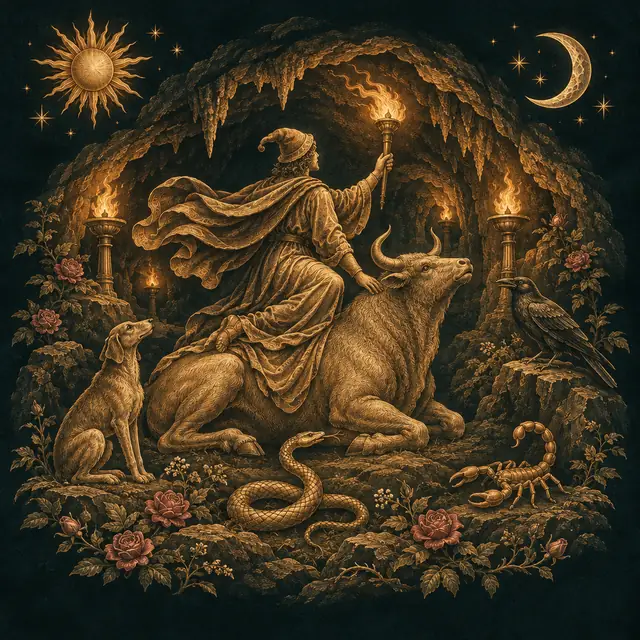
The god of a Roman mystery cult, open only to men and favoured by soldiers and officials, which appears about AD 100 and dies out by about 400. It met in small cave-like rooms; some four hundred are known, from Britain to Syria. At the end of each stood the same scene: Mithras in a Persian cap killing a bull, with a dog, a snake, a scorpion and a raven, the Sun and Moon above. There were seven grades of initiation, from Raven to Father. No sacred text survives, so the story behind the pictures has to be guessed.
The teaching
Taught from the carvings of his temples, with Porphyry, Celsus and the Christian writers who answered the cult.
A story told in stone
The cult kept its story in pictures rather than books, and the pictures tell it in a set order, carved in panels around the great scene of the bull or painted on the temple walls. Its outline is the same from the Thames to the Euphrates; the words that went with it are lost, and it is read from the stone. The temple as a cave, the bull-slaying image, the members' meal and the seven grades are taught under Orders and mystery schools, in The ancient mysteries; here is the story the panels tell, and what the few writers outside the cult recorded of it.
Born from the rock
Mithras is born from a rock, a youth already, naked but for his Persian cap, rising from the stone with a knife in one hand and a torch in the other; in some carvings shepherds watch, and the inscriptions call him the god born from the rock. In a carving from Housesteads on Hadrian's Wall he comes out instead from an egg within the ring of the zodiac. His first deed is a miracle of water: he draws his bow and shoots an arrow into a rock, a spring gushes out, and a figure kneels to drink.
The bull
Then comes the bull. Mithras finds it at pasture, seizes it by the horns and rides it as it bolts, holding on until it tires; then he hoists it by the hind legs onto his shoulders and drags it into the cave, a labour the carvings show again and again. In the cave he kills it, kneeling on its back, pulling its head up by the muzzle and driving his knife into its neck, often with his face turned back towards the Sun above. From the dying bull life springs: ears of wheat grow from its tail, and in some carvings grapes from its blood, while a dog and a snake reach for the wound and a scorpion grips its parts. A line painted in the temple beneath the church of Santa Prisca in Rome, as it is usually read, says to him: and you saved us too, by shedding the blood.
The Sun and the meal
After the slaying the Sun himself kneels before Mithras, who sets a crown on his head, or raises the bull's haunch over him; then the two clasp right hands over an altar and are bound in friendship. They feast together on the hide of the bull, served by attendants wearing the masks of a raven and a lion, as on a carving from Konjic in Bosnia, and the members' own meal on the benches of the temple was the image of that feast. Last of all Mithras climbs into the Sun's chariot and rises with him into the sky.
What the outsiders wrote
The first writer to name him, the poet Statius, about AD 90, speaks of Mithras twisting the horns of the bull under the rocks of a Persian cave. Plutarch says that the pirates of Cilicia whom Pompey crushed kept secret rites, among them those of Mithras, which still lasted in his own day. Porphyry tells that Zoroaster first dedicated a natural cave in the mountains of Persia to Mithras, the maker and father of all, as an image of the world Mithras made, and gives him his seat on the line of the equinoxes, bearing the sword of the Ram and riding the Bull, as lord of all that comes to be.
The pagan Celsus, as Origen quotes him, describes an emblem of the Mithraic mysteries for the soul's road through the heavens: a ladder with seven gates and an eighth above them, the first gate of lead for Saturn, the second of tin for Venus, then bronze for Jupiter, iron for Mercury, a mixed metal for Mars, silver for the Moon and gold for the Sun. And a Christian of the fourth century, Firmicus Maternus, preserves a line spoken to the initiate: initiate of the stealing of the bull, joined by the right hand to the illustrious father.
The rival rite
The Christian writers saw his rites as a rival's. Justin Martyr wrote that in the mysteries of Mithras bread and a cup of water are set out with certain words, and held that evil spirits had copied the Lord's Supper. Tertullian wrote that Mithras signs his soldiers on the forehead, offers bread and brings in an image of resurrection. These are the charges of opponents, and they record what outsiders saw: a meal of bread and water, a mark on the forehead and an image of rising.
The god of the contract
His name is that of Mithra in the old Persian hymns, the god of the covenant, whose very name means contract: he has a thousand ears and ten thousand eyes, keeps watch over every oath, and strikes down the one who breaks his word. The Roman worshippers dressed their god as a Persian and held that their mysteries came from Persia, as Porphyry's story of Zoroaster shows, and their own god too was a god of the bond: his members were joined to him and to one another by the clasp of the right hand.
The sky in the carving
Many have read the bull scene as a picture of the sky, for the zodiac often frames it and the grades are joined to the planets. Each creature in it has its constellation on the band of the sky between the Bull and the Scorpion: the Dog, the Snake, the Raven, the Scorpion, the ear of wheat in the Virgin's hand, and in some carvings the Lion and the Cup. The two torchbearers, one torch raised and one lowered, have been taken for the rising and the setting sun, or for spring and autumn. The members climbed through seven grades as Celsus' ladder climbs through seven planets, and their god sat, as Porphyry said, on the line where day and night are equal.
Who took it up
The cult had no heirs. The name is that of the old Persian god Mithra, but scholars since the 1970s doubt that the Roman mysteries came from Persia, as Franz Cumont had taught. Because the grades and the zodiac fill its art, many read its bull-slaying as a picture of the sky.
What later tellings added or changed
That Mithras was born of a virgin on 25 December, had twelve disciples and rose from the dead. In the carvings he is born from a rock; no source gives him disciples, a death or a resurrection, and the date belongs to the feast of the Sun, not to him.
The texts that tell it
- The bull slaying reliefsCarving, 2nd to 4th century AD
The same scene stood at the end of every temple of the cult: Mithras in a Persian cap and cloak, kneeling on a bull and stabbing it, a dog and a snake at the wound, a scorpion below, a raven, Sun and Moon above. With no sacred text surviving, these hundreds of carvings and paintings are the chief record of the cult.
What the scene meant to its worshippers is not known, and every reading of it is a reconstruction.
Ask the Oracle about it - The London MithraeumBuilding, about AD 240
A temple of Mithras by the river Walbrook in the City of London, found in 1954 while an office block was being built, when crowds queued to see it. It held marble heads of Mithras and other gods. It was rebuilt on its original site under a new building and opened to visitors in 2017.
Ask the Oracle about it - On the Cave of the NymphsEssay, 3rd century AD
Porphyry, the Platonist, reads a cave in the Odyssey as a picture of the world, and on the way says that Mithraic temples were made as caves, an image of the cosmos, with the stars and the passing of souls in mind. It is one of the few ancient writings that speaks of the cult from outside it.
Ask the Oracle about it - The Mithras LiturgySpell, 4th century AD
A rite of ascent in the great magical papyrus of Paris, in which the speaker rises through the powers of the heavens and meets a young god of fire. The scholar Albrecht Dieterich named it in 1903 and took it for a Mithraic text, because the god is called Helios Mithras.
Most scholars now think it comes from Egyptian magic and not from the Roman cult.
Ask the Oracle about it - Texts and Monuments of the Mysteries of MithrasCollection, 1894 to 1899
Franz Cumont, the Belgian historian, gathered every known text and monument of the cult in two volumes and read them as a Persian religion carried west. His view ruled for seventy years until scholars at a congress in 1971 began to see the cult as largely a Roman creation.
Ask the Oracle about it
How the house tells a life
This is a story, told with its sources and with what later tellings added or changed. What it means for you is yours to judge.
The arts it feeds
Lives near it in time
Stories of forbidden knowledge
DionysusOrpheusEnochKing MidasIcarusNarcissusCupid and PsycheHermes TrismegistusSolomon and the demonsLilithMerlinMorgan le FayThe whole tree

