
Hermes Trismegistus
Legend; the writings in his name date from about AD 100 to 300
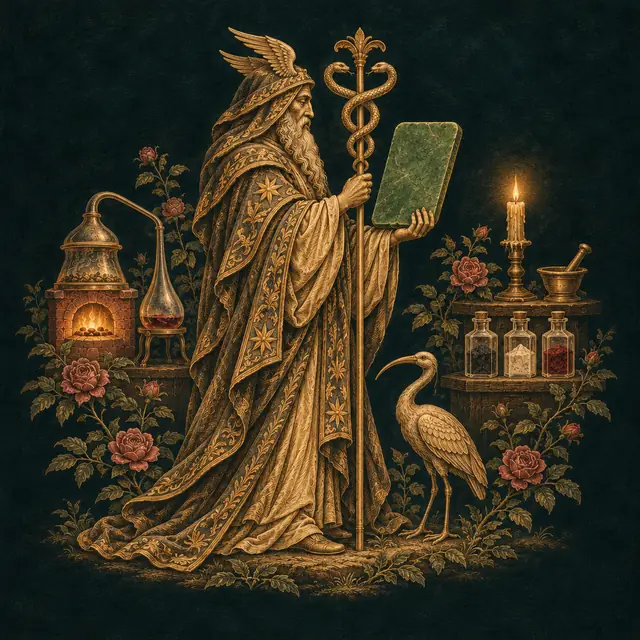
What is the story of Hermes Trismegistus, and what does it warn of?
The story and its sources
A legendary sage, the Greek Hermes joined to the Egyptian Thoth, under whose name the Hermetica were written in Roman Egypt. The Renaissance believed him older than Moses: in 1463 Marsilio Ficino set Plato aside to translate the Corpus Hermeticum first. In 1614 the scholar Isaac Casaubon showed from their language that the texts belong to the early Christian centuries.
The teaching
Taught from the Hermetica, with Plato, Clement, Augustine and the Arabic and Renaissance tellers of his legend.
Thoth, the scribe of the gods
The story begins in Egypt with Thoth, the god of Hermopolis, shown with the head of an ibis or as a baboon, who invented writing, keeps the reckoning of time by the moon, knows the words that heal, and stands as scribe beside the scales when the heart of the dead is weighed. The Greeks who settled in Egypt knew him for their own Hermes, the messenger of the gods and the guide of souls, and named his city for him. His priests hailed him as great, great and great again, and from that triple praise came the name the Greeks gave him: Trismegistos, thrice greatest.
The inventor of letters
Plato tells the oldest Greek tale of him. At Naucratis lived the god whose bird is the ibis, Theuth, who invented number and calculation, geometry and astronomy, draughts and dice, and above all letters. He showed his arts to Thamus, king of all Egypt, and praised writing as a remedy for memory and for wisdom. The king answered that the maker of an art is not the best judge of its use: letters bring forgetfulness into the souls of those who learn them, for they trust marks outside themselves instead of remembering from within, and seem to know much while knowing little. Cicero adds that the fifth of the five Mercuries he counts fled to Egypt after killing Argus, gave the Egyptians their laws and letters, and is called by them Theuth.
The teacher of Tat and Asclepius
In the treatises written in his name Hermes is a teacher, and the books are his lessons. He speaks with his son Tat, with Asclepius and with Ammon, one pupil or a few at a time, in a shut sanctuary or on the road down a mountain, and leads each from what is seen to the God who is not seen. The seer of the first treatise, to whom Poimandres, the Mind of the sovereignty, shows the making of the world and who is sent out as a guide to his race, is by tradition Hermes himself.
In the Asclepius he speaks of his forebears: the first Asclepius, finder of medicine, whose body lies in his temple on the mountain of Libya while he heals the sick from heaven, and the elder Hermes, whose name he bears, who dwells in the city named for him and helps all who come to him there. What the treatises teach, God and the cosmos, the bowl of mind and the rebirth, is taught on the branch The Hermetica, and the vision on the branch Poimandres.
Words that must not be translated
The legend makes his teaching Egyptian at the root, and its very words powers. In the sixteenth treatise Asclepius begs King Ammon to keep the discourse from being put into Greek, for Greek is a speech of empty argument, while the sound of the Egyptian words holds in itself the power of what they say.
In the Kore Kosmou, kept by Stobaeus, Isis tells her son Horus how Hermes saw the whole of things, understood it and had the power to make it known. What he understood he wrote, and most of what he wrote he hid, keeping a wise silence, so that every later age would have to seek it. Over his books he spoke a prayer that they stay unseen and untouched until a time came that was worthy of them; then he rose to the stars, and his son Tat became heir to his knowledge.
Three Hermeses, and a tablet in a vault
The Arabic tellers made him three. The first Hermes lived in Egypt before the Flood, the first to speak of the heavens, and, foreseeing the waters, carved the arts and sciences on the walls of temples so that they would not perish; the Hebrews call him Enoch and the Arabs Idris, the prophet whom God raised to a high place. The second lived in Babylon after the Flood and brought back the learning that had been lost. The third lived in Egypt and wrote on medicine and on alchemy.
The Book of the Secret of Creation tells how Balinus found beneath a statue of Hermes a vault, and in it an old man on a throne of gold holding a tablet of emerald, with a book before him; the words of that Emerald Tablet are taught line by line on their own branch.
Older than Moses
The Church read him two ways. Lactantius counted him a pagan sage of great age who taught one God, Lord and Father, and spoke even of God's Son; Augustine set him after Moses and condemned the Asclepius for teaching people to make gods of statues. Clement of Alexandria describes the Egyptian priests walking in procession with forty-two books of Hermes, thirty-six holding the whole philosophy of Egypt, its hymns, its stars, its worship and its laws, and six on medicine; Iamblichus reports counts of his books that run to tens of thousands.
To the Middle Ages he was the father of philosophers and of alchemy, the Hermetic art, and a glass vessel closed by melting its neck is still called hermetically sealed, by the seal of Hermes. In 1488 Siena laid his figure in the floor at the door of its cathedral, handing an open book to two figures, with the words Hermes Mercurius Trismegistus, contemporary of Moses.
What the legend teaches
Through Hermes his tellers teach that wisdom is given, kept and handed on: from a god to a sage, from a teacher to a pupil who is ready for it, from one age to another, written and hidden until the seeker comes. Ficino made him the first of a chain of sages through whom one ancient theology came down to Plato and agreed at last with the Christian faith; that chain, and Hermes as philosopher, priest and king in one, is taught on the branch Ficino and the Renaissance. The alchemists took from him the Work, and the Hermetic orders their name.
And beside all the books written in his name stands the old tale of Theuth with its warning: letters keep the words, but only a mind that has made them its own keeps the wisdom.
Who took it up
Every Hermetic order takes its name from him, the Golden Dawn among them; none descends from an ancient school of his.
What later tellings added or changed
That he was a man who lived, wrote thousands of books and carved the Emerald Tablet. The seven principles taught under his name come from The Kybalion of 1908.
The texts that tell it
- Corpus HermeticumTreatise, about AD 100 to 300
Seventeen Greek treatises in which Hermes teaches his son Tat and the healer Asclepius about God, the mind and the rebirth of the soul; the first, Poimandres, is a vision of the making of the world. Gathered in Byzantium, they were taken in the Renaissance for the oldest theology in the world.
Written in Roman Egypt by unknown authors under his name, not by any ancient sage.
Ask the Oracle about it - AsclepiusTreatise, 4th century AD
A Hermetic dialogue known in a Latin version, its Greek lost, on God, the world and humankind, the great miracle. It tells of the Egyptian art of drawing spirits into statues and holds a prophecy of the end of Egypt’s gods. It was the one Hermetic book the Latin Middle Ages could read.
Written under his name, and handed down for centuries as a work of Apuleius.
Ask the Oracle about it - The Emerald TabletTreatise, by the 10th century
A few lines on the one thing and the making of the stone, said to be found on a tablet of emerald in the tomb of Hermes. It first appears in Arabic, at the end of the Book of the Secret of Creation under the name of Balinus, and in Latin became the founding text of medieval alchemy.
Its date and origin are uncertain, and it is not his.
Ask the Oracle about it - PimanderTranslation, 1463
Marsilio Ficino, in Florence, translated the first fourteen treatises of the Corpus Hermeticum into Latin at the order of Cosimo de Medici, who asked for them before Plato. Printed in 1471, the book spread the belief that Hermes was older than Moses through Renaissance Europe.
Ask the Oracle about it - De rebus sacris et ecclesiasticis exercitationes XVIBook, 1614
Isaac Casaubon, writing against a Catholic history of the Church, showed from the Greek of the Hermetic texts, their words and their ideas, that they belong to the early Christian centuries and not to ancient Egypt. After him Hermes could no longer be read as a teacher before Moses.
Ask the Oracle about it - The KybalionBook, 1908
A short American book by Three Initiates setting out seven Hermetic principles, of mind, correspondence, vibration and others. It has been read as the teaching of Hermes ever since, and it belongs to the New Thought movement of its day.
It has no link to the ancient Hermetica; William Walker Atkinson is usually taken to be its author.
Ask the Oracle about it
How the house tells a life
This is a story, told with its sources and with what later tellings added or changed. What it means for you is yours to judge.
The arts it feeds
Lives near it in time
Stories of forbidden knowledge
EnochKing MidasIcarusNarcissusMithrasCupid and PsycheSolomon and the demonsLilithMerlinMorgan le FayThe Holy GrailOdinThe whole tree

