
The Sibyl
Greek and Roman legend; first named by Heraclitus, about 500 BC
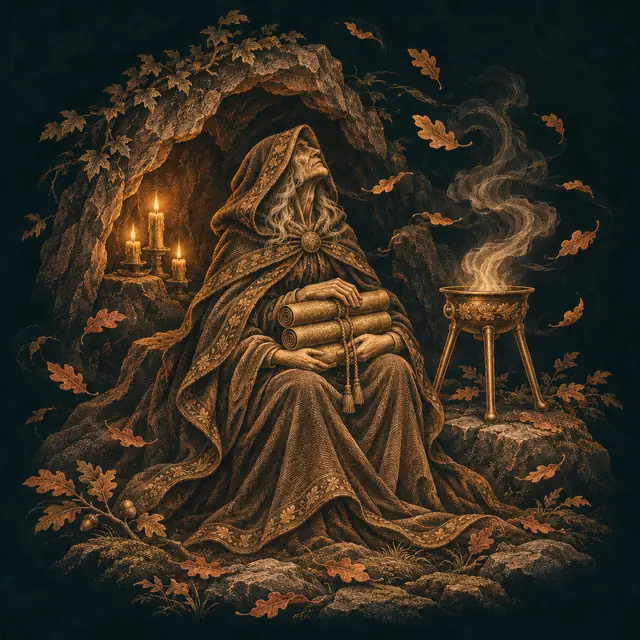
What is the story of the Sibyl of Cumae, and what has it been taken to mean?
The story and its sources
A prophetess who speaks in a frenzy, without being asked. Heraclitus, about 500 BC, is the first to name her; by Roman times there were said to be ten, at Delphi, Erythrae, Cumae and elsewhere. In Roman legend the Sibyl of Cumae offered nine books of prophecy to King Tarquin, burned six when he would not pay, and sold him the last three at the first price. Rome kept those books on the Capitol and consulted them in emergencies until they burned in 83 BC. In Virgil’s Aeneid she guides Aeneas through the underworld.
The teaching
Taught from Virgil's Aeneid, Ovid, the Roman tale of the books, Heraclitus and the Sibylline Oracles.
The voice of a thousand years
The first word of her comes from Heraclitus, as Plutarch quotes him: the Sibyl with raving mouth utters things without laughter, without ornament and without perfume, and her voice reaches across a thousand years, through the god. She is not a priestess who answers when asked, as the Pythia does at Delphi, but a woman seized by the god who prophesies unbidden, often of disasters far off. Plato counts her among those whose divine madness has done Greece good: the prophetesses of Delphi and Dodona, he says, have done great things for Greece when out of their senses and little or nothing when in them, and the Sibyl and others with inspired foresight have set many on the right road. In time her name became the name of a kind, and Varro, the Roman antiquary, counted ten: the Persian, the Libyan, the Delphic, the Cimmerian, the Erythraean, the Samian, the Cumaean, the Hellespontine, the Phrygian and the Tiburtine.
Herophile
Pausanias was shown the rock at Delphi where a Sibyl named Herophile stood to sing. In her verses she says that she was born of a mortal father and a nymph of Mount Ida, and calls herself the wife of Apollo, and his sister, and his daughter; and long before the war she sang that Helen would be the ruin of Asia and of Europe. She wandered from Samos to Claros, Delos and Delphi, and died in the Troad, where her tomb stood in the grove of Apollo Smintheus.
The books on the Capitol
After the bargain with King Tarquin, Rome laid the three books that remained in a stone chest beneath the temple of Jupiter on the Capitol, in the keeping of two men, later ten, later fifteen, who alone might open them, and only at the senate's command, when a plague, a defeat or a portent showed the gods were angry. The books answered not with forecasts but with remedies: a new rite, a feast for the gods, a new god brought in. So in the war with Hannibal they told Rome that a foreign enemy could be driven from Italy if the Mother of the Gods were brought from Pessinus in Phrygia, and her sacred stone was carried to the city. When the books burned, the senate sent to Erythrae, Samos, Troy and the Greek cities of Italy for verses to make a new collection, and Augustus laid it in gilded cases beneath the statue of Apollo on the Palatine.
The cave at Cumae
Virgil gives her a name, Deiphobe, daughter of Glaucus, priestess of Apollo and of Hecate, and a cavern cut into the rock at Cumae with a hundred mouths, from which her answers rush out in a hundred voices. The seer Helenus has warned Aeneas that she writes her prophecies on leaves and sets them in order in her cave, but when the door opens the wind scatters them and she never gathers them again, so that many go away unanswered; so Aeneas begs her to sing, not to write. As the god comes on her, her face and colour change, her hair falls loose, her breast heaves, she grows taller and her voice is no longer mortal: the god, she cries, behold the god. She rages in the cave, trying to throw him off, as Apollo works her mouth like a rider breaking a horse, until the doors fly open.
Wars, she foretells, horrid wars, the Tiber foaming with blood, a second Achilles and a foreign bride once more; and she gives him the counsel that is hers alone: do not yield to troubles, but go against them more boldly than your fortune allows.
The descent
When Aeneas asks to go down to his dead father she tells him the truth of that road: the way down is easy, for the door of black Dis stands open night and day, but to retrace one's steps and come out to the upper air, that is the task, that the labour. First he must find in a dark wood the golden bough, sacred to the queen of the dead, which comes away easily in the hand of one whom fate calls and which no force can break otherwise, and when it is plucked another grows in its place; and he must bury his drowned comrade Misenus. After the sacrifices to Hecate she cries to the uninitiated to keep far off, tells Aeneas that now he needs courage and a steady heart, and plunges into the cave with him at her heels.
Below, she is his guide and his teacher. She stills Cerberus with a drugged cake of honey, tells him the crimes punished behind the walls of Tartarus, which Hecate once showed her, and has him set the bough on the threshold of Persephone's house before they pass into the fields of the blessed to find his father.
Grains of dust
Ovid lets her tell her own story as she leads Aeneas back up the dark road. She is no goddess, she says. When she was young, Apollo, wanting her, offered her whatever she wished, and she pointed to a heap of dust and asked for as many birthdays as it had grains, and forgot to ask that the years be young ones. He would have given her youth too had she yielded to him, but she refused. Now she has lived seven hundred years and must see three hundred harvests more to match the dust; she shall shrink until her body weighs almost nothing, no one shall believe a god once loved her, and Apollo himself shall not know her, but the Fates shall leave her her voice. In Petronius' novel the freedman Trimalchio boasts that he saw her at Cumae hanging in a jar, and when the boys asked her, Sibyl, what do you want, she answered, I want to die.
The Church's witness
The books that survive under her name, the Sibylline Oracles, were written by Jewish and then Christian authors who borrowed her voice for their own prophecies: the fall of empires one after another, a judgement by fire, the kingdom of God on earth. One poem among them hides an acrostic whose first letters, as Augustine records, spell in Greek Jesus Christ, Son of God, Saviour. Christians took the pagan seer for a witness from outside to what the prophets of Israel had foretold, and read Virgil's fourth Eclogue the same way, with its last age of the Cumaean song and the child at whose birth a golden race shall rise through all the world. So she passed into the Church's own song: the Dies Irae sings of the day of wrath that shall dissolve the world in ashes, as David bears witness with the Sibyl.
What the tellers read in her
The Greeks heard in her the god's voice breaking through a human one, and honoured her raving as a madness sent from heaven, wiser than sober sense. Rome kept her as a counsellor in danger, whose books gave not the future but the rite that would set things right. Virgil made her the guide who knows that the way down is easy and the way back the labour, and Ovid the warning of long life asked for without youth. The Church made her a witness that truth had been spoken outside Israel too, and T. S. Eliot set Petronius' words at the head of The Waste Land: the seer who has outlived everything and longs only to die.
Who took it up
The Sibylline Oracles that survive are Jewish and Christian verses written between about 150 BC and AD 600 under her name. The Church accepted her as a pagan witness to Christ: she is in the hymn Dies Irae, and Michelangelo painted five sibyls on the Sistine ceiling.
What later tellings added or changed
That the surviving oracles are the books Rome kept. Those are lost. The tale that she asked for as many years as grains of sand and forgot to ask for youth is told by Ovid.
The texts that tell it
- The Aeneid, Book SixEpic, about 19 BC
Virgil brings Aeneas to the Sibyl of Cumae, who prophesies in her cave with a hundred mouths, tells him to find the golden bough, and leads him down through the underworld to meet his father. It is the best known of all her appearances and fixed her image as guide to the world of the dead.
Ask the Oracle about it - The Sibylline BooksOracles, kept until 83 BC
The Roman books of prophecy said to have been bought by King Tarquin from the Sibyl of Cumae. Kept on the Capitol by a college of priests, they were consulted in times of plague, defeat or portent to learn what rites would appease the gods. They burned with the temple of Jupiter in 83 BC, and a new collection was later made.
They are lost; nothing of their text is known with certainty, and the tale of their purchase is legend.
Ask the Oracle about it - The Sibylline OraclesOracles, about 150 BC to AD 600
Twelve books of Greek hexameter verse, prophesying the fall of empires and the judgement of the world, written by Jewish and later Christian authors in the Sibyl’s name. Early Christian writers quoted them as pagan witness to their faith, which is why she was given a place beside the prophets.
Written under her name, not by any Sibyl: they are the work of many hands across several centuries.
Ask the Oracle about it - Metamorphoses, Book FourteenPoem, about AD 8
Ovid lets the Sibyl of Cumae tell Aeneas her own story: Apollo offered her whatever she wished, and she asked for as many years as the grains of a heap of dust, but forgot to ask for youth. She has lived seven hundred years and will dwindle until only her voice is left.
Ask the Oracle about it - The Sibyls of the Sistine ChapelPainting, 1508 to 1512
Michelangelo painted five Sibyls, of Delphi, Erythrae, Cumae, Persia and Libya, enthroned on the Sistine ceiling in alternation with seven prophets of Israel. They show the Church’s view that the pagan seers too foretold Christ, and the Libyan Sibyl turning with her great book is among the most admired figures of the ceiling.
Ask the Oracle about it
How the house tells a life
This is a story, told with its sources and with what later tellings added or changed. What it means for you is yours to judge.
The arts it feeds
Lives near it in time
Stories of forbidden knowledge
SisyphusCirceTiresiasPrometheusPandoraPersephoneTheseus and the MinotaurCassandraThe PhoenixDionysusOrpheusEnochThe whole tree

