
Sisyphus
Greek myth; in Homer’s Odyssey, about 700 BC
What is the story of Sisyphus, and what has it been taken to mean?
The story and its sources
A king of Corinth, the craftiest of men. In the Odyssey, about 700 BC, Odysseus sees him in the underworld pushing a great stone up a hill; each time it nears the top it rolls back down. Homer gives no reason. Later writers supply one: he told a river god where Zeus had taken his daughter, he chained up Death so that no one could die, and when he was at last brought below he talked his way back to the daylight and refused to return.
The teaching
Taught from Homer's Iliad and Odyssey, the later Greek tellers and Albert Camus's essay of 1942.
The craftiest of men
Homer's first word of Sisyphus is of his cunning. In the Iliad he is the son of Aeolus, king of Ephyra in a corner of Argos where horses graze, the craftiest of men and grandfather of the hero Bellerophon. Later tellers make Ephyra into Corinth and him its founder, and give him a wife, Merope, one of the seven Pleiades, who shines the faintest of the sisters because she alone married a mortal. When the thief Autolycus steals his cattle and changes their look, Sisyphus knows them by the marks he has set under their hooves, and some add that he lay with the thief's daughter Anticleia, so that Odysseus was his son and not the son of Laertes.
The god and Death
Then he crosses the gods. When Zeus carries off Aegina, daughter of the river god Asopus, Sisyphus tells her searching father where she has gone, and takes a spring of water for the citadel of Corinth in payment. Zeus sends Death to fetch him, and Sisyphus binds Death in chains, so that for a while no one on earth can die, until Ares sets Death free and hands Sisyphus over to him.
Even then he has a trick left. Before he dies he tells his wife to leave his body unburied and make him no offerings, and when he comes below he complains that she has wronged him and begs leave to go back and punish her. Once in the daylight he refuses to return, and lives on to old age before he is fetched again. The poet Alcaeus sums it up: the wisest of men thought he had mastered death, yet for all his cleverness he crossed the river of the dead twice.
The stone
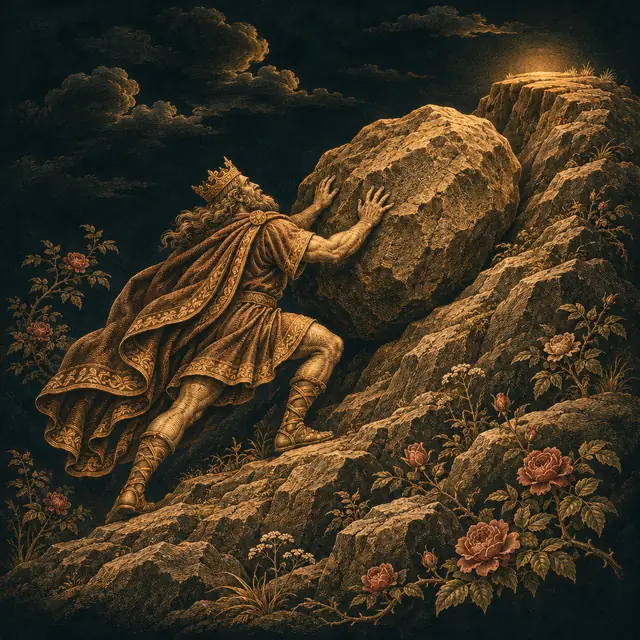
In the Odyssey, Odysseus among the dead sees him in hard torment, gripping a monstrous stone with both hands and thrusting it up a hill with hands and feet. Each time he is about to heave it over the crest its weight turns it back, and the pitiless stone rolls down again to the plain; and he strains to push it up once more, the sweat running from his limbs and the dust rising above his head. He stands among the great offenders, beside Tityos whose liver the vultures tear and Tantalus who can never drink, and Homer says nothing of why. When Orpheus sings in the underworld, Ovid tells, Sisyphus sits down on his stone to listen.
The stone in this life
The ancients read the punishments below as pictures of life above. Lucretius, who held that no one suffers after death, says that Sisyphus is here before our eyes: he is the man who seeks from the people the rods and axes of office and always goes away beaten and sullen, for to seek power, which is empty and never truly given, and to toil hard for it without end, is to push uphill a stone that rolls back from the very top and races down to the plain. Plato's Socrates notes that Homer's sufferers without end are kings and men of power, since power gives the most room for wrong, and counts among the joys of death the chance to meet Sisyphus and question him.
Camus: the absurd
Albert Camus begins from the one question he holds to be serious: whether life is worth living in a world that offers no meaning of its own. The absurd, he says, lies neither in us nor in the world but in their meeting, our longing for clarity faced with the world's silence. It is not to be escaped, neither by suicide nor by a leap of hope into a faith that denies it, but lived with open eyes, and from living it come three things: revolt, freedom and passion. Sisyphus is his absurd hero by his passions as much as by his torment: his scorn of the gods, his hatred of death and his love of life earned him the labour in which the whole being strives and accomplishes nothing.
The hour of the descent
What holds Camus is the walk back down. When the stone has rolled away and Sisyphus goes down after it, there is a pause like a breath, and that is the hour of consciousness: each time he leaves the heights he is stronger than his rock. His torment is that he knows, and the same clear knowledge is his victory, for there is no fate that scorn cannot overcome. The descent may be made in sorrow, and it may be made in joy. His fate belongs to him and his rock is his own, every grain of it a world, and the struggle towards the heights is enough to fill a human heart.
Who took it up
No cult or order was his. Albert Camus made him the emblem of a life without given meaning in The Myth of Sisyphus, 1942, and ended by saying that one must imagine him happy.
What later tellings added or changed
That the stone is a punishment for pride alone. The old sources charge him with cheating death and telling a god’s secret. Whether the story is about despair or about endurance is the reader’s question, and Homer does not answer it.
The texts that tell it
- The Odyssey, Book ElevenEpic, about 700 BC
Odysseus, telling of his visit to the dead, sees Sisyphus heaving a monstrous stone up a hill with hands and feet, only for it to roll back to the plain each time he nears the top, the sweat pouring from him. It is the first telling of the punishment, and Homer gives no reason for it.
Ask the Oracle about it - The Iliad, Book SixEpic, about 750 BC
In the tale of the hero Bellerophon, told on the battlefield, Homer names Sisyphus as a king of Ephyra, later taken for Corinth, and the craftiest of men, the grandfather of Bellerophon. It is the oldest mention of him, as a man of cunning before he is a man of the stone.
Ask the Oracle about it - The Myth of SisyphusEssay, 1942
Albert Camus wrote this essay in occupied France on whether life is worth living when the world offers no meaning of its own. He ends with the king going back down the hill to his stone, aware of his lot and refusing to despair of it, and says that we must imagine him happy. It made Sisyphus the emblem of the twentieth century’s absurd.
Ask the Oracle about it
How the house tells a life
This is a story, told with its sources and with what later tellings added or changed. What it means for you is yours to judge.
The arts it feeds
Lives near it in time
Stories of forbidden knowledge
Isis and OsirisThothGilgameshCirceTiresiasPrometheusPandoraPersephoneThe SibylTheseus and the MinotaurCassandraThe PhoenixThe whole tree

