
Thoth
Egyptian god; named in the Pyramid Texts, about 2400 BC
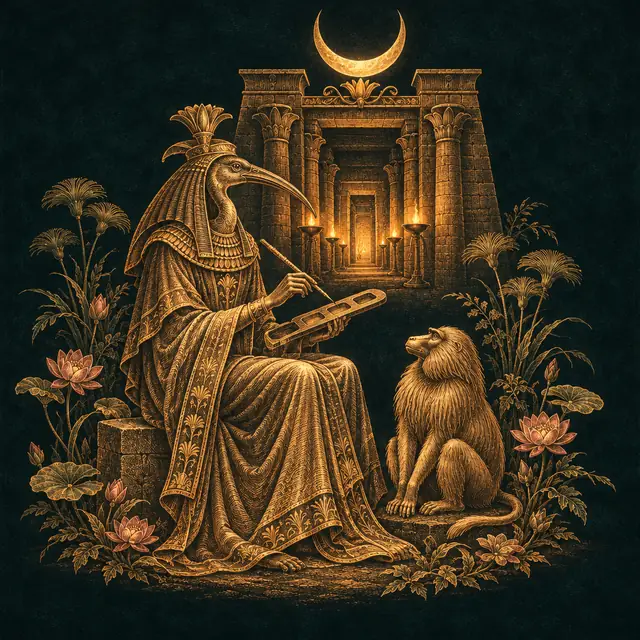
What is the story of Thoth, the Egyptian god of writing, and who took him up?
The story and its sources
The Egyptian god of writing, reckoning and the Moon, shown as an ibis or a baboon, with his chief temple at Hermopolis. He is scribe of the gods: he records the verdict when the heart of the dead is weighed, and in the myths he heals the eye of Horus and settles the quarrel of Horus and Set. The Greeks in Egypt took him for their Hermes. In Plato’s Phaedrus, about 370 BC, he offers writing to a king, who answers that it will give people the look of wisdom and weaken their memory.
The teaching
Taught from the Book of the Dead, Plato's Phaedrus and the First Tale of Setne Khamwas.
The ibis and the baboon
Thoth is the god who knows. His city is Hermopolis, which the Egyptians called Khemenu, the town of the Eight, and his creatures are the ibis and the baboon, whose cries the Egyptians heard as a greeting to the rising sun. He is the Moon, who keeps the light while the Sun is below and measures out the months; in the Book of the Heavenly Cow the Sun, withdrawing from the world, makes him his deputy in the night sky. He is lord of the divine words, the hieroglyphs, the reckoner of the years, the patron of every scribe, who keeps the accounts of the gods and writes down their decrees.
The peacemaker of the gods
In the myths he mends what violence breaks. When Set tears out the eye of Horus, Thoth makes it whole again, and the sound eye, the wedjat, is the Moon filling each month; the sign is taught in Symbols, under The all-seeing eye. When the Sun has cursed the sky goddess so that she can bear her children on no day of the year, it is Thoth who wins five new days from the Moon at draughts. When the child Horus is stung by a scorpion in the marshes and Isis cries out to heaven, the boat of the Sun stands still in the sky until Thoth comes down from it with the spells that drive the poison out. In the long lawsuit of Horus and Set he is the scribe of the court, who writes its letters to the goddess Neith and to Osiris among the dead, and speaks for the right of Horus.
The scribe of the judgement
He is best known in the hall of judgement, where the heart of the dead is weighed against the feather of truth. Anubis watches the plummet, and Thoth, ibis headed, stands with his palette and reed to write down what the balance shows and to announce it: when heart and feather hang level, the dead are true of voice. Because he knows every name and keeps every account, the dead claim his knowledge in their spells, and some speak as Thoth himself, for whoever has his words can pass every gate. The judgement is taught in full under Death and what follows, in The weighing of the heart.
Theuth and Thamus
Plato's Socrates tells a story of Egypt. At Naucratis lived an old god named Theuth, whose bird is the ibis. He invented number and calculation, geometry and astronomy, draughts and dice, and above all letters, and he brought his arts to Thamus, king of all Egypt at Thebes, asking that they be given to the Egyptians. The king weighed each one, praising some and blaming others, and when they came to letters, Theuth said that this art would make the Egyptians wiser and give them better memories: it was a remedy for both.
The king answered that the maker of an art is not the best judge of its use, and that Theuth, out of a father's love for his children, had given letters the opposite of their power. In Jowett's English: “this discovery of yours will create forgetfulness in the learners' souls, because they will not use their memories; they will trust to the external written characters and not remember of themselves.” Writing is a remedy for reminding, not for memory, the king says, and it gives the look of wisdom without the thing: its pupils hear much without being taught, seem to know much while knowing nothing, and are tiresome company.
The living word
Socrates draws the lesson. Writing is like painting: its figures stand as if alive, but ask them a question and they keep a solemn silence. A written word says the same thing for ever, falls into the hands of those who understand it and those who do not, and cannot defend itself when it is wronged, for its father is not there to help it. The better word is the one written with knowledge in the soul of the learner, which can defend itself and knows when to speak and when to be silent; the written word is only its image. A sensible farmer does not sow the seed he cares for in a summer garden of Adonis for the pleasure of seeing it green in eight days, but in fit soil, content if it ripens in eight months. So the one who knows plants living words by conversation in a soul fit to receive them, and writes, if at all, for play and as a store of reminders against forgetful old age.
The book in the river
The First Tale of Setne Khamwas tells of a book that Thoth wrote with his own hand. Prince Naneferkaptah, who cares for nothing but old writings, learns from an aged priest where it lies: in the river at Koptos, in a box of iron, within it a box of copper, then one of juniper, one of ivory and ebony, one of silver, and in a box of gold the book, with snakes and scorpions all around it and a serpent that cannot die coiled about the box. He sails to Koptos with his wife Ahwere and their son Merib, makes by his spells a boat and crew to search the river, and kills the serpent three times: twice it lives again, and the third time he cuts it in two and puts sand between the halves.
He reads the book. With its first spell he charms the sky, the earth, the underworld, the mountains and the waters, and understands what the birds, the fish and the beasts are saying; with the second he sees the Sun rising with his gods and the Moon with all the stars. He copies it on fresh papyrus, soaks the copy until it dissolves, and drinks it, and so knows everything in it. But Thoth complains to the Sun, and the Sun gives Naneferkaptah and all his house into his power. Merib falls from the boat and drowns, then Ahwere, and Naneferkaptah binds the book to his body and throws himself into the river.
Setne and Tabubu
Long after, Setne, a son of King Ramesses, hears of the book and goes down into Naneferkaptah's tomb at Memphis, where the book gives light in the dark. The ghost of Ahwere tells him their story to warn him, but he will not be turned back. Naneferkaptah plays him at draughts for the book and wins three games, and with each he drives Setne deeper into the ground, until only his head shows. Setne calls to his foster brother to bring the amulets of the god Ptah, springs up out of the earth, seizes the book and goes, and as the light goes with him darkness falls on the tomb behind.
Then in the temple of Ptah he sees a woman, Tabubu, more beautiful than any he has known, and follows her to her house. To have her he signs away everything he owns, makes his children sign it too, and lets them be killed and thrown from the window to the dogs and cats. As he reaches for her she cries out, and he wakes in the road, naked, and finds his children alive. The king tells him to take the book back, and he carries it into the tomb as the ghost foretold, a forked stick in his hand and a brazier burning on his head; and at the ghost's asking he brings the bodies of Ahwere and Merib from Koptos to lie beside him.
What the tellers teach
The two tellings give one caution from two sides. Plato's king warns that writing stores words without giving understanding, and that wisdom lives only in a soul that has made it its own. The Egyptian tale warns that knowledge seized without right, read out of the god's own book by one to whom it was never given, takes from its holder all that he loves, and is mended only by giving it back. Later ages built on the name. The writings under the name of Hermes Thrice Great, who is Thoth in Greek dress, are taught under The Hermetic principles, in The Hermetica; and in 1781 Antoine Court de Gébelin declared the tarot to be the Book of Thoth, saved from the ruin of Egypt, the belief from which Crowley's deck took its name.
Who took it up
The Hermetic writings of Roman Egypt were put under the name of Hermes joined to Thoth. Aleister Crowley named his tarot, painted by Frieda Harris between 1938 and 1943, the Thoth deck, after the eighteenth-century claim that the cards were an Egyptian book.
What later tellings added or changed
A “Book of Thoth” holding all magic. It is the subject of an Egyptian tale of the Ptolemaic age, in which the prince who steals it loses his family, and no such book exists. The “Emerald Tablets of Thoth the Atlantean” were written by Maurice Doreal in the 1930s.
The texts that tell it
- The Book of the Dead, Spell 125Funerary texts, from about 1550 BC
The spell for entering the hall of judgement, written on papyri buried with the dead. Its pictures show the heart weighed against the feather of truth, with Thoth, ibis headed, writing down the verdict. It is the scene by which he is best known, the scribe of the gods who keeps the record that cannot be falsified.
Ask the Oracle about it - PhaedrusDialogue, about 370 BC
Near the end of this dialogue Plato has Socrates tell a story of Theuth, as he spells Thoth, offering the art of writing to the Egyptian king Thamus. The king answers that it will weaken memory and give only the look of wisdom. It is the best known Greek use of the god and has been argued over by every age that has thought about books.
Ask the Oracle about it - The First Tale of Setne KhamwasTale, Ptolemaic age
An Egyptian story in demotic script on a papyrus now in Cairo. Prince Setne goes after a book written by Thoth himself, which gives power over heaven, earth and the beasts. Its earlier owner lost his wife and son for it, and Setne too is brought low until he returns it to the tomb. It is the source of every later tale of a Book of Thoth.
The book in the tale is fiction within fiction: no such book of Thoth has ever existed.
Ask the Oracle about it - The Book of ThothBook, 1944
Aleister Crowley’s account of his tarot, painted to his design by Frieda Harris between 1938 and 1943. He named book and deck after the Egyptian god of writing, following the old French belief that the tarot was a book of Thoth saved from Egypt, a claim the history of the cards does not bear out.
Ask the Oracle about it
How the house tells a life
This is a story, told with its sources and with what later tellings added or changed. What it means for you is yours to judge.
The arts it feeds
Lives near it in time
Stories of forbidden knowledge
Isis and OsirisGilgameshSisyphusCirceTiresiasPrometheusPandoraPersephoneThe SibylTheseus and the MinotaurCassandraThe PhoenixThe whole tree

