
Gilgamesh
Mesopotamian epic; the oldest poems about 2100 BC
What is the story of Gilgamesh, and what has it been taken to mean?
The story and its sources
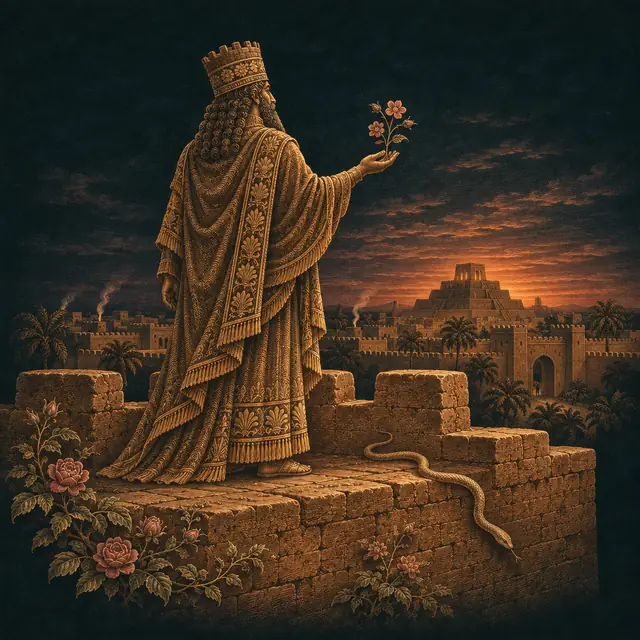
The oldest long poem that survives. Gilgamesh was probably a real king of Uruk, about 2700 BC; Sumerian poems about him were written by about 2100 BC, and the Akkadian epic took its standard form in twelve tablets around 1200 BC, credited to the scholar Sin-leqi-unninni. The king befriends the wild man Enkidu, and when Enkidu dies he goes looking for a life without death. Utnapishtim, who survived the flood, tells him that death is the lot the gods fixed for mankind. A plant that restores youth is stolen from him by a snake, and he goes home to the walls he built.
The teaching
Taught from the Standard Babylonian epic of twelve tablets, with the Old Babylonian tablets and the Sumerian poems of Bilgames.
He who saw the deep
The epic opens on its hero before it names him: he who saw the deep, who knew all things, who travelled a far road and came back weary and at rest, and set down all his labours on a tablet of stone. It bids the reader walk the wall of Uruk and look at its brickwork, whose foundations the seven sages laid, then open the box of cedar and read on its tablet of lapis lazuli what Gilgamesh suffered. He is two thirds god and one third man, the son of the goddess Ninsun, tall, beautiful and without equal, and he gives his city no rest: he wears out its young men and takes its young women, until the people cry out to the gods.
The wild man
The mother goddess Aruru washes her hands, pinches off clay and throws it into the wild, and Enkidu is made: a man covered in hair, who grazes with the gazelles, drinks with the beasts at the water hole and springs the hunter's traps. The trapper takes his trouble to Gilgamesh, who sends the woman Shamhat to the water hole. For six days and seven nights Enkidu lies with her, and when he turns back to his herd the gazelles run from him and his legs no longer keep up with them; he is weaker, but his mind has grown wide. Shamhat takes him to the shepherds' camp, where for the first time he eats bread and drinks beer, seven jugs of it, washes and oils himself, and becomes a man.
The friend and the forest
Enkidu hears that the king goes in first to every bride, and in anger he bars the door of the wedding house. The two wrestle in the street until the doorposts shake, and when Gilgamesh at last kneels with one foot on the ground, his anger leaves him, and they kiss and become friends. Then Gilgamesh resolves to go to the Forest of Cedars and kill its guardian Humbaba, whom the god Enlil set there. Enkidu and the elders warn him, but in the Old Babylonian tablet Gilgamesh answers: only the gods live for ever with the Sun; the days of men are numbered, and all they do is wind; let me make a name that lasts.
On the road Gilgamesh dreams every night, and every morning Enkidu reads the dream as good. Among the cedars Humbaba meets them, roaring like the flood, and the Sun god sends thirteen winds to pin him so that he can move neither forward nor back. He begs for his life and offers to serve them; Enkidu urges his friend to strike before the gods hear, and Humbaba curses Enkidu, that he shall not live long. They kill him, fell the tallest cedar for a door to Enlil's temple, and float home down the Euphrates.
Ishtar and the Bull of Heaven
Washed and in clean robes, Gilgamesh is so splendid that the goddess Ishtar asks him to be her husband, promising a chariot of lapis lazuli and gold. He refuses and tells her what became of her lovers: Tammuz, for whom the land must weep each year, the bird whose wing she broke, the lion, the stallion, the shepherd she turned into a wolf. In fury she makes her father Anu give her the Bull of Heaven, threatening otherwise to break open the underworld and let the dead rise to eat the living. At the Bull's snorting the ground opens and men of Uruk fall by the hundred into the pits, until Enkidu seizes its tail and Gilgamesh drives his sword into its neck; then Enkidu tears off its haunch and flings it at the goddess.
The death of Enkidu
That night Enkidu dreams that the gods sit in council and decree that one of the two must die for Humbaba and the Bull, and that it shall be Enkidu. He curses the trapper and Shamhat who brought him out of the wild, until the Sun god reminds him that she gave him bread fit for a god, beer fit for a king, and Gilgamesh for a friend, and he blesses her instead. He dreams of the house of dust, where those who enter have no light, dust is their food and clay their bread, they are clothed in feathers like birds, and kings who wore crowns serve as servants. He sickens for twelve days and dies.
Gilgamesh calls on mountains, rivers and beasts to weep for him. He covers his friend's face like a bride's, paces round him like a lioness robbed of her cubs, and tears out his hair, and he will not give him up for burial until a worm falls from his nose.
The road of the Sun
Now Gilgamesh is afraid: shall I not die too, and be like Enkidu? Dressed in lion skins he wanders the wild in search of Utnapishtim, the one man the gods made immortal. At the twin peaks of Mashu, where the Sun goes in and comes out, the scorpion man and his wife let him pass, and he runs the Sun's road under the mountain through twelve double hours of utter darkness, and comes out among trees whose fruit is carnelian and whose leaves are lapis lazuli. By the shore at the edge of the world Siduri keeps a tavern, and in the Old Babylonian tablet she gives him her counsel: the life you seek you shall not find, for when the gods made mankind they gave death to men and kept life for themselves. So fill your belly, make merry day and night, wear clean clothes and wash your head, look at the child who holds your hand and let your wife delight in your embrace, for this is the lot of mankind.
The flood
The ferryman Urshanabi takes him over the Waters of Death, which no hand may touch. Utnapishtim tells him that no one sees the face of death or hears its voice, yet death snaps mankind off like a reed; the gods fix death and life, and do not reveal the day. Then he tells how he himself escaped. When the gods resolved on a flood, Ea whispered the warning to the reed wall of his house: tear down the house and build a boat, give up wealth and save life. He built it as wide as it was long and loaded it with his gold and silver, his family, his craftsmen and the seed of every living thing.
For six days and seven nights the storm raged, until the gods themselves cowered like dogs and Ishtar cried out like a woman in labour for the people she had borne. On the seventh day it was still, and all mankind had turned back to clay. The boat grounded on Mount Nimush; he sent out a dove and a swallow, which came back, and a raven, which found food and did not return. He made an offering and the gods gathered like flies at its smell. Enlil raged that a man had lived, but Ea rebuked him, and Enlil made Utnapishtim and his wife like gods, to dwell far off at the mouth of the rivers.
Sleep, the plant and the wall
Let him first conquer sleep, Utnapishtim says, for six days and seven nights; but Gilgamesh falls asleep at once. Utnapishtim's wife bakes a loaf for each day and sets it by his head, and when he wakes sure he has only dozed, the seven loaves show him the days, the first dried hard, the last still on the coals. Death, he cries, is in my bedroom. At the wife's asking, Utnapishtim gives him a parting secret: a thorny plant at the bottom of the deep that makes the old young again. Gilgamesh ties stones to his feet, sinks down and takes it, and names it The old man grows young, meaning to try it on an old man of Uruk. But when he stops to bathe in a pool, a snake smells its fragrance, comes up and carries it off, and as it goes it sheds its skin. Gilgamesh sits down and weeps: for whom have my hands laboured? Then he brings the ferryman home and shows him the wall of Uruk, and the epic ends where it began.
What the epic teaches
The epic gives its answer in its frame. The man who went out to escape death comes home having seen everything, and what he brings back is the story written on stone and the wall that outlasts him; the tavern keeper's counsel to live the given life well is the same answer told from the other side. The twelfth tablet, from a Sumerian poem, adds a word about the dead: Enkidu's ghost, risen for a moment from the underworld, tells his friend how the dead fare, the man with seven sons sitting like a companion of the gods, the one with no one to make him offerings eating scraps thrown in the street. In the Sumerian poem of his death the gods tell Bilgames that no man is given life for ever, but that he shall be a judge among the dead.
Who took it up
No order took him up. The tablets lay buried until the 1850s; George Smith read the flood tablet in London in 1872, and the likeness to the story of Noah made the epic famous. Modern writers on myth, Jung’s followers among them, read it as the first story of facing death.
What later tellings added or changed
That the epic is one fixed book. It is pieced from broken tablets of different ages, and new fragments still change lines. That the flood tablet proves or disproves the Bible is a claim made about it, not something it says.
The texts that tell it
- The Epic of Gilgamesh, Standard Babylonian versionEpic, about 1200 BC
The twelve tablets in Akkadian credited to the scholar Sin leqi unninni, best known from the library of Ashurbanipal at Nineveh. It tells the friendship with Enkidu, the killing of Humbaba and the Bull of Heaven, Enkidu’s death, the journey to Utnapishtim and the plant of youth lost to a snake. It opens and closes on the walls of Uruk.
It is pieced together from broken tablets of different ages, and new fragments still change its lines.
Ask the Oracle about it - The Sumerian poems of BilgamesPoem, about 2100 BC
Five separate poems in Sumerian about the king, among them his journey against Huwawa, the Bull of Heaven, his death, and his friend’s descent to the underworld. They were written down under the kings of Ur, who claimed him as their ancestor, and the later epic took much of its matter from them.
The surviving copies are mostly a few centuries younger than the poems themselves.
Ask the Oracle about it - The Epic of Gilgamesh, Old Babylonian versionEpic, about 1800 BC
The first telling of the story as one poem, in Akkadian, known from several tablets now in Philadelphia, New Haven and elsewhere. It holds the meeting with the tavern keeper Siduri, who counsels him to take joy in food, in clean clothes and in his family, a passage the later epic left out.
Ask the Oracle about it - The Chaldean Account of GenesisBook, 1876
George Smith of the British Museum, who in 1872 had read out the flood tablet from Nineveh to a crowded meeting in London, gathered the tablets he had found into this book. It brought Gilgamesh, then read as Izdubar, back to the world after more than two thousand years under the ground.
Ask the Oracle about it
How the house tells a life
This is a story, told with its sources and with what later tellings added or changed. What it means for you is yours to judge.
The arts it feeds
Lives near it in time
Stories of forbidden knowledge
Isis and OsirisThothSisyphusCirceTiresiasPrometheusPandoraPersephoneThe SibylTheseus and the MinotaurCassandraThe PhoenixThe whole tree

