
Tiresias
Greek myth; in Homer’s Odyssey, about 700 BC
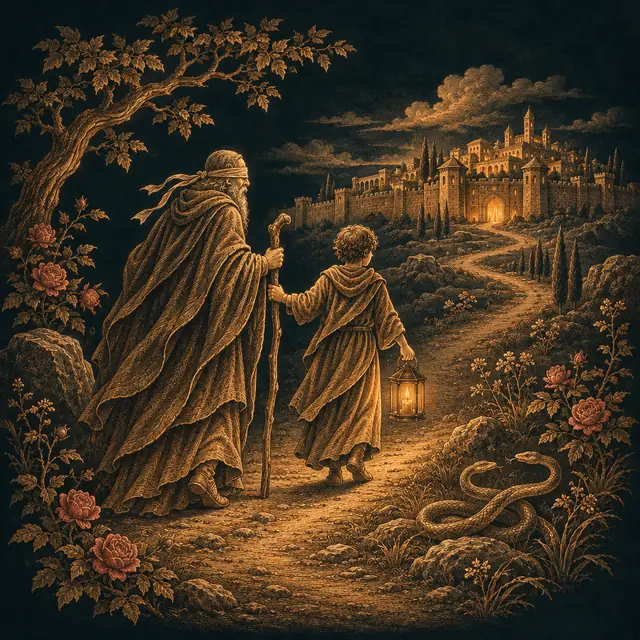
What is the story of Tiresias, and what has it been taken to mean?
The story and its sources
The blind seer of Thebes. In the Odyssey, about 700 BC, he alone among the dead keeps his mind, and Odysseus goes down to ask him the way home. In the plays of Sophocles he tells Oedipus what Oedipus does not wish to know, and warns Creon too late. Two tales explain his blindness: a poem of Hesiod’s school says he was turned into a woman and back, answered a question from Zeus and Hera about men and women, and was blinded by Hera and given foresight by Zeus; Callimachus says he saw Athena bathing.
The teaching
Taught from Homer's Odyssey, the plays of Sophocles, Callimachus' Bath of Pallas and the old tale of the snakes.
Seven years a woman
An old poem of Hesiod's school, retold by later writers, gives the first story of how he came to see. On Mount Cyllene Tiresias comes upon two snakes coupling and strikes them, and he is turned into a woman; seven years later he sees the same pair, strikes them again, and becomes a man. Then Zeus and Hera fall to arguing whether a man or a woman has the greater pleasure in love, and they ask him, who has known both. If the pleasure is counted as ten parts, he answers, the man has one and the woman nine. Hera in anger takes his sight, and Zeus, since no god may undo what another god has done, gives him the knowledge of what is to come and a life of seven generations. Ovid tells it so, with Jupiter, merry with nectar, teasing Juno over the question.
The bath of Pallas
Callimachus tells it otherwise, in his hymn for the bathing of Athena's image at Argos. The boy's mother is the nymph Chariclo, the goddess's dearest companion. One noon on Mount Helicon, while the goddess and the nymph are bathing in the spring of the Horse, Tiresias, out hunting with his dogs, comes thirsty to the water and sees what is not lawful to see, and his eyes are darkened. His mother cries out against the goddess, and Athena answers that it was not she who blinded him: the old laws of Kronos ordain that whoever sees an immortal against the god's will pays a heavy price, and what is done cannot be undone.
But she gives him gifts in place of his eyes: to be a seer above all others, to know which birds are of good omen and which of ill, a staff to guide his feet, a long span of life, and after death to be the only one among the dead who keeps his understanding. And she tells Chariclo that the mother of Actaeon, whose son will be torn apart by his own hounds for seeing Artemis bathe, will one day envy her, who loses only her son's sight.
The seer of Thebes
Through his seven generations he speaks to each ruler of Thebes in turn, reading the birds from his seat of augury, with a boy to lead him and his daughter Manto beside him. He goes out in a fawnskin with old Cadmus to dance for Dionysus while King Pentheus mocks the god. In the war of the seven against Thebes he tells Creon that the city can be saved only if Creon's son Menoeceus dies for it, and the young man gives his life on the walls. He dies when Thebes falls at last to the sons of the seven, drinking from the cold spring of Tilphusa as its people flee.
Oedipus
In Sophocles' Oedipus the King the city is dying of plague, and the oracle demands the killer of the old king Laius. Oedipus sends for the seer, who comes unwillingly, grieving at how terrible it is to know when knowledge brings no help to the one who knows, and he asks to be sent home. Oedipus, enraged by his silence, accuses him of the murder himself. Then Tiresias speaks: Oedipus is the defiler of the land. When the king mocks his blind eyes, he answers that Oedipus has eyes and does not see the evil he stands in, nor where he lives nor with whom; that the man he seeks is here, a Theban born; that he shall go out blind who now sees, and a beggar who is now rich, feeling his way with a staff to a strange land; and that he shall be found brother and father of his own children, son and husband of the woman who bore him, and his father's killer.
Antigone
In the Antigone the boy leads him to King Creon, who has left the body of Polynices for the birds and dogs and walled up Antigone alive for burying her brother. Tiresias tells what he has heard and seen: the birds at his seat screaming and tearing one another with their talons, the sacrifice that will not burn, the fat melting from the thighbones and dripping on the ash, the gall bursting. The altars are fouled with flesh carried from the unburied dead, and the gods no longer take the prayers. All men go wrong, he says, but the one who has gone wrong and mends it, instead of standing fast, is no fool, for stubbornness is the true folly: yield to the dead, and do not stab a fallen man.
Creon calls him a seller of prophecy, and Tiresias answers with the sentence: Creon shall give a child of his own body, a corpse for the corpses, because he has thrust below one who belongs above and keeps above one who belongs to the gods below. Creon gives way, too late.
Among the dead
In the Odyssey the seer comes with his golden staff to the pit Odysseus has dug at the edge of the dead, bids him put up his sword and step back, and drinks the blood. Then he tells him all. The god of the sea is angry with him for blinding his son, but he may yet come home if he and his men leave untouched the cattle of the Sun on Thrinacia; if they harm them, his ship and his men are lost, and he comes home late, alone, in a stranger's ship, to find men devouring his house and courting his wife. When he has killed them he must take an oar on his shoulder and walk inland until he meets people who know nothing of the sea, and a traveller who calls the oar a winnowing fan; there he is to plant it in the ground and sacrifice to Poseidon. And death shall come to him gently, in a sleek old age, with his people prospering around him: a death away from the sea, as most read the words, though they can also mean out of it.
The witness
His tellers make him the one who sees what the sighted will not. In Sophocles blindness and sight change places: the seer knows from the first, and the king who answered the riddle of the Sphinx is the last to know himself, and puts out his own eyes. The seer's word is not his to soften, either: he would keep silent, but the thing will come whether he speaks or not, and those who hear it turn on the one who brings it. In Ovid it is Tiresias who foretells that the boy Narcissus shall live long if he never comes to know himself. T. S. Eliot set him at the heart of The Waste Land, the old man who has lived as man and woman and has suffered beforehand all that the poem shows, and wrote in his notes that what Tiresias sees is the substance of the poem, for in him all its women are one woman and the two sexes meet.
Who took it up
No order was his, though an oracle of his was shown in Boeotia. Poets have used him as the witness who has seen everything: he speaks in Tennyson and stands at the centre of T. S. Eliot’s The Waste Land, 1922.
What later tellings added or changed
That blindness is the price of sight. The Greeks often paired the two, but the stories give different causes, and neither makes it a bargain he chose.
The texts that tell it
- The Odyssey, Book ElevenEpic, about 700 BC
Odysseus goes to the edge of the land of the dead and pours out blood so that Tiresias may drink and speak. Alone among the shades the seer keeps his mind. He tells Odysseus of the trials still to come, of the cattle of the Sun he must not touch, and of a quiet death far from the sea.
Ask the Oracle about it - Oedipus the KingPlay, about 429 BC
In Sophocles’ tragedy Oedipus summons the blind seer to name the killer of the old king, and Tiresias at first will not speak. Taunted, he says that Oedipus himself is the man he seeks. The scene of the blind man who sees and the sighted king who does not is the heart of the play.
Ask the Oracle about it - AntigonePlay, about 441 BC
Tiresias comes to King Creon to tell him the birds and the sacrifices have gone wrong because of the unburied body of Polynices. Creon accuses him of taking bribes, then gives way when it is already too late to save Antigone, his son and his wife.
Ask the Oracle about it - The Bath of PallasHymn, 3rd century BC
Callimachus’ fifth hymn tells another story of the blinding: as a boy Tiresias came by chance upon Athena bathing in a spring and lost his sight for it. His mother, the goddess’s companion, pleads for him, and Athena, unable to undo the law of the gods, gives him the gift of prophecy and a long life.
Ask the Oracle about it - The Waste LandPoem, 1922
T. S. Eliot gives Tiresias the central place in his poem: old, blind, having lived as man and woman, he watches a joyless meeting in a London flat. In his notes Eliot calls him the most important figure in the poem, in whom all the others meet.
Ask the Oracle about it
How the house tells a life
This is a story, told with its sources and with what later tellings added or changed. What it means for you is yours to judge.
The arts it feeds
Lives near it in time
Stories of forbidden knowledge
Isis and OsirisThothGilgameshSisyphusCircePrometheusPandoraPersephoneThe SibylTheseus and the MinotaurCassandraThe PhoenixThe whole tree

