
Persephone
Greek myth; the Homeric Hymn to Demeter, about 650 to 550 BC
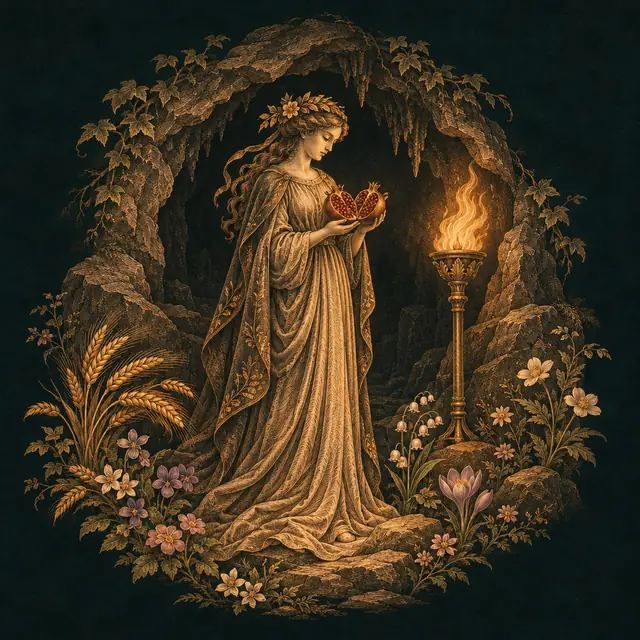
What is the story of Persephone, and what has it been taken to mean?
The story and its sources
Daughter of Demeter, goddess of the grain. In the Homeric Hymn to Demeter, of the late seventh or early sixth century BC, Hades carries her off to the underworld with the consent of Zeus. Her mother searches the earth and lets nothing grow until the gods give way. But Persephone has eaten pomegranate seed below, so she must spend a third of each year there as queen of the dead and returns each spring. The hymn ends with Demeter founding her rites at Eleusis, near Athens.
The teaching
Taught from the Homeric Hymn to Demeter, Ovid's Metamorphoses and Fasti, and Claudian's Rape of Proserpine.
The hymn in brief
The Homeric Hymn to Demeter tells it first. As the girl gathers flowers with the daughters of Ocean, the earth opens beneath a wonderful narcissus that Earth made grow as a snare, at the will of Zeus, and Hades carries her off in his golden chariot. Her mother searches nine days with torches, learns the truth from the Sun, leaves the gods in anger, nurses a prince at Eleusis in the likeness of an old woman, and at last keeps the seed in the ground until Zeus sends Hermes to bring the girl back. The hymn, the rites it founds at Eleusis and their promise are taught in full under Orders and mystery schools, in The ancient mysteries; here the story is told from the daughter's side.
The maiden's own account
When mother and daughter meet, the hymn lets Persephone tell it herself. She was playing in a lovely meadow with her companions, the daughters of Ocean, whom she names one by one, and with Pallas and Artemis, gathering crocus and iris, hyacinth, rose and lily, and the narcissus, which the wide earth made grow yellow as a crocus. She plucked it for joy, and the earth gave way beneath her, and the strong lord who receives many carried her off under the earth in his golden chariot, though she cried aloud. And he put the pomegranate seed in her mouth by stealth, she says, sweet food, and made her eat it against her will; the hymn's own telling says only that he gave it to her in secret. Hecate in her cave heard her cry and the Sun saw it all, and from that day Hecate was her attendant and companion.
The queen below
Hades does not woo her with tears but with a kingdom. As he sends her up to her mother he tells her that while she is below she shall rule all that lives and moves, and have the greatest honours among the gods, and that those who wrong her and do not appease her with offerings shall be punished for ever. So she goes down each year to the throne below, and the Greeks knew her as the dread queen of the dead. In the Odyssey it is she who sends up the shades of famous women to Odysseus, she who might send up the Gorgon's head, and her grace that leaves Tiresias his mind. The gold leaves buried with initiates have the soul greet her as queen of those below and claim to come pure from the pure, and Pindar, as Plato quotes him, sings that those from whom she accepts the price of an ancient grief she sends back in the ninth year to the sun above, to become noble kings and men great in wisdom.
Ovid's Proserpina
Ovid gives the Roman telling as a song of the Muses. The giant Typhoeus lies under Sicily and shakes it, and the king of the dead comes up to see that no crack lets daylight into his realm. Venus, on her mountain of Eryx, sees him and tells Cupid to shoot, to win the third kingdom for love as well, and because the daughter of Ceres, like Pallas and Diana, scorns her. Near Henna, at the lake of Pergus, Proserpina is gathering violets and white lilies when Pluto sees her, loves her and seizes her almost in one moment; her dress tears, the flowers she has gathered fall, and such is the innocence of her years that she grieves for them too. The nymph Cyane rises from her pool to bar his way, saying that he should have asked and not taken; he strikes the pool with his sceptre and drives his chariot down into the earth through it, and Cyane, grieving, melts away in tears into her own water.
The search and the seeds
Ceres searches every land and sea, lighting pine torches at the fires of Etna to search by night. At Cyane's pool the nymph, who can no longer speak, shows her the girl's girdle floating on the water, and the mother curses the whole earth, Sicily most of all, breaks the ploughs and blights the seed. Then the nymph Arethusa, whose stream runs under the sea from Greece, tells her what she saw as she passed through the underworld: Proserpina, sad and still afraid, but a queen, the great wife of the tyrant of the dead. Jupiter answers the mother that this is no injury but love, and that the girl may come back if she has eaten nothing below, for so the Fates decree. But she has eaten seven seeds of a pomegranate in the garden of the dead, and Ascalaphus saw it and told, and she turns him into a screech owl. So Jupiter divides the year, and she spends as many months with her husband as with her mother.
The tellings differ here: the hymn gives one seed and a third of the year below, the Metamorphoses seven seeds and half the year, and Ovid's Fasti three seeds.
Claudian's epic
Claudian, court poet to the emperor Honorius, made an epic of it. The lord of the dead, angry that he alone of the three brothers has no wife, threatens war on heaven and the loosing of the Titans, until the Fates calm him and he asks Jupiter for a bride. Ceres has hidden her daughter in Sicily, in a house the Cyclopes built, and goes to visit the mother of the gods in Phrygia, while the girl sits weaving a robe for her mother with the whole order of the world upon it, the seats of the elements, the zones of the sky and the encircling Ocean. Venus, Diana and Minerva lure her out to the meadows of Henna, and Pluto bursts from the earth in his chariot.
When she weeps he comforts her gently: she shall not lose the light, for below there are other stars and another sun, the blessed fields, a tree of golden fruit that is hers, and the Fates to serve her; and the dead keep holiday at the wedding. The third book follows Ceres home to the empty house and up to Etna, where she lights her torches from two cypresses, and breaks off as her search begins.
What the tellers read in it
The story has been read from the first as the life of the grain. Cicero gives the old reading plainly: Proserpina is the seed of the crops, hidden under the earth and sought by her mother; and Porphyry read the god who carries her down as the sun when it goes beneath the earth, and the maiden as the power in the seed. For the initiates of Eleusis the tale was more than the turning year: the mother's grief and the daughter's return promised them a better lot in the darkness after death. Pausanias records an old poet's word that the flower that snared her was the narcissus, and so argues that the narcissus grew long before the boy Narcissus died. In the twentieth century Carl Jung and Karl Kerényi wrote of mother and daughter as one life seen twice, each woman reaching back into her mother and forward into her daughter.
Who took it up
The Eleusinian Mysteries, kept for well over a thousand years until the sanctuary was closed and then sacked in the 390s AD, were hers and her mother’s. Initiates swore silence about what was shown, and the oath was largely kept: only hostile Christian writers claim to tell it.
What later tellings added or changed
That it is only a tale to explain winter. In Greece the grain lies stored through the dry summer, and some scholars read her absence as that. What the initiates saw at Eleusis is not known, and every modern account of it is a reconstruction.
The texts that tell it
- The Homeric Hymn to DemeterHymn, about 650 to 550 BC
The oldest full telling. Hades carries Persephone off as she gathers flowers; Demeter searches with torches, nurses a prince at Eleusis in disguise, and withholds the grain until Zeus gives way. Because the girl has eaten pomegranate seed, she must spend part of each year below. The hymn ends with the founding of the rites at Eleusis.
Ask the Oracle about it - Metamorphoses, Book FivePoem, about AD 8
Ovid tells the rape of Proserpina, as the Romans named her, as a song sung by the Muses. Venus sends Cupid to make Pluto love her; the nymph Cyane weeps herself into a pool; and the girl must spend half the year with her husband and half with her mother. He told it again in the Fasti.
Ask the Oracle about it - The Rape of ProserpineEpic, about AD 396
Claudian, a court poet at Milan and Rome, wrote three books of a Latin epic on the theft of Proserpina and the search of Ceres, rich in description of the underworld and of Sicily. It was left unfinished, and was much read and copied in the Middle Ages.
Ask the Oracle about it - The Rape of ProserpinaSculpture, 1621 to 1622
Gian Lorenzo Bernini carved Pluto seizing her in white marble, with his fingers pressing into her thigh and the three headed dog Cerberus at his feet, when he was in his early twenties. It stands in the Galleria Borghese in Rome and is the best known image of the myth.
Ask the Oracle about it
How the house tells a life
This is a story, told with its sources and with what later tellings added or changed. What it means for you is yours to judge.
The arts it feeds
Lives near it in time
Stories of forbidden knowledge
GilgameshSisyphusCirceTiresiasPrometheusPandoraThe SibylTheseus and the MinotaurCassandraThe PhoenixDionysusOrpheusThe whole tree

