
Christian Rosenkreuz
Legend; first told in the Fama Fraternitatis, printed 1614
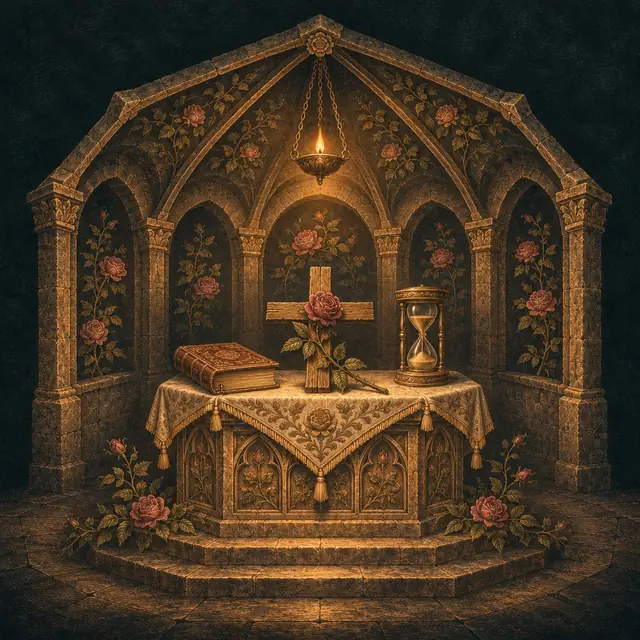
What is the story of Christian Rosenkreuz, and was he a real person?
The story and its sources
The founder named in the Rosicrucian manifestos. The Fama Fraternitatis, printed at Kassel in 1614, tells of a German of noble birth who learned the wisdom of the East at Damascus, Damcar and Fez, came home, founded a brotherhood of eight to heal the sick without payment, and died at more than a hundred. His tomb, it says, was opened 120 years later and found lit from within, the body whole. The Confessio followed in 1615 and gave his birth as 1378 and his age as 106, and in 1616 The Chymical Wedding, an allegorical romance, which the Lutheran pastor Johann Valentin Andreae later owned as his own youthful work.
The teaching
Taught from the three Rosicrucian books of 1614 to 1616, with Michael Maier and the later Rosicrucians who took up the founder.
The founder in brief
The Fama's founder is a German of noble birth and small means who learns the wisdom of Damcar and Fez, is laughed at by the learned of Spain, and comes home to gather eight brothers sworn to heal the sick for nothing and to stay hidden a hundred years. His tomb, opened a hundred and twenty years after his death, is a vault of seven sides lit by a sun of its own, with his body whole inside. His journey, his vault and his Chymical Wedding are told in full on the branch The Rosicrucians; what follows is what the books and their readers make of the man himself.
The guest who thought himself unworthy
The Chymical Wedding draws him as an old man and makes his humility the point of the tale. When the winged messenger brings his invitation he is so afraid that his hair stands on end and a cold sweat runs over him, though a vision had told him seven years before that the call would come. At the castle, among guests who boast of their learning and their visions, he and eight others choose to spend the night bound in the hall rather than lie down among the proud. When all are weighed, emperors, kings and the learned are found too light, nearly every one, and of the nine who doubted themselves only he and one companion outweigh all seven weights; when three knights are added to the scale, he outweighs them too.
He is honest to the end. On the last day, hearing the old porter's plea and the rule that whoever commits his fault must take his place, Christian, who need not have spoken, goes to the king and confesses that he too has looked on the sleeping Venus, a sight forbidden to the guests, and takes the keeping of the gate on himself.
The silence after the call
The Fama ended by asking the learned of Europe to answer, and hundreds did, in letters and printed pamphlets, and no one heard back. Michael Maier, physician to the emperor, wrote his Silentium post clamores, the silence after the clamours, to explain why. Colleges of the wise, he argued, have stood among many peoples from the oldest times, among the Egyptians and the followers of Pythagoras, and all of them kept silence and chose their members, so that the secrets of nature should not be thrown before the unworthy. A brotherhood that answered every letter would be no such brotherhood; the brothers read the heart and call whom they find ready, and the seeker's part is to make himself worthy and wait.
The master of the later orders
Later Rosicrucians set him at the head of their own line. The orders of the eighteenth century and after, from the Gold and Rosy Cross onwards, claimed to carry on his brotherhood, and the Golden Dawn built a copy of his seven-sided vault for the rite by which its members entered its inner order. Rudolf Steiner taught that he was a real initiate: a child raised in the thirteenth century by a council of twelve wise men, who gathered all their wisdom into him, then born again in the fourteenth as Christian Rosenkreutz, to live more than a hundred years and teach their pupils, and at work unseen in every century since.
What the story teaches
The books teach a way of holding knowledge through the life they give their founder. Learn from every people, as he learned at Damcar and Fez, and keep what is good even where it is mixed with error; give the art away, healing the sick and taking nothing; live as the people of the country live and do not set yourself apart; choose a worthy heir; and let what you know wait for its time, as his vault waited a hundred and twenty years to open. The Chymical Wedding adds the virtue the rest depend on: of all the guests it is the old man who doubted his own worth who is found heavy enough, and the one who owns his fault unasked who is trusted with the gate.
Who took it up
No brotherhood answered the hundreds who wrote in reply to the manifestos, and none has been shown to exist then. Every later Rosicrucian body, from the Gold and Rosy Cross of the 1750s to AMORC, founded in 1915, took the name from the books.
What later tellings added or changed
That he lived. Historians treat him as a figure of fiction from the circle of Andreae at Tübingen; the name, a rose and a cross, echoes Luther’s seal and the arms of Andreae’s own family. The dates in the Confessio fit no record.
The texts that tell it
- Fama FraternitatisLegend, printed 1614
The first Rosicrucian manifesto, printed at Kassel, which tells his story: a German of noble birth who learned at Damascus, Damcar and Fez, founded a brotherhood of eight to heal the sick without payment, and whose tomb was found lit from within 120 years after his death. It called the learned of Europe to answer, and hundreds did.
Anonymous; it came from the circle of Johann Valentin Andreae at Tübingen.
Ask the Oracle about it - Confessio FraternitatisLegend, printed 1615
The second manifesto, printed at Kassel in Latin, which gave his birth as 1378 and his age at death as 106, attacked the pope and promised a coming reformation of the world. No brotherhood ever answered those who wrote in reply.
Anonymous, from the same circle as the Fama.
Ask the Oracle about it - The Chymical Wedding of Christian RosenkreutzNovel, printed 1616
An allegorical romance in seven days in which the old Christian Rosenkreutz is called to a royal wedding, passes trials and watches a king and queen raised again by alchemical art. Johann Valentin Andreae later owned it as a jest of his youth.
Ask the Oracle about it - Silentium post clamoresBook, printed 1617
Michael Maier’s defence of the brotherhood the manifestos announced, one of the hundreds of books and pamphlets their story set off, explaining why so few who wrote to the brothers had heard back. Its author nowhere claims to have met them.
Ask the Oracle about it
How the house tells a life
This is a story, told with its sources and with what later tellings added or changed. What it means for you is yours to judge.
The arts it feeds
Lives near it in time
Stories of forbidden knowledge
The Holy GrailOdinLokiFaustThe Monkey KingThe GolemHiram AbiffThe Sorcerer’s ApprenticeFrankensteinJekyll and HydeDorian GrayDraculaThe whole tree

