
Dorian Gray
The novel by Oscar Wilde, 1890
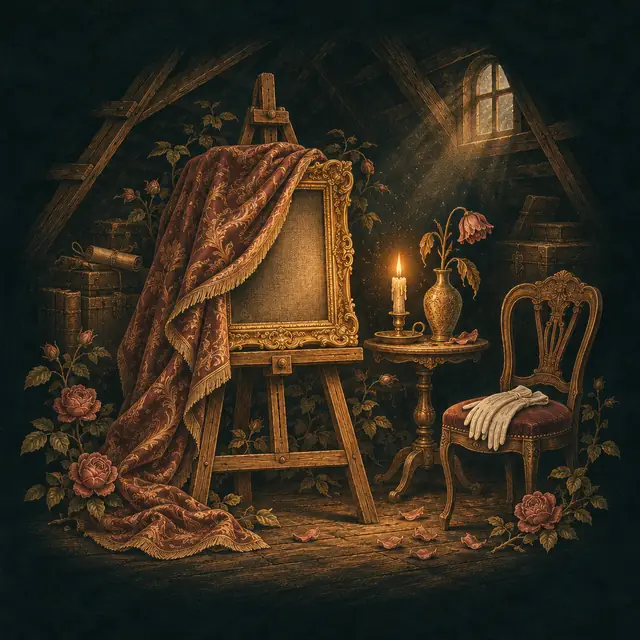
What is the story of Dorian Gray, and what does it warn of?
The story and its sources
The only novel of Oscar Wilde, printed in a magazine in 1890 and as a book, lengthened and with its famous preface, in 1891. A painter makes a portrait of a beautiful young man, Dorian Gray, who wishes that the picture might grow old in his place. It does. Led on by the talk of Lord Henry Wotton he lives for sensation, and every cruelty marks the canvas while his face stays young. He hides the picture in an attic. At last he stabs it, and the servants find the portrait fresh and a withered dead man on the floor, known only by his rings.
The teaching
Taught from Oscar Wilde's novel as he lengthened it in 1891, with its preface and his letters in its defence.
The preface
Wilde set his rules before the story. The artist is the creator of beautiful things; to reveal art and conceal the artist is art's aim. “There is no such thing as a moral or an immoral book. Books are well written, or badly written. That is all.” Those who find ugly meanings in beautiful things are corrupt without being charming; it is the spectator, and not life, that art really mirrors; and the preface ends, “All art is quite useless.”
The wish before the portrait
In the painter Basil Hallward's studio, among the scent of lilac and the murmur of bees, Lord Henry Wotton sees the portrait of a young man of extraordinary beauty and wants to meet him; Basil, who has put too much of himself into the picture, begs him not to spoil the boy. Dorian comes to sit, and Lord Henry talks to him: of the only way to be rid of a temptation, which is to yield to it; of curing the soul by the senses and the senses by the soul; of youth, the one thing worth having, which goes so soon.
When the portrait is finished Dorian looks at it and understands for the first time that he will grow old and the picture will not. If only it were the other way, he cries: if the picture could grow old and he stay young, he would give everything for it; he would give his soul.
Sibyl Vane
Dorian falls in love with Sibyl Vane, a girl of seventeen who plays Shakespeare's heroines in a shabby theatre in the East End, Juliet one night and Rosalind the next; her brother, a sailor leaving for Australia, swears to kill the man if he ever wrongs her. Dorian brings his friends to see her act, and she acts badly, because, she tells him, now that she knows real love she can no longer pretend; and he, who loved her only as art, casts her off cruelly. Going home at dawn he sees a touch of cruelty in the mouth of the portrait.
He resolves to make amends and marry her, but the next day Lord Henry brings word that she has killed herself, and teaches him to see her death as a fine tragedy in which he had a part. That night Dorian goes to the opera.
Eighteen years
He hides the portrait under a purple pall in his old schoolroom at the top of the house and keeps the key. Lord Henry sends him a yellow book, a French novel about a young man who spends his life seeking every sensation, and it becomes the pattern of his own. For eighteen years he studies perfumes, music, jewels and embroideries, the vestments of the Church and the lives of the wicked; rumours follow him, young men he befriended come to shame and ruin, and he goes in disguise to the opium dens by the docks; and every cruelty marks the canvas while his face stays young. He goes up to the locked room and holds a mirror beside the picture, looking from the ruined face on the canvas to the young one that laughs back from the glass.
The murder and the hunt
On the eve of his thirty-eighth birthday Basil comes to beg him to answer the rumours, saying he would have to see Dorian's soul to know him. Dorian takes him up to the room and shows him the soul. Basil, horrified, begs him to pray, and Dorian, seized by a sudden hatred, stabs him in the neck. He forces a chemist who was once his friend to destroy the body, and the man later kills himself.
In an opium den a woman calls him Prince Charming, Sibyl's name for him, and her brother, who has hunted him all these years, catches him in the street; Dorian points to his face in the lamplight, a face of twenty, and is let go, until the woman tells the sailor that the man has had that face for eighteen years. Soon after, Sibyl's brother is shot by accident in a thicket on Dorian's estate, and Dorian feels only relief.
The knife and the picture
At last Dorian tells Lord Henry he means to be good: he has spared a village girl he could have ruined. He goes up to see whether the portrait has changed for it. It has, but only to show a new look of cunning in the eyes and the curved wrinkle of the hypocrite about the mouth, for the good deed was vanity and the wish for a new sensation. The picture is his conscience, and it will not let him rest. He takes the knife that killed Basil and, to kill the past and be free, stabs the canvas.
The servants hear a cry, break in, and find on the wall a splendid portrait of their master in all his youth and beauty, and on the floor a dead man in evening dress with a knife in his heart, withered, wrinkled and loathsome of face, whom they know only by his rings.
What the story teaches
Wilde, answering the reviewers who called the book immoral, said that it had a moral after all, and named it: “All excess, as well as all renunciation, brings its own punishment.” The painter worships beauty too much and dies by the hand of the soul he helped make vain; Dorian lives for sensation and tries to kill his conscience, and in that moment kills himself; Lord Henry would be only a spectator of life, and learns that those who will not take part are wounded more deeply than those who do. The portrait teaches the rest without a word: a life can keep its face and lose its soul, and the soul keeps the record.
Who took it up
No order was involved. Reviewers of 1890 called the book immoral, and passages from it were read against Wilde at his trials in 1895. The bargain echoes Faust, though no devil appears and no contract is signed: the wish is simply granted.
What later tellings added or changed
That Wilde meant a plain sermon. His preface says there is no such thing as a moral or an immoral book. That the picture was a real cursed painting: it is his invention.
The texts that tell it
- The Picture of Dorian Gray, in Lippincott’sNovel, 1890
The first version, printed in thirteen chapters in Lippincott’s Monthly Magazine of July 1890. Its editor had already cut passages he feared would offend, and the reviews still called the story immoral. This is the text of the bargain between a young man and his painted likeness as Wilde first published it.
Ask the Oracle about it - The Picture of Dorian GrayNovel, 1891
The book edition, issued by Ward, Lock and Company, in which Wilde added six chapters, toned down some lines and set at the front his preface of epigrams on art. The new chapters give the story of Sibyl Vane’s brother and widen Dorian’s fall. It is the text nearly every reader since has known.
Ask the Oracle about it - The Picture of Dorian Gray, the filmFilm, 1945
Albert Lewin’s film for MGM, with Hurd Hatfield as Dorian and George Sanders as Lord Henry. It is shot in black and white, and the portrait alone appears in colour, the ruined version painted by Ivan Albright. It fixed the image of the hidden picture for a generation of viewers.
Ask the Oracle about it - The Picture of Dorian Gray, the operaOpera, 1996
An opera by the American composer Lowell Liebermann, to his own libretto after Wilde, first staged at Monte Carlo. It keeps the story close to the novel and gives the portrait’s changes to the orchestra. It is one of the few full stagings of the tale in music.
Ask the Oracle about it - The Picture of Dorian Gray: An Annotated, Uncensored EditionNovel, 2011
An edition by the scholar Nicholas Frankel, printed by Harvard University Press, of Wilde’s typescript as he sent it to the magazine, before its editor cut it. It restores passages on the painter’s love for Dorian that were removed before the story first appeared. It shows how much of the book was shaped by fear of scandal.
Ask the Oracle about it
How the house tells a life
This is a story, told with its sources and with what later tellings added or changed. What it means for you is yours to judge.
The arts it feeds
Lives near it in time
Stories of forbidden knowledge
The Holy GrailOdinLokiFaustThe Monkey KingThe GolemChristian RosenkreuzHiram AbiffThe Sorcerer’s ApprenticeFrankensteinJekyll and HydeDraculaThe whole tree

