
Dracula
The novel by Bram Stoker, 1897
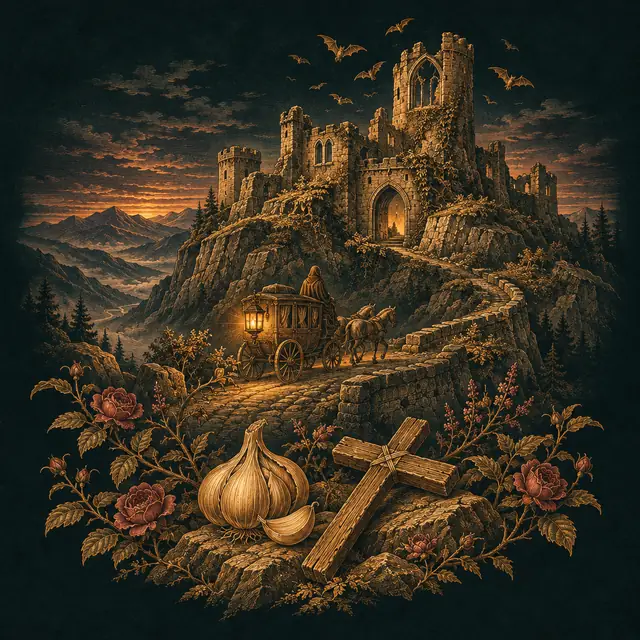
What is the story of Dracula, and what is truly known of its sources?
The story and its sources
A novel by the Irish writer Bram Stoker, published in 1897 and told through diaries, letters and newspaper cuttings. A Transylvanian count buys a house in England and travels there by ship; a small company led by Professor Van Helsing track him, drive him home and destroy him at sunset before his castle. Stoker never visited Transylvania. He took the name from a history book in the library at Whitby, which mentioned a fifteenth-century prince of Wallachia called Dracula, and built the rest from travel books and from earlier vampire fiction such as Carmilla.
The teaching
Taught from Bram Stoker's novel of 1897, told in its own journals, letters and cuttings.
Harker's journal
The story begins in the journal of Jonathan Harker, a young solicitor sent to Transylvania to settle the purchase of an old estate near London for Count Dracula. On the way, on the eve of St George's Day, a landlady presses a crucifix on him, and peasants cross themselves and make the sign against the evil eye; at the Borgo Pass a calèche driven by a tall man with burning eyes carries him through a night of blue flames and wolves to a ruined castle. The Count welcomes him at the door: “Welcome to my house! Enter freely and of your own will!” He is a tall old man with a long white moustache, pointed ears, sharp white teeth, hair on the palms of his hands and a grip as cold as ice.
The prisoner of the castle
Little by little Harker learns where he is. The Count casts no reflection in his shaving glass, lunges at his throat when he cuts himself, and draws back from the crucifix round his neck; the doors are locked and Harker is a prisoner. From a window he sees the Count crawl face down the castle wall like a lizard. In a forbidden room three women with red lips and sharp teeth bend over him to feed, until the Count drives them off and gives them a child in a bag instead. In the chapel vaults he finds the Count lying in a box of earth, his eyes open and stony, his lips red with fresh blood. Fifty boxes of earth go down the road to the sea, and Harker escapes down the wall.
Lucy
The Count crosses to England in a Russian schooner that drifts into Whitby harbour in a storm, its dead captain lashed to the wheel with a crucifix in his hands, and a great dog leaps ashore. Lucy Westenra, the friend of Harker's betrothed, Mina, walks in her sleep to the churchyard on the cliff, where Mina sees something dark bent over her, and afterwards there are two small red marks on her throat. Her old suitor Dr Seward calls in his teacher from Amsterdam, Professor Van Helsing, and four men give her their blood; Van Helsing fills her room with garlic flowers, but her mother, not knowing, takes them away, and a wolf breaks the window. Lucy dies, and soon the newspapers tell of a beautiful lady who lures children on Hampstead Heath.
The stake and the Host
Van Helsing shows the others what she has become. By night her tomb is empty; by day she lies in it more beautiful than in life, her lips red; and in the churchyard they see her come with a child at her breast and call to Arthur, her betrothed, with a voluptuous sweetness. Van Helsing seals the tomb against her with the consecrated Host crumbled into paste, and the next day Arthur drives a stake through her heart while the others pray. Her face goes back to the sweetness and purity they knew, and they cut off her head and fill her mouth with garlic. Then the little company swears to hunt the Count himself.
The lore of the nosferatu
Van Helsing teaches them what he knows. The vampire, the nosferatu, does not die like the bee when it has stung once; it grows stronger, has the strength of twenty men, and can command the rat, the owl, the bat, the moth, the fox and the wolf. It can come as mist or as a beast, see in the dark and pass through a crack; it casts no shadow and no reflection. It may not enter a house unless someone of the household has once bidden it come in. Its power ceases with the dawn, and it can change its shape only at noon, at sunrise or at sunset; it must rest in the unhallowed earth of its own grave, and it can cross running water only at the slack or the flood of the tide.
Garlic it hates, and the crucifix, and a branch of wild rose laid on its coffin keeps it in; a sacred bullet fired into the coffin kills it, or a stake through the heart, or the cutting off of the head. The Count, he says, must have been the voivode who won his name against the Turk across the great river, and learned his arts at the Scholomance in the mountains above Lake Hermanstadt, where the devil claims the tenth scholar as his due.
The hunt
The Count strikes back at the company itself. He comes by night to Mina, now Jonathan's wife, while her husband lies in a stupor, and makes her drink his blood from a cut in his breast, binding her to him; when Van Helsing touches her forehead with the Host it burns a red scar into her skin, and she cries out that she is unclean. The hunters find his boxes of earth across London and make each useless with the Host, and when they corner him in his house in Piccadilly a slash of Jonathan's knife spills gold from his coat and he flees, crying that his revenge has only begun and that time is on his side.
He sails for home. Through her bond with him, Mina under hypnosis at sunrise and sunset hears what he hears, lapping water and creaking chains, and reasons out his road: up the rivers to his castle, carried in his box by the Szgany who serve him.
Sunset before the castle
The hunters divide and race him across the snows of Transylvania. Van Helsing, with Mina, reaches the castle first, sets her inside a ring of crumbled Host where the three women cannot reach her, and by day destroys them in their tombs. At sunset on the sixth of November the cart with the great box comes up the road with its Szgany guard, and the men fight their way to it; Jonathan's knife shears through the Count's throat as the Texan, Quincey Morris, plunges his bowie knife into the heart, and the body crumbles into dust before their eyes, with a look of peace on the face.
Quincey, mortally wounded, dies seeing that the scar has gone from Mina's forehead. Seven years later Jonathan adds a note: they have a son, named for their friend, and no proofs of what happened, and they ask no one to believe them.
What the story teaches
Stoker's novel sets the oldest protections against the newest age. Its hunters are a doctor, a lawyer, a lord, a Texan and a schoolmistress with a typewriter, who keep their records in shorthand, on phonograph cylinders and by telegraph, and who win only when they join that modern method to the old lore of garlic, the crucifix, the wafer and the stake, and to the faith that gives those things their power. Van Helsing asks the doubting doctor whether there are not things which he cannot understand, and yet which are.
The evil in the book must first be invited in, and it is resisted by a company that holds together, gives its blood for one another and shares everything each of them knows, until the scattered journals and letters become the single record the reader holds.
Who took it up
No order is behind it. The Balkan belief in the returning dead was real and was reported to western Europe in the 1720s and 1730s, when Austrian officials recorded graves being opened in Serbia. Stoker’s papers show no link with the Golden Dawn, though it is often said he was a member.
What later tellings added or changed
That the Count is a portrait of Vlad the Impaler. Stoker’s notes show he knew little more than the name and a line or two. Sunlight does not kill the Count in the book; that comes from the film Nosferatu, 1922. Romanian folklore did not treat the prince as a vampire.
The texts that tell it
- DraculaNovel, 1897
Bram Stoker’s novel, told in diaries, letters and newspaper cuttings, of a Transylvanian count who travels to England and the company led by Professor Van Helsing that hunts him home. It drew on travel books, earlier vampire fiction and the Balkan belief in the returning dead. It made the vampire one of the great figures of modern fiction.
Ask the Oracle about it - Dracula, or The UndeadPlay, 1897
A stage reading of the novel given at the Lyceum Theatre in London on 18 May 1897, a week before the book came out, to protect Stoker’s rights in it. Stoker was the theatre’s manager and cut the script from his own proofs. It was performed once, to a small audience.
Ask the Oracle about it - Dracula’s GuestStory, 1914
A short story printed by Stoker’s widow Florence two years after his death, in which an Englishman on his way to Transylvania is lost in a storm near Munich and saved by a great wolf. She said it was an episode left out of the novel. It is often printed with Dracula as a prelude.
Whether it is a cut chapter of the novel or a separate story is debated.
Ask the Oracle about it - NosferatuFilm, 1922
F. W. Murnau’s silent film, an unlicensed version of the novel with the names changed and the count called Orlok. Florence Stoker sued, and a German court ordered the copies destroyed, though some survived. It is the source of the idea that sunlight kills the vampire, which is not in the book.
Ask the Oracle about it - Dracula, the stage playPlay, 1924
The play written by the actor Hamilton Deane, licensed by Florence Stoker, which toured Britain and reached London in 1927. Revised by John L. Balderston, it opened on Broadway that year with Bela Lugosi as the count. It gave Dracula his evening dress and his cape.
Ask the Oracle about it - Dracula, the filmFilm, 1931
Tod Browning’s film for Universal, drawn from the Deane and Balderston play, with Bela Lugosi repeating his stage part. Its accent, manner and staring eyes made the image of the count that most people now hold. It began the long line of horror films from that studio.
Ask the Oracle about it
How the house tells a life
This is a story, told with its sources and with what later tellings added or changed. What it means for you is yours to judge.
The arts it feeds
Lives near it in time
Stories of forbidden knowledge
The Holy GrailOdinLokiFaustThe Monkey KingThe GolemChristian RosenkreuzHiram AbiffThe Sorcerer’s ApprenticeFrankensteinJekyll and HydeDorian GrayThe whole tree

