
Padmasambhava
8th century AD
Who was Padmasambhava, and what is truly known of them?
What is known
The Indian tantric teacher whom Tibetan Buddhists call Guru Rinpoche and whom the Nyingma school honours as a second Buddha. The oldest sources are slight. The Testament of Ba, whose earliest parts go back to the ninth or tenth century, and manuscripts from Dunhuang tell of a teacher from Oddiyana invited to Tibet under King Trisong Detsen in the 770s, who subdued the spirits of the place so that Samye, the first monastery in Tibet, could be built, and who then left or was sent away. Historians accept that such a teacher probably came; almost everything else that is told of him belongs to later devotion.
The teaching
Taught from what the Tibetan tradition keeps in his name, from the Garland of Views to the treasure texts.
The view and the deed
Tibetan tradition gives his teaching one line above all: though my view is higher than the sky, my care for the cause and effect of actions is finer than flour. The view is the mind's own nature, open and without limit, in which there is nothing to take up or throw away; the conduct is the plain law of karma, kept in the smallest act. The two are held together, and neither excuses the other.
The nine vehicles
The Garland of Views, a short text the Nyingma hold to be his own, sets every path in order, and the school counts nine vehicles after it. Three lead out of the source of suffering: the vehicle of the hearers, who know the four truths and the absence of a self in persons; of the solitary buddhas, who see the twelve links of dependent arising alone; and of the bodhisattvas, who join the emptiness of all things to compassion for all beings.
Three are the outer tantras, of purity and austerity: in kriya the practitioner serves the deity as a subject serves a lord, with washing, fasting and offerings; in charya the two meet as friends; in yoga the practitioner and the deity are of one nature. And three are the inner tantras, of skilful means: mahayoga, which sees all that appears as the mandala of the deities and trains in the stage of creation; anuyoga, the stage of completion, where space and wisdom are inseparable, worked through the subtle body only under a teacher; and atiyoga, the Great Perfection, which teaches that the mind's nature is pure and complete from the beginning, so that there is nothing to make and nothing to remove, only to recognise.
Taming, not destroying
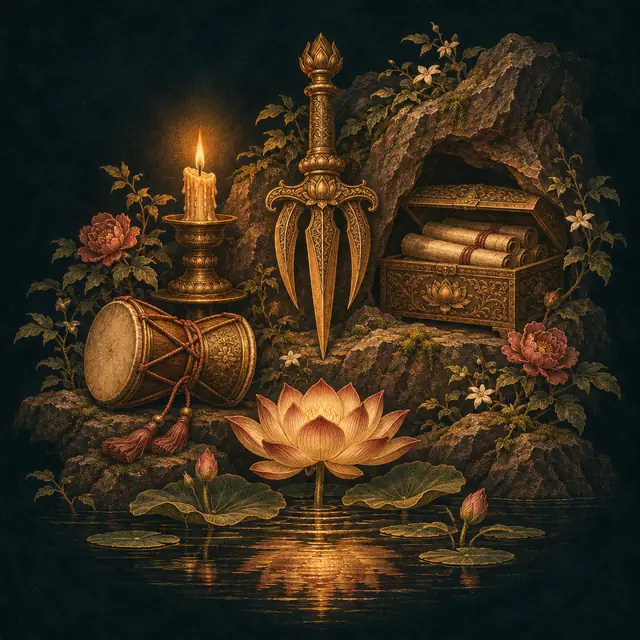
The oldest stories tell of him as one who tamed the spirits of a land, and the tradition teaches what that taming is. A hostile spirit is not killed but brought under an oath to protect the teaching, so that the old gods of mountain and lake become its guardians. The wrathful deities of his rites, and the ritual dagger of Vajrakilaya above all, work in the same way: the dagger pins down what obstructs, and its three-sided blade cuts the three poisons, desire, hatred and ignorance, which are the real enemies. The fierce form is compassion at its fiercest, aimed at the obstacle and never at the being.
The mind's own nature
The cycle of treasure texts in which the Book of the Dead was found holds a short teaching in his name on seeing awareness naked. This one mind, it says, which holds all of the round of births and all of nirvana, has been present from the beginning, and yet it is not recognised. The schools give it many names, the self, the mind, the middle, buddha nature, the great seal, the ground of all. Look into your own mind: looking, there is nothing to see, and that not seeing is the seeing. It is empty, without centre or edge; it is clear, and knows; and its display never stops. The buddha is not to be looked for anywhere else.
The between
From the same cycle comes the Liberation by Hearing in the Between, read to the dying and the dead. Its six betweens, the clear light at death, the peaceful and wrathful deities, and its counsel to recognise all that appears as the mind's own display are taught on the page of the Tibetan bardo, among death and what follows. It is the teaching of naked awareness given for the hour when it is needed most: whoever has learned in life to recognise the mind's nature can recognise it in death.
The prayer and the mantra
He is approached first by prayer. The prayer in seven lines that every Nyingma practitioner knows calls on him from the north west of the land of Oddiyana, where he was born on the stem of a lotus and gained the highest accomplishment; it names him the Lotus Born, surrounded by many dakinis, and asks him, as the one in whose footsteps the practitioner follows, to come and give his blessing.
His mantra is Om Ah Hum Vajra Guru Padma Siddhi Hum. The first three syllables are the body, speech and mind of the buddhas; Vajra Guru is the teacher of the indestructible; Padma is the lotus, his family and his name; Siddhi asks for accomplishment, the ordinary kind and the highest; and the last Hum gathers it into the heart. It is recited in a steady voice, without strain, with the mind on its meaning.
Guru yoga
The heart of his practice is guru yoga, union with the teacher. One sees him in front or above the crown of the head, in his familiar form, and prays with the seven lines and the mantra. Lights stream from the three syllables at his forehead, throat and heart, white, red and blue, into one's own forehead, throat and heart, cleansing body, speech and mind and giving their blessing. At the end he melts into light and dissolves into oneself, and one rests, making nothing, in the nature of mind, which is the teacher's mind and one's own, never two.
Orders and memberships
The Nyingma, the oldest school of Tibetan Buddhism, takes him as its founder, and every Tibetan school honours him. The Nyingma took shape as a body in the centuries after him, in answer to the newer schools of the eleventh century.
The legend
That he was born as a boy of eight in a lotus on a lake, that he lived for more than a thousand years, and that he hid teachings across Tibet, the treasures or terma, to be found by destined revealers in later ages. The book known in the West as the Tibetan Book of the Dead is one of these: tradition has him compose it, and Karma Lingpa brought it to light in the fourteenth century.
Their works
- Testament of BaAccount, earliest parts 9th or 10th century
A Tibetan account of the founding of Buddhism in Tibet under King Trisong Detsen, which tells of a teacher from Oddiyana who subdued the spirits of the land so that Samye could be built and was then sent away. It is among the oldest sources for him and treats him far more briefly than later lives.
It survives in several versions of different dates, and its oldest layer is argued.
Ask the Oracle about it - Copper Island LifeBiography, 12th century
The Zanglingma, a life of Padmasambhava revealed as a hidden treasure by Nyangral Nyima Özer, which tells of his birth in a lotus, his teaching in Tibet and his hiding of teachings for later ages. It set the pattern of his sacred biography.
Tradition holds it was hidden by his consort Yeshe Tsogyal; historians date it to its revealer’s century.
Ask the Oracle about it - Chronicle of PadmaBiography, 1352
The Padma Kathang, a long verse life of Padmasambhava revealed by Orgyen Lingpa, telling his lotus birth, his deeds in India and Tibet and his parting for the land of the demons in the southwest. It is the life Tibetan devotion knows best.
Tradition holds it was hidden in his time; historians date it to its revealer’s century.
Ask the Oracle about it - Tibetan Book of the DeadScripture, 14th century
The Bardo Thodol, Liberation by Hearing in the Between, a text read to the dying and the dead to guide them through the states between death and rebirth. Karma Lingpa brought it to light as a hidden treasure. Walter Evans Wentz published it in English in 1927 under its Western name, and Jung wrote on it.
Tradition has Padmasambhava compose it; historians date it to its revealer’s century.
Ask the Oracle about it
How the house tells a life
This life is told from the record, with what is documented, what is legend and what was forged kept apart. A membership in an order is stated only where documents show it. A person’s chart explains none of their deeds.
The arts it feeds
Lives near it in time
Thinkers and teachers
ManiPorphyryHypatiaProclusBodhidharmaAdi ShankaraAl-KindiAvicennaMilarepaAl-GhazaliHildegard of BingenJoachim of FioreThe whole tree

