
Porphyry
About 234 to about 305
Who was Porphyry, and what is truly known of them?
What is known
Philosopher born at Tyre in Phoenicia and first named Malchus. He studied at Athens under Longinus and from 263 at Rome under Plotinus, who sent him to Sicily to recover from a time of despair. About 301 he published his teacher’s essays as the Enneads, with a Life of Plotinus. His Isagoge, an introduction to Aristotle’s logic, was the beginner’s book of logic through the Middle Ages. He wrote On Abstinence, the fullest ancient case against killing animals for food; On the Cave of the Nymphs, which reads a passage of Homer as the soul’s descent and return; a Letter to Anebo, questioning the rites of the priests; and Against the Christians, in fifteen books, which emperors ordered burned and which survives only in fragments.
The teaching
Taught from his own books, above all On Abstinence, On the Cave of the Nymphs, the Sentences and the Letter to Marcella.
Genus, species and the ladder of kinds
Porphyry's Introduction teaches the five words by which anything can be said of anything. A genus is what is said of many things differing in kind, in answer to what they are, as animal is said of horse and man. A species is what stands under a genus, as man under animal. A difference sets one species apart from another in the same genus, as rational sets man apart from horse. A property belongs to one species alone, to all of it and always, as the ability to laugh belongs to man. An accident can come and go without destroying its subject, as being white, or being asleep.
Ordered by these, the kinds form a ladder. At the top is substance, the highest genus; under it body; under body, living body; under that, animal; under animal, rational animal; under that, man; and under man the individuals, Socrates and Plato. Each step down adds a difference and each step up takes one away.
The cave with two gates
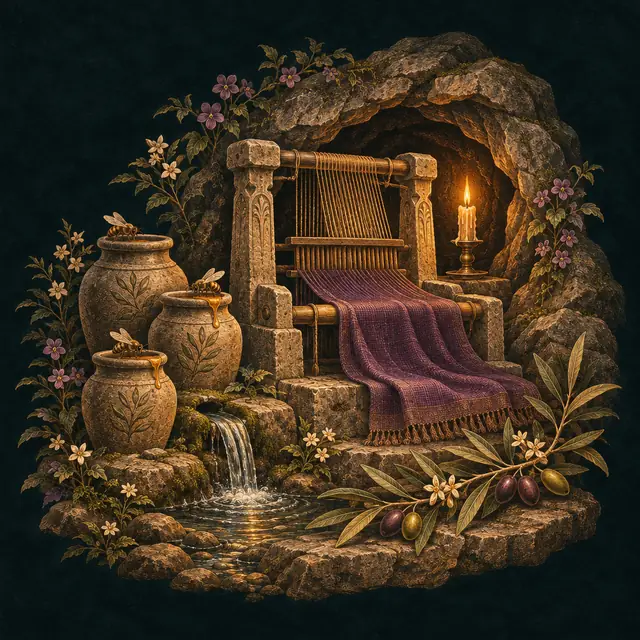
Porphyry reads the cave of the nymphs in the Odyssey as the world and the soul's way through it. The cave is lovely and dim: dim because the world is made of matter, lovely because it is ordered by form. Its nymphs of the springs are souls coming down into birth, drawn by moisture, for souls take delight in becoming wet, as Heraclitus says. The looms of stone on which the nymphs weave cloth of sea purple are the bones, on which the soul weaves its flesh of blood; the bees that store their honey there are the souls who live justly and go home, and honey, which preserves and purifies, is their sign.
The cave has two gates. The northern gate is the way down for mortals, and the southern gate, which no mortal enters, is the way of the gods. Following older readers, he sets them in the sky: souls come down into birth through Cancer, the sign of the summer turning, and go up through Capricorn, the sign of the winter turning. The olive at the head of the harbour stands for the wisdom by which the world is made. And Odysseus, who lays his goods down in the cave, must still wander until he reaches people who know nothing of the sea: so the soul must put off everything of this world of matter before it is at rest.
Why the seeker of god keeps from meat
On Abstinence is written to a friend who has gone back to eating meat. It is not addressed to athletes, soldiers, sailors or those in public life, but to the one who asks who he is, where he came from and where he is going. That person must loosen the soul from the body, and the food of flesh, Porphyry holds, weighs the soul down and feeds the passions, while a plain diet without meat leaves the mind free for what is above.
Nor do the gods ask for blood. The first offerings, he teaches after Theophrastus, were grass, then the fruits of trees, then grain, wine and oil; the killing of animals came later, born of famine and war. To the god above all nothing that can be seen or spoken is to be offered, only pure silence and pure thoughts of him; to the gods of mind, hymns; to the lesser gods, first fruits. It is the wicked daimons that feed on the smoke of blood.
And animals reason, feel and speak among themselves, so justice reaches them too: to kill them for food without need is to wrong them. He ends with the peoples who kept from flesh: the priests of Egypt, the Essenes, the Brahmins and ascetics of India, and the highest of the Persian magi.
The four grades of virtue
In his Sentences the virtues stand in four grades. The civic virtues give the passions measure, so that one lives well with others. The purifying virtues free the soul from the passions altogether and turn it from the body. The virtues of the soul that contemplates Intellect live in its light. And the virtues that are patterns stand in Intellect itself, of which all the others are images. Whoever has the higher has the lower too, but not the other way round.
What the rites can do
Porphyry asked hard questions of the priests in his Letter to Anebo, and the answer of Iamblichus, theurgy, is taught on the page of white and black magic, among magic and protection. His own judgement, as Augustine reports it from his book on the return of the soul, is measured. The rites can cleanse the lower, spiritual part of the soul, which receives images, so that it may see spirits and gods; they cannot cleanse the intellectual soul or bring it back to God, which only wisdom and a pure life can do.
The soul, he says, must flee from every body to be happy, and once purified it returns to the Father and never again to the evils of this world, nor, as some taught, into the bodies of beasts. A universal way for freeing the soul, open to all, he says he had not yet found in any school or any people.
The letter to Marcella
Leaving on a journey, he wrote a letter of counsel to Marcella. God needs nothing and is honoured not by gifts but by a soul made like him; the wise person's mind is his temple and its virtue his offering, and the wise honour God even in silence. Let four things be held fast: faith, truth, love and hope. One must believe that the only salvation is in turning to God; believing, strive to know the truth about him; knowing it, love him; and loving him, nourish the soul with good hope through life.
Train yourself to go up into yourself, he writes, gathering out of the body all the scattered parts of the soul into one. No passion is a friend to the soul's safety, and none of the goods of the body or of fortune is truly ours. It is not the wise person's tongue that is precious before God, but his deeds.
Orders and memberships
A member of the circle of Plotinus at Rome, an open school with no initiation. He writes of the mysteries, those of Mithras among them, as a scholar; no initiation of his own is recorded.
The legend
A church historian of the fifth century says he had been a Christian and left in anger after Christians beat him at Caesarea; the tale comes from the other side of a quarrel and nothing confirms it. The “tree of Porphyry” is a diagram that medieval teachers drew from his logic. His own report that he once reached union with the highest god, at sixty-eight, is his word alone.
Their works
- Life of PlotinusBiography, about 301
The life of his teacher that Porphyry set at the head of his edition of the Enneads. It tells of Plotinus’s school at Rome, his habits and his pupils, the spirit called up at the temple of Isis, and the order of his writings. It is the chief source for Plotinus, and one of the few lives of a philosopher written by someone who knew him.
Ask the Oracle about it - IsagogeTreatise, about 270
A short introduction to the categories of Aristotle, written in Sicily, on genus, species, difference, property and accident. Boethius put it into Latin, and for a thousand years it was the first book of logic a student read. Its question whether kinds exist apart from things began the long medieval quarrel over universals.
Ask the Oracle about it - On Abstinence from Animal FoodTreatise, late 3rd century
Four books written to a friend who had gone back to eating meat. Porphyry gathers the arguments of philosophers and the customs of Egyptian priests, Jews, Persian magi and Indian sages, and argues that the soul seeking the divine should keep from killing. It is the fullest case for a meatless life to come down from antiquity.
Ask the Oracle about it - On the Cave of the NymphsEssay, late 3rd century
A reading of a dozen lines of the Odyssey on a cave in Ithaca with two gates, one for mortals and one for gods. Porphyry reads it as the cosmos and the soul’s way down into birth and back again, drawing on the cave shrines of Mithras. It is the model of the allegorical reading of myth in the late Platonists.
Ask the Oracle about it - Letter to AneboLetters, late 3rd century
A letter of questions to an Egyptian priest: how gods can be moved by sacrifice and names, whether divination and theurgy deceive. It drew Iamblichus’s reply, On the Mysteries, and the debate it began over what rites can do for the soul runs through all later Platonism.
The letter is lost and is known from quotations by Eusebius, Augustine and Iamblichus.
Ask the Oracle about it - Against the ChristiansTreatise, late 3rd century
Fifteen books of criticism of the Christian scriptures, which found errors in the Gospels and dated the Book of Daniel to the second century BC, a dating most scholars now accept. Christian emperors ordered the work burned in 448, and it was answered for two centuries.
It survives only in fragments quoted by its opponents, and which fragments are his is argued.
Ask the Oracle about it
How the house tells a life
This life is told from the record, with what is documented, what is legend and what was forged kept apart. A membership in an order is stated only where documents show it. A person’s chart explains none of their deeds.
The arts it feeds
Lives near it in time
Thinkers and teachers
PatanjaliPtolemyMarcus AureliusNagarjunaPlotinusManiHypatiaProclusBodhidharmaAdi ShankaraPadmasambhavaAl-KindiThe whole tree

