
Ptolemy
About AD 100 to about 170
Who was Ptolemy, and what is truly known of them?
What is known
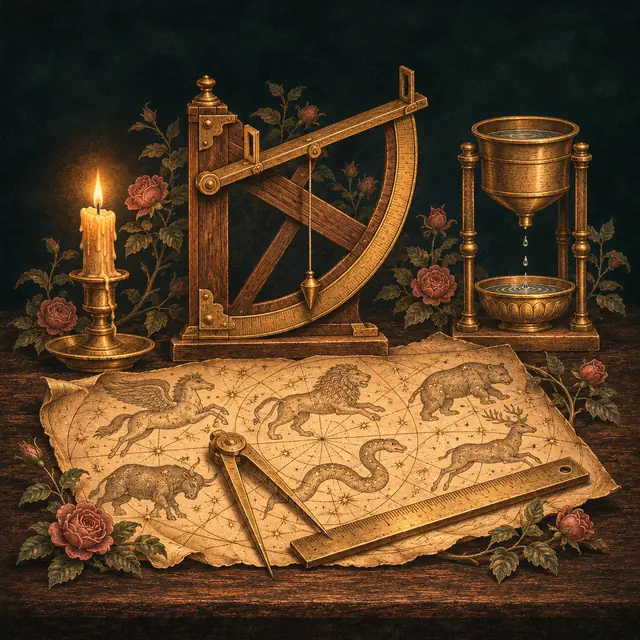
Astronomer, mathematician and geographer who worked at Alexandria; the observations he records run from AD 127 to 141, and nothing else of his life is known. His Almagest models the motions of Sun, Moon and planets by circles carried on circles about a still Earth, with tables for reckoning where each will be seen, and lists 1,022 stars in forty-eight constellations. It was the astronomers’ working book for some fourteen centuries. His Tetrabiblos treats astrology as a natural study, less certain than astronomy, and became its most quoted textbook. He also wrote a Geography, an Optics and a Harmonics, which sets the ratios of music beside the soul and the heavens. Astronomers still argue over whether some of his observations were computed and not made.
The teaching
Taught from his own books, above all the Almagest, the Tetrabiblos and the Harmonics.
Why astronomy
Ptolemy opens the Almagest with philosophy. Theoretical knowledge has three parts: theology, which looks to the first cause of the motion of the universe and lies beyond our grasp; physics, which studies changing matter and is too unstable for certainty; and mathematics, which alone gives sure and unshakeable knowledge, because its proofs are by arithmetic and geometry. So he chose mathematics, and in it the study of the heavenly things, which are always the same. It is the best road towards theology and towards physics too, and it shapes character: those who watch the constancy, order, proportion and calm of the heavens come to love that divine beauty and to make their own souls like it.
The heavens and the still Earth
His first principles are these. The heavens are round and turn as one round body; the Earth is round too, sits in the middle of the heavens, is as a point compared with them, and does not move. If the Earth turned, he argues, everything not standing on it would be left behind: clouds and birds would always drift towards the west.
Every motion in the heavens is built of uniform motion in circles. The sun's year is explained by a circle whose centre lies a little off the Earth, so that the sun seems to move faster on one side of it; the planets ride on small circles, epicycles, carried round on larger ones; and for the planets he sets a point off the centre of the great circle, the equant, from which their motion is seen to be uniform. He gives the rule for building such models: fit the simplest assumptions one can to the heavenly motions, and if they do not suffice, whichever ones do; and do not judge what is simple in the heavens by what seems simple to us.
Why the stars can be read
The Tetrabiblos begins with two kinds of foreknowledge from the heavens. The first, astronomy, finds their motions; the second, astrology, studies the changes those motions bring about below. That the heavens act on the earth is plain: the sun rules the seasons, the growth of plants and the breeding of animals; the moon, nearest to us, moves the tides and the waxing and waning of living things; the planets and fixed stars bring heat, wind and storm. If they act on everything else, it is reasonable that they act on human beings too, and that one who knows their motions and natures could foresee something of their effects.
But astrology is less certain than astronomy, and he says why. Its matter is changeable and hard to grasp; the configurations of the stars never return exactly as they were; and a birth is shaped not only by the sky but by seed, country, upbringing and custom. So its failures belong to the difficulty of the work, or to poor practitioners, not to the art itself, and a wise reader takes the sky as one cause among others, never as the only one.
Fate and the physician
Not every event is fixed. Some come from causes so great, like the heavens' great changes that bear on whole countries, that nothing can turn them aside; others follow the lesser causes of a single life, and those, he holds, can be met if they are foreseen, as a physician who knows what is coming can treat it in time. Foreknowledge also calms the soul, and he notes that the Egyptians joined medicine to astrology for this reason. This is his account of the art; the house gives it as his and not as a guide to health.
The natures of the planets
Each planet acts by the four qualities, heat, cold, moisture and dryness, and Ptolemy derives each nature from its place. The sun warms and moderately dries. The moon chiefly moistens, being near the earth and its vapours, and warms a little from the sun's light. Saturn chiefly cools and moderately dries, far as it is from the sun's heat and from the earth's moist vapours. Mars chiefly dries and burns, with its fiery colour and its nearness to the sun below it. Jupiter, moving between the cold of Saturn and the heat of Mars, is temperate, warming and moistening, and so brings fertile winds. Venus is like Jupiter the other way round, chiefly moistening and moderately warming. Mercury dries and moistens by turns, swift as it is and close to the sun and the moon.
From these follow the old divisions. Jupiter, Venus and the moon are beneficent, because heat and moisture make and nourish; Saturn and Mars are maleficent, because excessive cold and excessive dryness destroy; the sun and Mercury are common to both. The moon and Venus are feminine, being moist; the sun, Saturn, Jupiter and Mars are masculine; Mercury is both. The sun, Jupiter and Saturn belong to the day and the moon, Venus and Mars to the night, so that Saturn's cold is tempered by the warmth of day and Mars's dryness by the moisture of night.
The aspects and the concords of music
Signs act on each other at only a few distances. Opposition joins them across the circle on one straight line. Half of the opposition makes the square, and a third and two thirds of it make the sextile and the trine; and the square stands to the sextile as three to two and the trine to the square as four to three, the ratios of the fifth and the fourth in music. Trines and sextiles are called harmonious because they join signs of the same kind, both male or both female; squares and oppositions are discordant, because they join signs of opposite kinds.
The ages of a life
The planets rule the ages of a life in the order of their distance, from the nearest to the farthest. The moon has the first four years, the soft and growing time of infancy; Mercury the next ten, when the mind is shaped by learning; Venus the next eight, the season of the first loves; the sun the next nineteen, the prime, of mastery and ambition; Mars the next fifteen, of hard work and cares; Jupiter the next twelve, of withdrawal, dignity and good counsel; and Saturn the rest, of coldness, slowness and decline.
The harmony of soul and heaven
The Harmonics judges music by two powers together: hearing, which grasps what is near enough, and reason, which finds what is exact, and neither may overrule the other. Its last book sets the same ratios in the soul and in the heavens. The soul's three parts, the thinking, the perceiving and the living, answer to the octave, the fifth and the fourth, and its virtues to the concords within them; the circle of the zodiac answers to the scale, and the planets to its notes. Harmony is one form of reason that shows itself in sound, in the soul and in the sky, and to study it is to study the order that makes things beautiful.
Orders and memberships
None is documented. He names no teacher, dedicates his books to one Syrus, of whom nothing is known, and uses observations made by a certain Theon.
The legend
That he was a king of Egypt. Medieval writers, Arabic and Latin, confused him with the Ptolemies who ruled the country until 30 BC, more than a century before he was born, and old books draw him wearing a crown. A late Byzantine note that he was born at Ptolemais in Upper Egypt is unsupported.
What was forged, or is false
The Centiloquium, a hundred sayings on astrology passed down under his name and commented on for centuries, is not his. It is first known from an Arabic commentary of the tenth century.
Their works
- AlmagestTreatise, about AD 150
The Mathematical Composition in thirteen books, called the Almagest after its Arabic name. It models the motions of Sun, Moon and planets with circles carried on circles round a still Earth, gives tables for reckoning their places, and lists 1,022 stars in forty eight constellations. It was the astronomers’ working book for some fourteen centuries.
Ask the Oracle about it - TetrabiblosTreatise, after AD 150
Four books on astrology, which Ptolemy treats as a natural study of how the heavens affect the earth, less certain than astronomy but real. It covers the natures of the planets and signs, the fortunes of peoples and countries, and the reading of a birth chart, and it became the most quoted textbook of astrology in Arabic, Latin and every later age.
Ask the Oracle about it - GeographyBook, about AD 150
A guide to drawing a map of the known world, with methods of projection and the latitudes and longitudes of some eight thousand places. Lost to the Latin West until it was translated around 1406, it shaped the maps of the age of exploration.
Ask the Oracle about it - Handy TablesTables, about AD 150
Tables for working out the places of Sun, Moon and planets quickly, revised from those in the Almagest, with instructions for their use. They were the tables astrologers and astronomers actually worked from, and the commentaries of Theon of Alexandria kept them in use.
Ask the Oracle about it - HarmonicsTreatise, 2nd century AD
Three books on the mathematics of musical intervals, balancing reason and the evidence of the ear. The last part sets the ratios of music beside the parts of the soul and the motions of the heavens, and Johannes Kepler, reading it, found in it an ancestor of his own Harmony of the World.
Ask the Oracle about it - OpticsTreatise, 2nd century AD
A study of sight, reflection and refraction, with a table of how light bends from air into water and glass measured by experiment. It survives only in a Latin version made from an Arabic one, with its first book and its ending lost.
Ask the Oracle about it - CentiloquiumCollection, medieval
A hundred aphorisms on astrology, much copied and commented on in Arabic and Latin as the Fruit of Ptolemy’s teaching. It was printed with the Tetrabiblos in the Renaissance and long read as his last word on the art.
Not his: it was written centuries after him and placed under his name.
Ask the Oracle about it
How the house tells a life
This life is told from the record, with what is documented, what is legend and what was forged kept apart. A membership in an order is stated only where documents show it. A person’s chart explains none of their deeds.
The arts it feeds
Lives near it in time
Thinkers and teachers
PlatoZhuangziPhilo of AlexandriaMarcus ManiliusValentinusPatanjaliMarcus AureliusNagarjunaPlotinusManiPorphyryHypatiaThe whole tree

