
Nagarjuna
About AD 150 to about 250
Who was Nagarjuna, and what is truly known of them?
What is known
Indian Buddhist philosopher, usually placed in the second and third centuries AD and in southern India, the founder of the Madhyamaka or Middle Way school of Mahayana Buddhism. His Fundamental Verses on the Middle Way argue in twenty-seven chapters that nothing has an essence of its own: things arise in dependence on one another and are in that sense empty, and emptiness is itself not a thing to cling to. Two letters of advice, by tradition sent to a king of the Satavahana line, are also counted his. No account of his life was written until long after him; the earliest is a short Chinese biography attributed to the translator Kumarajiva, of about AD 405.
The teaching
Taught from his Fundamental Verses on the Middle Way, with the Dispeller of Disputes and his letters to a king.
Dependent arising
Nagarjuna opens his verses in praise of the Buddha, who taught that whatever arises in dependence is without ceasing and without arising, without ending and without lasting, without coming and without going, neither one thing nor many: the quieting of all elaborations, peace. These eight denials are the whole book in brief. Things arise only in dependence on causes and conditions, on their parts and on the minds that name them, and what arises so has no being of its own, no essence, svabhava. That lack of essence is what he calls emptiness.
Neither from itself nor from another
The first chapter tests causation. Nothing whatever, anywhere, arises from itself, from something else, from both, or without a cause. This fourfold test, whether a thing is, is not, both or neither, is his method throughout: every view of what things are in themselves is tried in each of the four ways and found wanting, so that only dependent arising is left.
So too with motion. The road already travelled is not being travelled, the road not yet travelled is not being travelled, and apart from these no road is being travelled. A mover does not move, a non-mover does not move, and what third thing could? If mover and moving were one, the doer and the deed would be one; if they were different, there could be a mover without motion. Mover and motion are set up together, each by the other, and neither stands alone.
No self, and no mine
If the self were the parts of a person, body, feeling, perception, formations and consciousness, it would come and go as they do; if it were something other than them, it would have none of their marks and could not be found. With no self there is no mine. When the thought of I and mine falls quiet, inwardly and outwardly, grasping ends, and with it birth. Bondage comes from deeds and defilements, these from false conceptions, and these from elaboration, and elaboration ends in emptiness. So the Buddhas taught a self to some, no self to others, and to others neither self nor no self, as each hearer needed.
The two truths
The Buddhas teach by two truths: the conventional truth of the world and the truth of the highest meaning. Whoever does not know the difference between them does not understand the deep point of the teaching. Without leaning on the conventional the highest cannot be taught, and without reaching the highest, nirvana is not attained. Carts, persons, causes and paths are real in the world's sense, and the teaching works in that sense; that none of them has a being of its own is the highest truth.
To the charge that emptiness destroys the Buddha's teaching, the four truths, the path and its fruit, he answers that it is the other way round. Whatever arises in dependence is emptiness; that, being a dependent designation, is itself the middle way; and nothing exists that does not arise in dependence, so nothing exists that is not empty. If things had essences, nothing could arise or cease, suffering could have no cause and no end, and no one could walk a path. For one to whom emptiness makes sense, everything makes sense.
Emptiness is no view to hold
Emptiness is not one more thing to believe. The Victors taught it as the giving up of all views, and those who make a view of emptiness itself are beyond help. Grasped wrongly it ruins the slow-witted, like a snake seized by the wrong end or a spell wrongly cast. To say that a thing exists is to hold that things last; to say that it does not exist is to hold that they are annihilated; the wise rest in neither existence nor non-existence.
Nirvana and the round of birth
There is not the slightest difference between the round of birth and death and nirvana; the limit of the one is the limit of the other, and between them there is not even the finest gap. Nirvana is not a place reached or a thing gained: not abandoned and not attained, not ended and not lasting. It is the stilling of all grasping and the quieting of all elaboration, peace; and, the chapter ends, no teaching was ever taught by the Buddha to anyone, anywhere.
An illusion that stops an illusion
If everything is empty, an opponent says, then your own words are empty and can refute nothing. Nagarjuna answers in the Dispeller of Disputes that his words, arising in dependence, are empty indeed, and work all the same, as a cart carries wood, a pot holds water and a cloth keeps off the cold though none has a being of its own. His denial works as one phantom conjured by a magician might stop another phantom; nothing with an essence is needed for it to do its work. And he holds no thesis: if he had one, the fault would be his, but he has none, so the fault does not touch him.
Counsel for a king
His letters bring the teaching into a life. The Precious Garland names two goods: high standing, which is happiness in this and future lives, and the highest good, which is freedom. Faith leads to the first and wisdom to the second; wisdom is chief, but faith comes first. The practice of high standing is sixteen things: to give up killing, stealing and taking another's partner; lying, divisive speech, harsh speech and idle talk; covetousness, malice and the view that nothing matters; and to keep from intoxicants, to live by right means, to do no harm, to give with respect, to honour those worth honour, and to love.
The Letter to a Friend asks the reader to treat alike the eight worldly concerns, gain and loss, pleasure and pain, praise and blame, fame and disgrace, and to count contentment the greatest of riches. One whose hair or clothes caught fire would drop everything to put it out; so, the letter says, one should strive to end the round of births, for nothing is more urgent.
Orders and memberships
By tradition a monk of the Mahayana. The Madhyamaka school descends from his writings, and Tibetan and East Asian schools count him among their patriarchs. Tibetan tradition makes him an abbot of the monastery of Nalanda, which was founded after his time.
The legend
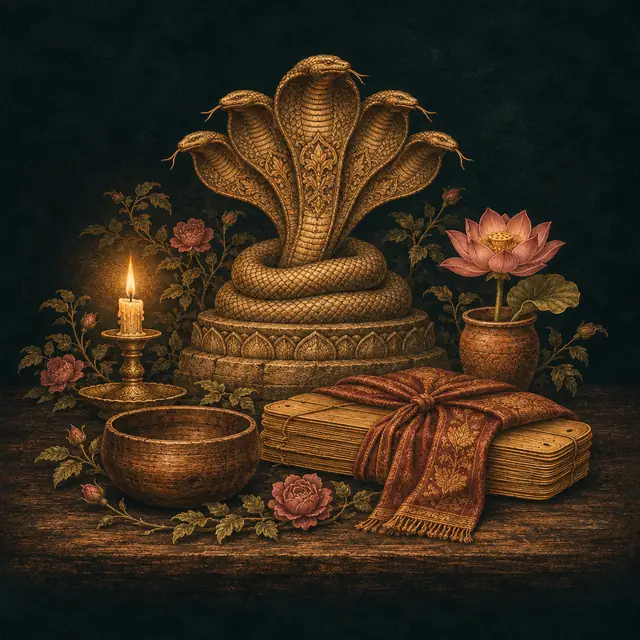
That he brought the Perfection of Wisdom scriptures up from the kingdom of the serpent spirits, the nagas, beneath the sea, and that he lived for six hundred years.
What was forged, or is false
Works on alchemy, among them the Rasaratnakara, and a number of tantric texts bear his name. Scholars date them many centuries after the philosopher and give them to one or more later writers called Nagarjuna, which is how one man came to be credited with so long a life.
Their works
- Fundamental Verses on the Middle WayVerses, 2nd or 3rd century AD
Some 450 verses in twenty seven chapters, the Mulamadhyamakakarika, arguing that causes, motion, the self and even nirvana have no essence of their own: all things arise in dependence and are empty, and emptiness too is not a thing to hold on to. It founded the Madhyamaka school and is studied wherever Mahayana Buddhism is taught.
Ask the Oracle about it - The Precious GarlandLetters, 2nd or 3rd century AD
The Ratnavali, five hundred verses of advice to a king on the path to happiness in this life and to awakening, on generous rule, on the care of the sick and the poor, and on the teaching of emptiness. It joins his philosophy to the practice of a good life.
Counted his by tradition, and most scholars accept it.
Ask the Oracle about it - Letter to a FriendLetters, 2nd or 3rd century AD
The Suhrllekha, a letter of some 120 verses by tradition sent to a king of the Satavahana line, setting out the Buddhist path for one living in the world. It was much loved in Tibet, where it is still taught to beginners, and was translated into Chinese several times.
Ask the Oracle about it - The Dispeller of DisputesTreatise, 2nd or 3rd century AD
The Vigrahavyavartani, seventy verses with his own commentary, answering the charge that if all things are empty his own words must be empty too and can prove nothing. He replies that his statements, like a magical illusion stopping another, work without any essence.
Ask the Oracle about it - The Life of NagarjunaBiography, about AD 405
A short Chinese life, the oldest that exists, attributed to the translator Kumarajiva. It tells of a brahmin who made himself invisible to enter a palace, turned to the Buddha, and brought the Mahayana scriptures from the palace of the serpent kings beneath the sea. It is legend through and through.
Its attribution to Kumarajiva is traditional.
Ask the Oracle about it - RasaratnakaraTreatise, medieval
An Indian work on alchemy and mercury under the name of Nagarjuna, one of several such books. They belong to the later tradition of Indian alchemy and to a later Nagarjuna, or to writers who borrowed the famous name, not to the philosopher of emptiness.
Not by the philosopher: the alchemical works under his name are centuries later.
Ask the Oracle about it
How the house tells a life
This life is told from the record, with what is documented, what is legend and what was forged kept apart. A membership in an order is stated only where documents show it. A person’s chart explains none of their deeds.
The arts it feeds
Lives near it in time
Thinkers and teachers
Philo of AlexandriaMarcus ManiliusValentinusPatanjaliPtolemyMarcus AureliusPlotinusManiPorphyryHypatiaProclusBodhidharmaThe whole tree

