
Mani
216 to 274 or 277
Who was the prophet Mani, and what did the Manichaeans teach?
What is known
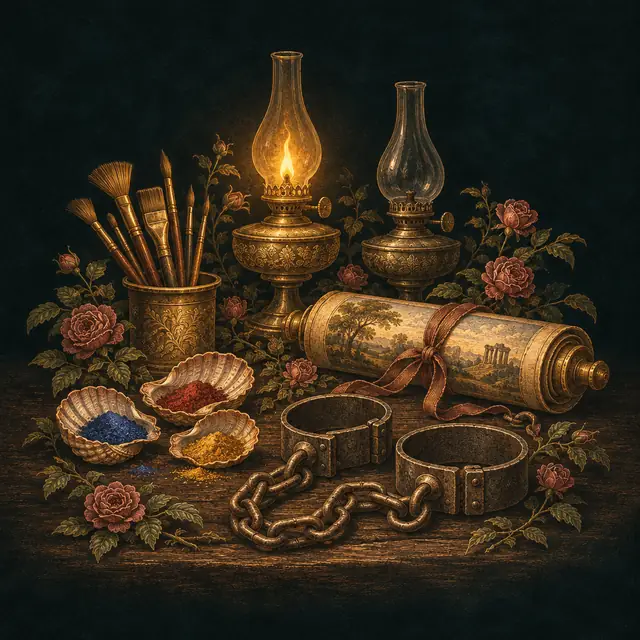
Founder of a religion, born in 216 near Ctesiphon in Babylonia. A tiny Greek parchment book now at Cologne, read in 1969, shows that he grew up in a baptising sect of Jewish Christians and left it at twenty-four after two revelations from a heavenly Twin. He preached under the Persian king Shapur I, for whom he wrote a book, travelled to India, and called himself an apostle of Jesus Christ and the last in a line with Zoroaster and the Buddha. He taught two principles, Light and Darkness, mingled in this world, and a church of the Elect and of Hearers, with a picture book to teach by. Under Bahram I he was chained and died in prison in 274 or 277. His church reached from Roman Africa, where Augustine was a Hearer for nine years, to China.
The teaching
Taught from the Kephalaia, the Cologne Mani Codex and the fragments of his own books.
Two principles and three times
Mani teaches that there are two principles, uncreated and wholly unlike: the Light and the Darkness. The Light is ruled by the Father of Greatness, who dwells in a land of light with his five dwellings, mind, thought, insight, counsel and reflection. The Darkness is ruled by the King of Darkness, in a land of five worlds, of smoke, fire, wind, water and darkness. Whoever would learn the teaching must first understand these two, and then the three times: the beginning, when they were apart; the middle, the present time, when they are mixed; and the end, when they are parted again for ever.
The First Man
The Darkness, restless and greedy, saw the light at its border, desired it and attacked. The Father of Greatness would not fight with his own hand. He called forth the Mother of Life, and she called forth the First Man, who armed himself with his five sons, the five bright elements, light air, wind, light, water and fire, and went down to battle. He was overcome, and the powers of darkness swallowed his sons. Yet the defeat served the Light: its armour was given to the Darkness as a bait, so that the powers which swallowed it might be held fast and in the end overcome.
The First Man lay in the depths, stunned. The Living Spirit came down with the Mother of Life to the edge of the darkness and called to him, and the call was like a sharp sword; the First Man heard and answered, and Call and Answer are counted as two gods. He was drawn up into the land of light, but his armour, the light he had lost, stayed mingled with the darkness, and the rest of the world's story is its rescue.
The world as a work of rescue
The Living Spirit made the world to free the light. From the powers of darkness he had overcome he made the heavens out of their skins, the mountains from their bones and the earth from their flesh: ten heavens and eight earths. From light that had not been spoiled he made the sun and the moon, and from light that was partly spoiled, the stars. The world is not the work of the Darkness but a great work of the Light, made to draw back what was lost.
So the light rises. The particles of light and the souls set free are carried up the Column of Glory, seen in the sky as the Milky Way, to the moon, which fills with them as it waxes and passes them on to the sun as it wanes; and the sun carries them home to the land of light. The moon and the sun are the ships of the light.
Adam awakened
The powers of darkness, to keep the light they still held, made Adam and Eve after the image of a shining messenger they had glimpsed, and bound the light in their bodies, to be passed on through begetting. Then Jesus the Splendour came to Adam, who lay in a deep sleep, woke him, and showed him his own soul: the light thrown down into everything, into the teeth of panthers and elephants, swallowed and devoured, bound in all that is. Adam cried out and wept over the one who had made his body and bound his soul, and Jesus gave him to eat of the tree of life.
The suffering Jesus in all things
The light scattered in the world is the Living Soul, which his churches also called the suffering Jesus, who hangs on every tree. It is in plants and fruits, in water and in the earth, and every blow struck at them strikes the light. So the Elect keep the rule of the three seals. The seal of the mouth is no meat, no wine and no false or wicked word; the seal of the hands is no harm to the light in plants, animals, water or earth, so that they neither kill nor harvest; and the seal of the breast is no marriage and no begetting. The Hearers bring them food, and the Elect, by their purity, prayer and hymns, set free the light in it as they eat.
The Hearers' way
Most of the church are Hearers, who live in the world, marry, work and own. They keep ten commandments, among them to give up idols, lying, avarice, killing, adultery, theft and magic; they pray at set hours towards the sun and the moon, keep the weekly fast of their church, and give alms to the Elect, and so share in the light the Elect set free. A Hearer who lives well is born again into a better life, and at last into the life of the Elect, and so comes home.
The apostle of the last age
Wisdom and good deeds, Mani teaches, have been brought to the world from age to age by the messengers of God: in one age by the Buddha to India, in another by Zoroaster to Persia, in another by Jesus to the West, and now in this last age through himself to Babylon. The earlier apostles did not write their own teaching, and after them their disciples forgot it or changed it; so he wrote his scriptures with his own hand and painted them too, so that his church might keep the teaching whole in every land and every language.
The end of the mixture
When the light has been gathered, the end comes. Jesus appears as judge and sets the good on his right and the wicked on his left, and the Elect and the good Hearers rise to the land of light. The world is then burned in a great fire for one thousand four hundred and sixty-eight years, until the last light in it is freed and gathered into the Last Statue, which goes up to the Light. The Darkness, with the souls that chose it, is shut away for ever in a mass that the texts call the Lump, and the two principles are parted, never to mix again.
Orders and memberships
He founded a church of his own, in ranks from the leader and twelve teachers down to the Elect and the Hearers. It was a public, missionary religion and no secret order, and the rulers of Rome, Persia and China each banned it in turn.
The legend
That he was flayed and his skin stuffed and hung at the city gate: later writers tell it, and his own church’s accounts say he died in chains. In the Middle Ages the Bogomils and the Cathars were called Manichees by their enemies; no line of descent from his church has been shown.
What was forged, or is false
The Acts of Archelaus, a Christian work of the fourth century, gave him a mock life as a slave boy named Cubricus who inherited another man’s books of magic. It is polemic, and for centuries it was the main account of him in the West.
Their works
- The Living GospelScripture, 3rd century
The first of the books Mani wrote for his church, in Syriac, in twenty two parts named for the letters of the alphabet. It set out his revelation of the Light and the Darkness. Only quotations survive, among them its opening words in the Cologne codex, where Mani calls himself an apostle of Jesus Christ.
The book itself is lost and is known only from quotations.
Ask the Oracle about it - ShabuhraganBook, 3rd century
The one book Mani wrote in Middle Persian, dedicated to the king Shapur I, which put his teaching in terms a Persian court would know. It dealt above all with the end of the world and the last judgement. Pieces of it were found among the manuscripts of Turfan in Chinese Central Asia early in the twentieth century.
It survives only in fragments.
Ask the Oracle about it - The Book of GiantsScripture, 3rd century
Mani’s retelling of the story of the giants born to the fallen Watchers, taken from a Jewish book of giants of which copies were found among the Dead Sea Scrolls. His church carried it from Persia to Central Asia, and fragments survive at Turfan in several languages. It shows how he gathered older scriptures into his own.
It survives only in fragments.
Ask the Oracle about it - The Picture BookPainting, 3rd century
A book of paintings Mani made to teach those who could not read, called the Ardahang in Persian. Later Persian writers remembered him as a painter above all for it. Painted Manichaean books from Central Asia and silk paintings from southern China are thought to carry on its tradition.
The book is lost; what it showed is known only from later reports and from the art of his church.
Ask the Oracle about it - KephalaiaTeaching, 4th century
A large book of chapters in Coptic, found in Egypt in 1929, in which Mani answers his disciples’ questions on the cosmos, the soul and his church. It is how his teaching was handed down in his own school. Though set down by his followers, it is the fullest account of his system in any language.
It was compiled by his followers after his death, not written by him.
Ask the Oracle about it - Cologne Mani CodexBiography, 4th or 5th century
The smallest known book of the ancient world, a Greek parchment codex about the size of a matchbox, read at Cologne in 1969. Its title calls it On the Origin of his Body. Gathered from his disciples’ memoirs, it tells of his youth among the baptists and his revelations from the heavenly Twin, and changed what scholars knew of him.
Ask the Oracle about it
How the house tells a life
This life is told from the record, with what is documented, what is legend and what was forged kept apart. A membership in an order is stated only where documents show it. A person’s chart explains none of their deeds.
The arts it feeds
Lives near it in time
Thinkers and teachers
ValentinusPatanjaliPtolemyMarcus AureliusNagarjunaPlotinusPorphyryHypatiaProclusBodhidharmaAdi ShankaraPadmasambhavaThe whole tree

