
Joachim of Fiore
About 1135 to 1202
Who was Joachim of Fiore, and what is truly known of them?
What is known
Calabrian abbot and interpreter of Scripture. Abbot of Corazzo by 1177, a house he worked to bring into the Cistercian order, he was encouraged by Pope Lucius III in 1184 to write down his reading of the Bible, left his abbey for the mountains, and founded the house of San Giovanni in Fiore; Pope Celestine III approved his new order in 1196. In three main works he taught that history unfolds in three overlapping ages, of the Father, the Son and the Holy Spirit, the third an age of contemplation still to come. He drew his thought in diagrams, gathered after his death as the Book of Figures. He died in 1202, having submitted his writings to the judgement of the Church.
The teaching
Taught from his own books, above all the Book of Concordance and the Exposition on the Apocalypse, with his figures.
Spiritual understanding
Joachim holds that the shape of history is written in Scripture and can be read by those to whom God gives spiritual understanding. It came to him, he says, at a stroke rather than by study alone: on an Easter night the fullness of the Apocalypse and the concord of the two Testaments opened to his mind, and at Pentecost, when he was struggling with the mystery of the Trinity, the figure of a psaltery of ten strings showed it to him. He teaches as an interpreter, not as a prophet. He claims no new revelation, only the gift of understanding the one already given.
Concord
His method is concord. The Old Testament and the New are set side by side, generation against generation, person against person, order against order, like the two halves of one pattern. Twelve patriarchs answer to twelve apostles and twelve tribes to twelve churches, and as the Gospel counts forty-two generations from Abraham to Christ, he counts forty-two in the age of the Church.
Concord is not allegory. Allegory draws a spiritual meaning out of a text; concord matches one history to another, so that what happened once shows the shape of what happens again. By it the reader can tell where in the pattern the present stands, and what season is coming.
The three states of the world
History has three states, one for each Person of the Trinity. The first is the state of the Father, the time of the Law and of the married, who serve God by begetting and labour. The second is the state of the Son, the time of the Gospel and of the clergy, who serve by preaching and the sacraments. The third is the state of the Holy Spirit, the time of the monks, who serve by contemplation and praise, and in it the understanding of the Scriptures will be complete.
The states do not simply follow one another. Each has a long hidden beginning inside the one before it, then a time of bearing fruit, then an end. The first began with Adam and bore fruit from Abraham; the second was already at work among the prophets of Israel and bore fruit with Christ; the third began with Saint Benedict and his monks, and its fruit is still to come. Joachim looked for new orders of spiritual men to open it, living and preaching the life of the Spirit in poverty and contemplation.
Servants, sons and friends
He sets the three states side by side in chains of images. The first was in the servitude of slaves, the second in the servitude of sons, and the third will be in liberty. The first was in fear, the second in faith, the third will be in love. The first was of slaves, the second of free men, the third of friends. The first was in the light of the stars, the second in the light of dawn, the third in the brightness of day. The first was winter, the second the start of spring, the third summer. The first bore nettles, the second roses, the third lilies. The first was water, the second wine, the third oil.
The movement is always the same: from command to grace, from grace to a fuller grace, from the letter to the spirit. Nothing of the earlier state is thrown away; it ripens.
Peter and John
Two apostles carry the second and third states. Peter, the active one, the shepherd who holds the keys, stands for the Church of the clergy. John, who leaned on the Lord's breast and outlived the others, stands for the contemplative Church to come. When Peter asks what will become of John, Christ answers, “If I will that he tarry till I come, what is that to thee?” Joachim reads it of the two Churches: the Church of Peter is not destroyed but carried over into the spiritual Church, as the active life gives way to the contemplative without ceasing to be needed.
The Apocalypse as history
In the Exposition on the Apocalypse the visions of Revelation become a map of the Church's history. The seven seals open seven times of struggle, and the dragon's seven heads are seven persecutors of the Church in turn, from Herod and Nero to the Antichrist still to come, the sixth in his own day. After the Antichrist falls there will be a sabbath on earth, a time of peace and contemplation before the end, and the last enemy, Gog, comes only at the very close. The reader of the book is meant to know the season, and to watch and amend.
Thinking in figures
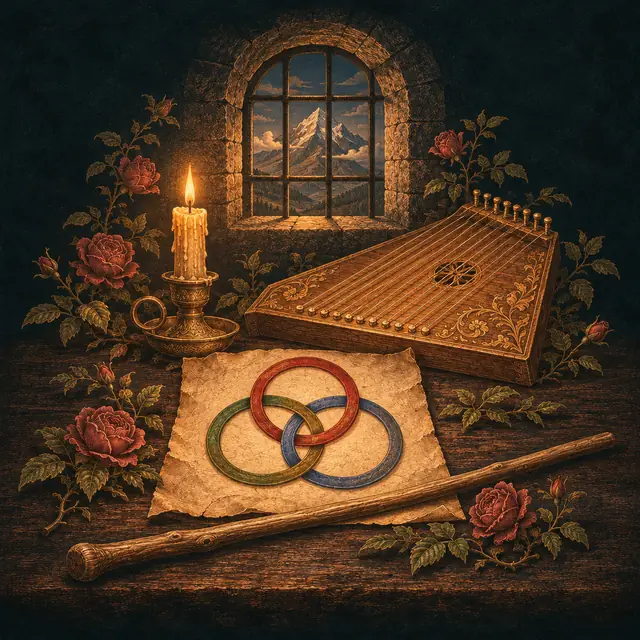
Joachim thinks in drawings as much as in words, and the figures gathered after his death keep his thought in that form. Trees grow through the generations, their branches the tribes and the orders. Three circles, each passing through the others, show the three states interlocked as the three Persons are one God. The psaltery of ten strings, one instrument with three corners, shows the one God in three Persons, and its strings sound the praise owed by all creation.
The figures are meant to be looked at slowly, until the eye takes in at once what the words must say one by one.
Orders and memberships
A monk and abbot who sought the Cistercian rule for his house, then founder of the Order of Fiore, a stricter branch that was absorbed into the Cistercians in the sixteenth century. In 1215 the Fourth Lateran Council condemned one of his tracts on the Trinity and left his person and his order untouched.
The legend
That he foretold the year 1260 as the start of the new age, and a line of “angelic popes”. The date was drawn from his numbers by followers after his death, and many of the prophecies that carried his fame are theirs.
What was forged, or is false
The commentary on Jeremiah, the Prophecies of the Popes and other books under his name were written by later hands, among monks of his own order and the Franciscans who took up his name. The “Eternal Gospel” condemned in 1255 was a follower’s compilation, not his book.
Their works
- The Book of ConcordanceBook, from the 1180s
The Liber de concordia, which matches the generations of the Old Testament with those of the New to read the shape of history. In it he set out his three ages, of the Father, the Son and the Holy Spirit, the third an age of contemplation still to come.
Ask the Oracle about it - Exposition on the ApocalypseCommentary, from the 1180s
His long reading of the Book of Revelation as a map of the history of the Church, through its persecutions to the coming age of the Spirit. It was his most influential work among the Franciscans and others who looked for the end of the age.
Ask the Oracle about it - The Ten Stringed PsalteryBook, from the 1180s
A book on the Trinity and on the psalms, built on the figure of a harp with ten strings that came to him, he says, in a vision at Pentecost. It shows his way of thinking in figures and numbers.
Ask the Oracle about it - The Book of FiguresCollection, early 13th century
A set of diagrams of his teaching: trees of the generations, interlocking circles of the Trinity, an eagle and a dragon of seven heads. They were gathered soon after his death and influenced, among others, Dante.
It was put together by his followers from his drawings, and how much is his own design has been argued.
Ask the Oracle about it - Commentary on JeremiahCommentary, about 1240s
A commentary that went under his name, foretelling disasters for the Church and the empire, which did much to spread his fame as a prophet in the thirteenth century.
It is not his; it was written by later hands among his followers.
Ask the Oracle about it
How the house tells a life
This life is told from the record, with what is documented, what is legend and what was forged kept apart. A membership in an order is stated only where documents show it. A person’s chart explains none of their deeds.
The arts it feeds
Lives near it in time
Thinkers and teachers
PadmasambhavaAl-KindiAvicennaMilarepaAl-GhazaliHildegard of BingenSuhrawardiIbn ArabiAlbertus MagnusRumiRoger BaconRamon LlullThe whole tree

