
Roger Bacon
About 1220 to about 1292
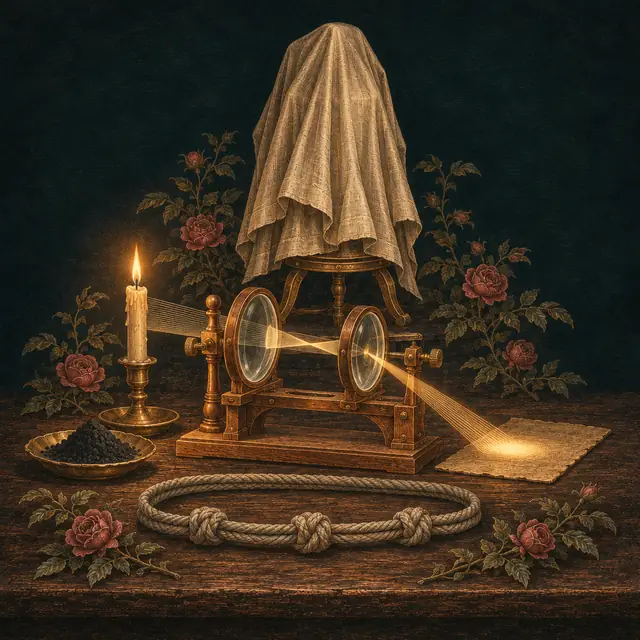
Who was Roger Bacon, and what is truly known of them?
What is known
English Franciscan friar and scholar. He lectured on Aristotle at Paris in the 1240s, joined the Franciscans about 1257, and worked at Oxford and Paris on languages, optics, the calendar and what he called experimental science. At the request of Pope Clement IV he wrote three large works and sent them to the pope in 1267 and 1268, the Opus majus first among them, urging the Church to reform its learning. He described how lenses might help weak sight, gave an early Western account of gunpowder, and held that alchemy and astrology, rightly practised, were useful sciences. A chronicle written about eighty years after his death says his order confined him around 1278 for “suspect novelties”; nothing nearer the event confirms it.
The teaching
Taught from his works for Pope Clement IV, above all the Opus majus, and his Letter on the Secret Works of Art and Nature.
The four causes of error
Bacon opens the Opus majus with the four causes of all human error. The first is submission to faulty and unworthy authority; the second, the influence of custom; the third, the opinion of the untaught crowd; and the fourth and worst, the hiding of one's own ignorance under a show of wisdom. Everyone in every walk of life is held by them, he says, and they must be cast out before anything true can be learned. The cure is not to despise the ancients but to remember that they were men, that they did not know everything, and that each age adds to what earlier ages began.
The tongues of wisdom
Wisdom was first written in Hebrew, Greek, Arabic and Chaldean, and the Latins have it only in translations made by men who knew neither the languages well nor the matter. So the student must learn the tongues, not to speak them grandly but enough to read and to correct; even the text of Scripture in common use, he complains, is corrupt and must be mended from the originals. Grammar is the first door into theology and philosophy alike.
Mathematics, the gate and the key
Mathematics is the gate and the key of the sciences, the first to be discovered and the easiest, and without it nothing can be known of the heavens or of nature. With it he shows that the calendar's year runs a little too long, so that the true equinox has drifted days away from the date the Church keeps; with it he measures the earth and the places on it; and with it the astronomer foresees the motions of the heavens.
The multiplication of species
Every natural thing acts on what is around it by sending out its likeness, which he calls its species: a power that goes out from it in straight lines through the air, is bent where it passes into a denser body, and turns back from a smooth one. Light is the plainest case, but heat, the influence of the stars and the working of one body on another all go the same way. Since everything in nature works along lines, angles and figures, the science of sight, perspective, is the model for all natural science.
From it he draws a practical counsel. If letters or other small things are looked at through a clear glass shaped like a segment of a ball, with its curved side toward the eye, they appear larger and plainer, and such a glass would serve the old and those with weak eyes.
Experimental science
There are two ways of knowing, by argument and by experience. Argument concludes, and makes us grant the conclusion, but it does not make the mind certain and at rest unless the truth is also found by experience. A man who has never seen fire may be shown by good argument that fire burns and destroys, yet he is not satisfied, and does not keep away from it, until he has put his hand or something that can burn into it.
Experimental science is therefore the mistress of the other sciences, with three prerogatives. It tests their conclusions by experience; it finds truths within their own fields that they cannot reach by their own means; and by its own power it searches out the hidden works of nature, to make things of wonder and to foresee what is to come. His example is the rainbow, which he studies in crystals, in the spray thrown up by oars and mill wheels, and in the drops of a sunlit mist, finding by measurement that the bow never stands more than forty-two degrees above the horizon.
Beside the experience of the senses he sets an inward experience, given by God to the holy, by which the soul knows what the senses cannot, and he holds that it has its own degrees.
Alchemy, speculative and practical
Alchemy is a science, and it has two parts. Speculative alchemy studies how all things without life are generated from the elements: the humours of the body, stones, salts, metals and colours. Natural philosophy and medicine need it, since without it they do not know where their own matter comes from. Practical alchemy teaches how to make noble metals and colours and many other things better and more abundantly by art than nature makes them, and how to make medicines that might lengthen life.
He held that human life had been shortened by bad living since the days of the patriarchs, and that a right rule of life, with medicines still to be found, could lengthen it again. That is taught here as his hope, not as a method: the old books of potable gold and elixirs name substances that are poisons, and no one makes or takes them.
The stars and the will
The heavens act on bodies by their rays, and so on the make-up of the body, which inclines the soul one way or another; but the soul is free, and the stars incline it without compelling. An astronomer who knows the heavens can foresee the general course of the seasons, of sickness and of events among peoples, and so serve medicine and the Church. The conjurors who use characters, charms and invocations are another thing entirely: they deceive, and their art is condemned.
Wonders without magic
In his letter on the secret works of art and nature he argues that art and nature can do greater things than the magicians claim, without any magic. Ships could be made to move without rowers, steered by one man, faster than if they were full of oarsmen; carriages could move with great speed with no animal to draw them; there could be machines for flying, in which a man sits and turns a device that makes artificial wings beat like a bird's; small machines to lift or lower vast weights; machines for walking on the bed of the sea; and glasses that make far things seem near.
Charms, characters and conjurations, by contrast, are nothing, or fraud. And the wise, he says, have always hidden the great works of nature from the unworthy, writing of them in figures, riddles and strange letters.
All wisdom is one
All wisdom, for Bacon, is one: given by God to the patriarchs and prophets, handed on to the philosophers, and gathered under theology, which is its mistress. Each science serves the next, and all serve moral philosophy, the knowledge of how to live, and through it the good of the Church and the commonwealth, and the winning of unbelievers by reason rather than by war.
Orders and memberships
The Franciscans, the Order of Friars Minor, from about 1257. No secret order is documented, and the Rosicrucian and alchemical brotherhoods that later claimed him were formed centuries after his death.
The legend
That he built a brazen head that could speak, as the Elizabethan play Friar Bacon and Friar Bungay tells it, and that he invented gunpowder, the telescope and the microscope. He wrote of what lenses and powders might do; he is not known to have made any of them first.
What was forged, or is false
The Mirror of Alchemy and several other alchemical tracts under his name are later works. The claim, made in 1921, that he wrote the Voynich manuscript in cipher has been given up; its vellum has been dated to the early fifteenth century.
Their works
- Opus majusBook, 1267
The Greater Work, sent to Pope Clement IV, urging reform of Christian learning. It treats languages, mathematics, optics, experimental science and moral philosophy, describes lenses to aid weak sight, and holds that alchemy and astrology, rightly practised, can serve the Church.
Ask the Oracle about it - Opus minusBook, 1267
The Lesser Work, sent to the pope with the first as a summary of it, adding a part on speculative and practical alchemy and on the making of medicines to lengthen life. It shows how seriously he took the art.
It survives only in part.
Ask the Oracle about it - Opus tertiumBook, 1267
The Third Work, written to introduce the other two to the pope in case they went astray, explaining his plan for learning and adding new matter on the reform of the calendar, on optics and on the errors of the schools.
Ask the Oracle about it - Letter on the Secret Works of Art and NatureLetters, mid 13th century
A letter arguing that nature and art can do great things without magic, and foretelling ships without rowers, carriages without horses and machines for flying. It was printed in 1542 and fed his later fame as a magician and a prophet of inventions.
Its date and parts of its text are argued.
Ask the Oracle about it - The Mirror of AlchemyTreatise, later Middle Ages
A short Latin book of alchemy on the making of metals and the stone of the philosophers, printed in 1541 and put into English in 1597. It made him an authority of the art for later alchemists.
It is a later work put under his name.
Ask the Oracle about it - Friar Bacon and Friar BungayPlay, about 1589
Robert Greene’s Elizabethan comedy, in which Friar Bacon of Oxford makes a brazen head that speaks while he sleeps, and outdoes a German conjuror before the king. It fixed the popular legend of Bacon as a wizard.
Ask the Oracle about it
How the house tells a life
This life is told from the record, with what is documented, what is legend and what was forged kept apart. A membership in an order is stated only where documents show it. A person’s chart explains none of their deeds.
The arts it feeds
Lives near it in time
Thinkers and teachers
Hildegard of BingenJoachim of FioreSuhrawardiIbn ArabiAlbertus MagnusRumiRamon LlullMeister EckhartMarsilio FicinoJohannes ReuchlinPico della MirandolaNiccolò MachiavelliThe whole tree

