
Rumi
1207 to 1273
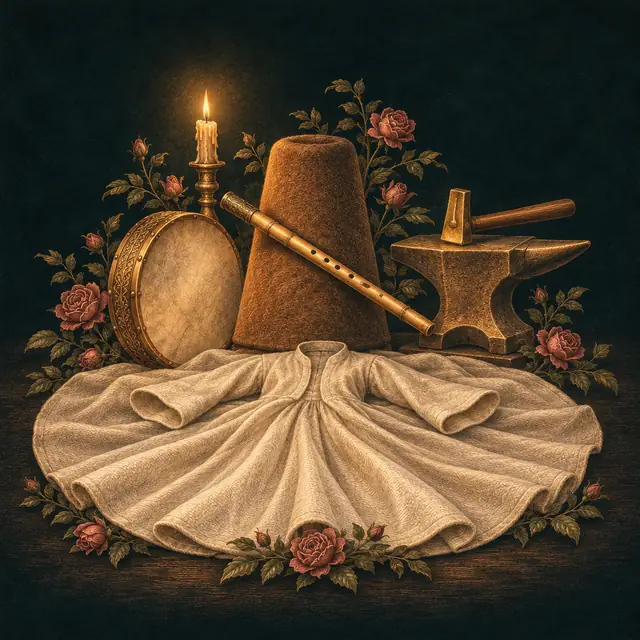
Who was Rumi, and what is truly known of them?
What is known
Persian poet and Sufi teacher. Born in 1207 in the region of Balkh, he left with his family before the Mongol invasions and settled at Konya in Anatolia, where he succeeded his father as a teacher of religious law. In 1244 he met the wandering dervish Shams of Tabriz; their friendship, and the disappearance of Shams about 1247, turned him to poetry. He left a collection of lyric poems named for Shams, some forty thousand lines, and the Masnavi, about twenty-five thousand couplets of teaching stories, dictated to his pupil Husam al-Din. He died at Konya on 17 December 1273, and his tomb there is a place of pilgrimage.
The teaching
Taught from his own words, above all the Masnavi, with the Divan of Shams and the Discourses.
Within the faith
Rumi teaches as a Muslim master of the Sufi path. The Masnavi calls itself, in its own preface, the roots of the roots of the roots of the religion, and its six books are woven from the Qur'an and the sayings of the Prophet, which it quotes on almost every page. The reed's lament with which it opens, and the turning of the dervishes who follow him, are taught on The Sufis and on Prayer in motion. His teaching itself is given in stories, and the stories are the way to learn it.
Love explains itself
Love is the heart of it. Love, he says, is the astrolabe of the mysteries of God: whether it is a love of this world or of the other, in the end it leads there. Reason, when it tries to explain love, lies down like a donkey in the mud; love alone explains love and the lover. And the proof of the sun is the sun itself: whoever wants a proof should not turn his face away from it.
The elephant in the dark
Some Indians brought an elephant to a town and kept it in a dark house, and the people went in to feel it, since no one could see it. One touched the trunk and said it was like a water pipe; one the ear, and said it was like a fan; one the leg, and said a pillar; one the back, and said a throne. Each described the part his hand had met, and they quarrelled.
If each had carried a candle, Rumi says, their words would have agreed. The eye of the senses is only the palm of a hand and cannot take in the whole, and the quarrels of those who are sure come from touching in the dark.
Moses and the shepherd
Moses heard a shepherd praying: where are you, Lord, that I may serve you, sew your shoes and comb your hair, wash your clothes and bring you milk? Moses rebuked him for blasphemy, and the shepherd tore his clothes and went off into the desert. Then God reproached Moses: you were sent to unite, not to sever. I have given each people its own way and its own words of worship; I look not at the tongue and the words but at the heart and its state.
Moses ran after the shepherd to tell him to pray as he liked, and found that he had already gone beyond words. Sincere love counts for more than correct speech, and the one who corrects another must take care not to wound.
Who is at the door?
A man knocked at his friend's door. Who is there? asked the friend. It is I, he answered. Go away, said the friend; there is no place at this table for one who is raw. The man went away and wandered for a year in the fire of separation until he was cooked; then he came back and knocked again. Who is there? It is you, he answered. Then come in, said the friend, since you are I: there is no room in this house for two. The self that says I stands between the lover and the Beloved, and love burns it away.
The chickpea in the pot
A chickpea in the boiling pot leaps up to the rim and cries out: why are you burning me? The woman cooking it strikes it down with the ladle and answers: I boil you not because I hate you but so that you may gain taste and savour and become food, and mingle with the life of a living being. When you were green in the garden, you drank the rain for this.
Suffering, in his teaching, is the cooking by which a soul ripens. The soul that understands this bears it as the chickpea learns to bear the fire, trusting the hand that holds the ladle.
I died as a mineral
Die before you die, says a saying he loves: let the self die now, and death holds no terror. He shows it as a ladder. I died as a mineral and became a plant, he says; I died as a plant and rose to be an animal; I died as an animal and became a man. Why should I fear? When was I ever less by dying? Once more I shall die as a man, to soar with the angels, and then pass beyond even the angel into what no mind can picture.
The polishers
He retells the contest of painters, setting the Chinese against the Greeks. The Chinese asked for a hundred colours and painted their wall; the Greeks asked for nothing and polished theirs; when the curtain between them was drawn, the Chinese painting shone on the Greek wall more beautiful than itself. The Greeks are the Sufis, he says: without study, books or learning, they have polished their breasts clean of greed, avarice and hatred, so that the forms of every heaven are reflected there. Al-Ghazali tells the same story with the painters the other way round.
The one task
In the Discourses he puts it plainly. There is one thing in this world that must never be forgotten. Forget everything else and remember that, and there is no cause to worry; remember everything else and forget that, and nothing has been done. It is as if a king sent you to a country on one particular task, and you did a hundred other things there but not that one.
The task is the trust that the Qur'an says was offered to the heavens, the earth and the mountains, which refused to bear it, and which the human being took up. To spend the self on anything less is like using a sword of priceless steel as a butcher's knife, or a golden bowl to boil turnips.
Orders and memberships
The Mevlevi order, known for its turning ceremony, was organised after his death by his son Sultan Walad and his followers, and takes its name from his title Mevlana, “our master”. He himself was trained in his father’s Sufi line and under the teacher Burhan al-Din.
The legend
That Shams was murdered by jealous disciples with the knowledge of one of Rumi’s sons: the story is told by a later biographer and is doubted. That Rumi first turned in ecstasy on hearing the goldbeaters’ hammers in the market is told in the same pious lives.
What was forged, or is false
Many verses passed round in English as Rumi are free modern versions that leave out his Islam, and some are not in his books at all. The well-known invitation to come “whoever you are” is traced by most scholars to an earlier poet.
Their works
- MasnaviPoem, about 1258 to 1273
About twenty five thousand couplets in six books of teaching stories, fables and commentary on the Qur’an, dictated to his pupil Husam al-Din. It opens with the reed flute crying for the reed bed it was cut from. Persians have long called it the Qur’an in Persian, and it is the great poem of Sufism.
Ask the Oracle about it - Divan of ShamsPoem, after 1244
His collection of lyric poems, some forty thousand lines, most of them signed with the name of Shams of Tabriz rather than his own. The friendship and loss of Shams turned him to verse, and these poems of longing and ecstasy are the source of most modern versions of Rumi.
Many of the poems passed round in English as his are free modern versions, and some are not in his books at all.
Ask the Oracle about it - DiscoursesTeaching, 13th century
Fihi ma fihi, In It What Is In It, his talks to friends and pupils written down by them, in plain Persian prose on prayer, love, the self and the meaning of verses of the Qur’an. It is the nearest record of how he taught face to face.
Ask the Oracle about it - Seven SermonsSermon, 13th century
Seven sermons from his years as a preacher and teacher of the law at Konya, written down by his hearers. They show the learned preacher he was before poetry took hold of him, and many of their stories reappear in the Masnavi.
Ask the Oracle about it - LettersLetters, 13th century
Some one hundred and fifty letters, many written to men of power at Konya on behalf of friends, pupils and family. They show the teacher at work in the world, asking favours, settling quarrels and comforting the bereaved.
Ask the Oracle about it - The Feats of the KnowersBiography, 14th century
Aflaki’s lives of Rumi, his family and the early masters of the Mevlevi order, written for Rumi’s grandson and full of miracles and stories. Many of the best known tales of Rumi and Shams come from it.
It was written long after him, and many of its tales are doubted.
Ask the Oracle about it
How the house tells a life
This life is told from the record, with what is documented, what is legend and what was forged kept apart. A membership in an order is stated only where documents show it. A person’s chart explains none of their deeds.
The arts it feeds
Lives near it in time
Thinkers and teachers
Al-GhazaliHildegard of BingenJoachim of FioreSuhrawardiIbn ArabiAlbertus MagnusRoger BaconRamon LlullMeister EckhartMarsilio FicinoJohannes ReuchlinPico della MirandolaThe whole tree

