
Meister Eckhart
About 1260 to about 1328
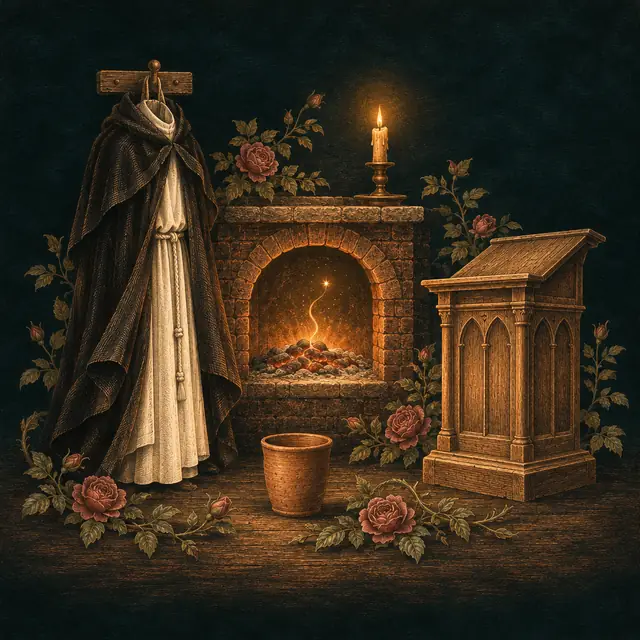
Who was Meister Eckhart, and what is truly known of them?
What is known
German Dominican friar, preacher and theologian, born in Thuringia about 1260. He was prior at Erfurt, twice held the Dominican chair of theology at Paris, in 1302 and 1311, was the first provincial of Saxony from 1303, and later directed the care of convents at Strasbourg and taught at Cologne. He wrote scholastic works in Latin and preached in German on the birth of God in the soul, on detachment, and on a ground where the soul and God are one. In 1326 the archbishop of Cologne opened proceedings against him for heresy; he appealed to the pope and went to Avignon. He died before the verdict: the bull of John XXII, dated 27 March 1329, condemned twenty-eight of his statements and noted that he had recanted whatever was in error.
The teaching
Taught from his German sermons, the Counsels on Discernment, On Detachment and the Book of Divine Consolation.
Let go of yourself
Eckhart's first counsel to the young friars is to look at oneself. Begin with yourself, he says, and let yourself go: wherever you find yourself, there let go of yourself. Whoever leaves his own will has left everything; whoever keeps it has left nothing, though he gave up all the riches and honours of the world.
And people should not think so much about what they ought to do as about what they are. If they are good, their works shine; holiness does not rest on doing but on being. The works do not make us holy; we make the works holy.
God in all things
The one who truly has God has him everywhere: in the street and among people as much as in church or in the cell, because he carries God with him in all he does. This is learned as writing is learned. At first the pupil must attend to every letter and keep it in mind; once the art is mastered, he writes freely without thinking of the letters, and the art works through him. So a person must be steeped in God until God shines in everything without effort.
For the same reason, love outranks rapture. If someone were caught up in a rapture like Saint Paul's and knew of a sick man who needed a little soup, it would be far better to come out of the rapture and serve him in love.
Detachment
His detachment and his birth of God in the soul stand among the other contemplatives on The Christian contemplatives; here they are as he unfolds them. On Detachment asks which virtue joins a person most closely to God, and answers: pure detachment, above love itself. Love makes me love God, but detachment makes God love me, for it is God's nature to fill what is empty, as nature cannot bear a void.
Detachment is a heart that stands unmoved by whatever befalls it, as a door swings to and fro on its hinge while the hinge stays where it is: the outer person may be busy and stirred while the inner person rests in God. The swiftest beast that carries a person to this perfection, he says, is suffering.
The birth of the Word in the soul
The Father speaks his Word eternally, and the same birth takes place in the ground of the soul. What good is it to me, he asks, that the Son was born of Mary long ago, if he is not born in me now, in my time and in my person? For this birth the soul must be still. The scripture says that while all things were in quiet silence, the almighty Word leaped down from heaven, and he reads it of the soul: its powers must be drawn in from the senses and from images, so that God can speak where nothing else speaks.
The ground
There is something in the soul, he preaches, so pure and so one that no time or flesh touches it: he calls it a spark, a little castle, a power, and at last simply the ground. There God's ground is the soul's ground and the soul's ground is God's ground. The eye with which I see God is the same eye with which God sees me: my eye and God's eye are one eye, one seeing, one knowing and one loving.
His Latin works say it in the language of the schools: being is God, and whatever is, is by God's being. A creature taken on its own is a pure nothing, and all it has it receives from God at every moment.
Without a why
Life lives out of its own ground and springs from its own source, without a why. If you asked life for a thousand years why it lives, it would answer only: I live because I live. So the just person works without why, not for a reward, not for heaven, not even for God as for a payment, but because the good is good. Some people, he warns, love God as they love a cow, for the milk and the cheese and their own profit.
The poor in spirit
The poor in spirit, in his most famous sermon, are those who want nothing, know nothing and have nothing. They do not even want to do God's will, because that too is a wanting of their own; they are as free of their own will as they were before they were. That is why he prays God to rid him of God: of every idea of God that stands between the soul and God himself.
Martha and Mary
He turns the old story of the two sisters round. Mary sits at the Lord's feet and listens, and is still learning; Martha has learned already, and works in the world from a ground so well grounded that her work does not hinder her. Christ names her twice, Martha, Martha, because she is complete in time and in eternity. The mature soul is not the one that keeps still, but the one that can act without being scattered.
Consolation
The Book of Divine Consolation teaches how to bear loss. The good person, insofar as he is good, is born of goodness, and goodness lives in him, so nothing that can be lost was ever truly his. If I suffer for God and in God, God suffers with me, and a suffering borne in him loses its bitterness, because it is his.
Whoever wants only what God wants has nothing to fear from any loss. What God wills, he wills too, and he would not have it otherwise.
Orders and memberships
The Order of Preachers, the Dominicans, all his adult life and in high office. His pupils Johannes Tauler and Henry Suso were Dominicans too. The lay circle called the Friends of God read him, and he founded no body himself.
The legend
That he was a pantheist, or a Zen master in a friar’s habit. Readers from the nineteenth century on took him up for their own causes, the Nazi ideologue Alfred Rosenberg among them. The Dominican order has asked Rome to state that he was no heretic.
What was forged, or is false
Many of the short sayings passed round under his name, and some German sermons and tracts in the old editions, are not his. The “Sister Katrei” treatise long printed among his works is by another hand.
Their works
- German SermonsSermon, early 14th century
His sermons in German to nuns, friars and lay people on the birth of God in the soul, on detachment and on a ground where the soul and God are one. Bold and paradoxical, they are the heart of his fame and of the German mystical tradition.
Many sermons in the old editions are not his.
Ask the Oracle about it - Book of Divine ConsolationBook, about 1320
A book of consolation in German, probably written for Agnes, queen of Hungary, teaching that suffering borne in God loses its sting. With a sermon on the nobleman, it forms the Liber Benedictus, and phrases from it were among those condemned.
Ask the Oracle about it - Counsels on DiscernmentTeaching, 1294 to 1298
Talks given to the young friars at Erfurt when he was their prior, on obedience, prayer, letting go of self will and finding God in all work. It is his earliest German work and the plainest.
Ask the Oracle about it - On DetachmentTreatise, early 14th century
A short German treatise that sets detachment above even love and humility, as the state in which the soul is empty of all things and God must pour himself into it. It is among his most read writings.
Its authorship was once doubted; most scholars now accept it.
Ask the Oracle about it - In agro dominicoRecord, 1329
The bull of Pope John XXII, issued after his death, which condemned twenty eight of his statements as heretical or suspect and noted that he had recanted whatever was in error. It limited his influence in the Church for centuries.
Ask the Oracle about it
How the house tells a life
This life is told from the record, with what is documented, what is legend and what was forged kept apart. A membership in an order is stated only where documents show it. A person’s chart explains none of their deeds.
The arts it feeds
Lives near it in time
Thinkers and teachers
SuhrawardiIbn ArabiAlbertus MagnusRumiRoger BaconRamon LlullMarsilio FicinoJohannes ReuchlinPico della MirandolaNiccolò MachiavelliIgnatius of LoyolaTeresa of ÁvilaThe whole tree

