
Pico della Mirandola
1463 to 1494
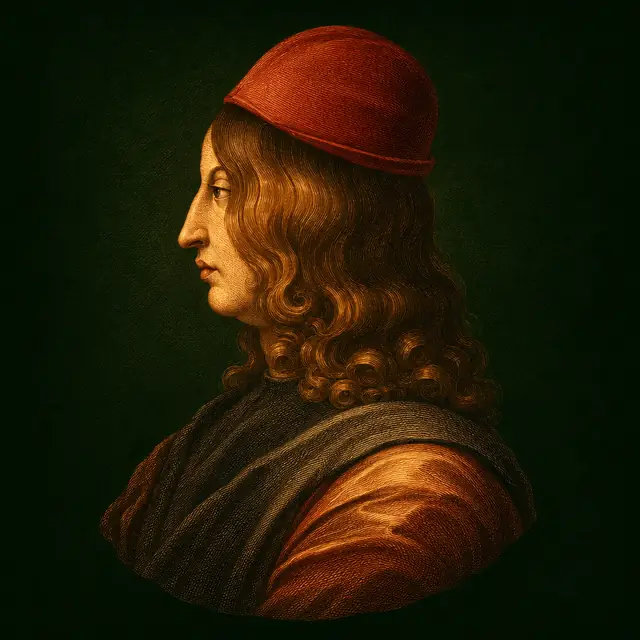
Who was Pico della Mirandola, and what is truly known of them?
What is known
Italian philosopher, a younger son of the counts of Mirandola. He studied at Bologna, Ferrara, Padua and Paris, and had Jewish scholars teach him Hebrew and translate Kabbalistic books for him. In December 1486 he printed nine hundred theses at Rome and offered to defend them in public. Pope Innocent VIII stopped the debate, a commission condemned thirteen theses and the pope then the whole book, and Pico fled to France, where he was arrested in 1488. Lorenzo de’ Medici brought him back to Florence. The speech written to open the debate was never given; it is now called the Oration on the Dignity of Man. His last large work attacked the astrology of prediction. He died at thirty-one.
The teaching
Taught from his own books, above all the Oration, the Nine Hundred Theses, the Heptaplus and the Disputations against astrology.
The maker of himself, in brief
Pico's best-known teaching is that the human being has no fixed place in the order of things and becomes what he makes himself, sinking toward the beasts or rising toward the angels by his own choice, and that the way up goes through moral philosophy, the study of nature and theology. The Oration that says it, with his magus who weds earth to heaven and his search for concord among all the schools, is taught on Ficino and the Renaissance. Here are the parts of his teaching that stand on their own.
Two kinds of magic
Magic, he holds, is two things that share one name. One is wholly the work and power of demons, a thing monstrous and accursed. The other, the magic that the Persian sages meant by the word, is the highest part of natural philosophy: it searches out the powers that God has scattered and hidden in the world and brings them into the light. It works no wonder against nature; it shows how wonderful nature already is.
Two kinds of Kabbalah
Kabbalah too is double. One kind is the art of combining letters, the Hebrew letters set in order and turned, which he likens to the art of Ramon Llull; the other is the knowledge of the higher powers, the ten sefirot and the angels, and this is the highest part of natural magic. The Kabbalah, he teaches, was received by Moses on Sinai beside the written Law and handed down by word of mouth, and rightly read it confirms the Christian faith: no science, one of his theses says, gives more certainty of the divinity of Christ than magic and Kabbalah. Two streams sets this Christian Kabbalah beside the Jewish one it grew from.
Four worlds
In the Heptaplus he finds the whole of philosophy in the six days of Genesis. There are three worlds: the angelic world of the pure minds, the heavenly world of the stars, and the world below the moon, of the elements and of things that are born and die. The human being is a fourth world, a small one that holds the other three: in him are the elements, the heavens and the angelic mind. Whatever is in one world is in the others in its own way. Fire is fire among the elements, the sun in the heavens, and among the angels the burning love of the seraphim.
So Moses' account of the six days can be read seven times over: once for each of the three worlds, once for the human being, once for all the worlds in their order, once for the bonds between all things, and once for the soul's happiness in God.
The first word
At the end of the book he takes the first Hebrew word of Genesis, Bereshit, in the beginning, and by the Kabbalists' art of moving and joining its letters draws a whole sentence out of it: the Father, in the Son and through the Son, the beginning and the end, or rest, created the head, the fire and the foundation of the great man with a good covenant. One word, rightly read, holds the creed and the shape of the world.
The heavens act by light and heat
His last great work turns against the astrology of prediction. The heavens act on the world below, he grants, but only by their motion and their light, and through these by a heavenly heat that fosters life in everything. That action is general, like the sun's warmth that serves all living things alike; it is not the particular cause of anyone's character, fortune or deeds, which come from nearer causes and from the free mind. If the stars ruled everything, praise and blame would be empty and the will would not be free.
He adds the astrologers' own weaknesses. They disagree with one another about the very foundations of their art, the same figure in the sky is read to opposite ends, and their forecasts fail more often than they come true, while people remember only the hits. Such an art corrupts philosophy, unsettles medicine and endangers religion.
Being and the One
On Being and the One sets out to show that Plato and Aristotle agree, against those Platonists who put the One above being. Being and one go together and reach equally far: whatever is, is one, and whatever is one, is. God is above being only in the sense that he is its fullness, beyond every limited thing that is, and we come nearest to naming him by denying every name, until he is found in the thick darkness where, as the Scripture says, he dwells.
The book ends on what this asks of a life: to become one, true and good in ourselves, so as to come to the one who is all three.
Orders and memberships
No order is documented. He belonged to the circle round Marsilio Ficino in Florence, a company of friends and not a society with rules, and in his last years he followed the preaching of Savonarola. He was buried at San Marco, the Dominican house.
The legend
That he had mastered twenty-two languages and all learning by twenty-three. That he was poisoned on the orders of Piero de’ Medici: tests on his bones, published in 2018, found arsenic enough to kill, so the poison is shown and the hand is not.
Their works
- Oration on the Dignity of ManEssay, 1486; printed 1496
The speech written to open his debate at Rome and never given. In it God tells Adam that he alone has no fixed place and may make himself what he will, and it praises magic and Kabbalah as means of understanding. It is the most famous text of the Renaissance.
Ask the Oracle about it - Nine Hundred ThesesBook, 1486
The Conclusiones, nine hundred theses drawn from Latin, Arabic, Greek, Hebrew and Chaldean sources, Kabbalah and magic among them, which he offered to defend in public. Pope Innocent VIII stopped the debate and condemned the book.
Ask the Oracle about it - HeptaplusBook, 1489
A sevenfold reading of the six days of creation in Genesis, finding in Moses the whole of philosophy and the order of the worlds. It is his chief work of Christian Kabbalah.
Ask the Oracle about it - Disputations against Divinatory AstrologyTreatise, printed 1496
Twelve books against the astrology of prediction, printed after his death, arguing that the stars act on the world only by light and heat and do not decide human fate. Kepler and others answered it for a century.
Ask the Oracle about it - On Being and the OneTreatise, 1491
A short book on whether being and the one are the same, written to reconcile Plato and Aristotle against the reading of the late Platonists. It was the only part finished of his plan for a book of concord between them.
Ask the Oracle about it
How the house tells a life
This life is told from the record, with what is documented, what is legend and what was forged kept apart. A membership in an order is stated only where documents show it. A person’s chart explains none of their deeds.
The arts it feeds
Lives near it in time
Thinkers and teachers
RumiRoger BaconRamon LlullMeister EckhartMarsilio FicinoJohannes ReuchlinNiccolò MachiavelliIgnatius of LoyolaTeresa of ÁvilaJohn of the CrossTycho BraheGiordano BrunoThe whole tree

