
Johannes Reuchlin
1455 to 1522
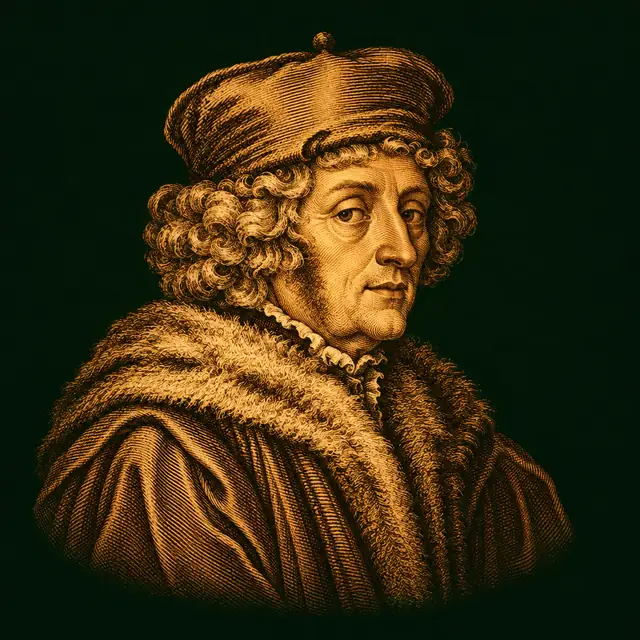
Who was Johannes Reuchlin, and what is truly known of them?
What is known
German jurist and humanist, born at Pforzheim, and for eleven years one of the three judges of the Swabian League. He learned Hebrew from Jewish teachers, among them the emperor’s physician Jacob Loans, and his De rudimentis hebraicis of 1506 gave Christian scholars a grammar and dictionary of the language. De verbo mirifico (1494) and De arte cabalistica (1517) argued that the Kabbalah bore out Christian teaching. From 1510 he opposed the campaign of Johannes Pfefferkorn to seize and burn Jewish books, and the Dominicans of Cologne pursued him for it for a decade; in 1520 Rome condemned his defence, the Augenspiegel.
The teaching
Taught from his own books, above all De verbo mirifico, De arte cabalistica and the Augenspiegel.
Back to the Hebrew
Reuchlin's first lesson is to go to the source. The Scriptures were given in Hebrew, and the Latin of the Church, however venerable, is a translation that can err; so the student learns the language, its letters, its grammar and its words, and reads the text itself. Where Jerome's Latin goes astray he says so, and gives the rule he worked by: he reveres Jerome as an angel and honours the commentators as masters, but he worships the truth as God. Hebrew, for him, is the oldest of tongues, the one in which God spoke to the fathers.
The wonder-working word
In On the Wonder-Working Word three men talk: Sidonius, a philosopher of the school of Epicurus; Baruchias, a Jew learned in the Kabbalah; and Capnion, a Christian, who bears Reuchlin's own name put into Greek. They ask what word has the power to work wonders, and find the answer in the names of God. In the age of nature, Capnion says, God was named with three letters, Shaddai, as the Lord tells Moses: “I appeared unto Abraham, unto Isaac, and unto Jacob, by the name of God Almighty, but by my name JEHOVAH was I not known to them.” In the age of the Law he was named with the four letters that may not be spoken. In the age of grace he is named with five: the letter shin, set in the midst of the four, makes the name of Jesus, and the name that could not be spoken becomes one that can.
That, for Capnion, is the wonder-working word: the name in which God and the human being meet, as the Word was made flesh. It is a Christian reading. The Jewish masters from whom he learned the letters read the same names to other ends, as Two streams sets out.
Kabbalah means receiving
On the Art of the Kabbalah brings three new speakers together: Simon, a Jew; Philolaus, a Pythagorean; and Marranus, a Muslim. Kabbalah, Simon teaches, means receiving: it is the symbolic theology that Moses received with the Law and that was handed on by mouth, in which letters, names and numbers are signs of divine things. It has two parts, the work of creation, which studies the making of the world, and the work of the chariot, which rises in contemplation toward the throne of God. Its whole purpose is the soul's ascent, from the senses to the mind and from the mind to God.
Letters and numbers
The Kabbalists read the Scriptures by three arts. Gematria counts the value of the letters, since each Hebrew letter is also a number, so that words of equal sum are joined in meaning. Notarikon reads a word as the first letters of a sentence, or makes one word from the first letters of many. Temurah exchanges letters by a fixed rule, finding one word hidden in another.
By such means the seventy-two names of God are drawn from three verses of Exodus, each of seventy-two letters, read together letter by letter. And the Kabbalists speak of fifty gates of understanding and thirty-two paths of wisdom, by which the soul climbs.
Pythagoras reborn
The Pythagorean in the dialogue is there for a reason. Pythagoras too taught in symbols, and Reuchlin holds that his school and the Kabbalah are one way of thinking: both teach that the visible points to the invisible, that number is a ladder toward God, and that the soul must be cleansed and raised from the senses to the mind. In his dedication to Pope Leo X he writes that as Ficino had given Plato back to Italy, and Lefèvre d'Étaples Aristotle to France, so he would give Pythagoras, reborn through the Kabbalah, to Germany.
The books must not be burned
Asked whether the books of the Jews should be taken from them and burned, he answered no, and printed his reasons in the Eye Glass. The Talmud and the Kabbalah should be kept and studied, for they serve learning and the understanding of Scripture; only a book plainly written to slander, and proved so in a court, may be taken away. The Jews are fellow citizens of the Empire under its law, their books are their own property, and the law protects them as it protects anyone's.
Nothing is won by burning. Let every university in Germany keep two teachers of Hebrew for ten years, he proposes, and let Christians answer Jews with reasons, gently and kindly, never with force.
Orders and memberships
No order is documented. He was a layman and a judge, and moved in the humanist circles of Heidelberg and Florence, where he met Pico in 1490. Later occult writers name him as a Kabbalist master; his books are the only ground for it.
The legend
That he was a Protestant before Luther. He stayed in the Roman church to his death, and took back the promise of his library from his great-nephew Melanchthon when Melanchthon held to Luther. That he practised the Kabbalah as magic rests on nothing but the titles of his books.
Their works
- De arte cabalisticaBook, 1517
On the Art of the Kabbalah, a dialogue among a Jew, a Pythagorean and a Muslim on the letters, names and numbers of the Kabbalah, which argues that it bears out Christian teaching. Dedicated to Pope Leo X, it was the fullest account of the Kabbalah then written by a Christian.
Ask the Oracle about it - De verbo mirificoBook, 1494
On the Wonder Working Word, a dialogue holding that the name of Jesus, written in Hebrew as the four letters of the divine name with a fifth added, is the word of power. It was the first book of Christian Kabbalah in Germany.
Ask the Oracle about it - De rudimentis hebraicisBook, 1506
On the Rudiments of Hebrew, a grammar and dictionary of the language for Christian scholars. It opened the Hebrew Bible to readers who had none of the language, and later Protestant and Catholic scholarship rests on it.
Ask the Oracle about it - AugenspiegelTreatise, 1511
The Eye Glass, his printed defence of his advice to the emperor against seizing and burning Jewish books, which held that the Talmud and the Kabbalah should be kept and studied. It drew a decade of attack from the Dominicans of Cologne and was condemned by Rome in 1520.
Ask the Oracle about it - HennoPlay, 1497
A Latin comedy of a peasant, his wife and a cunning servant, written for students at Heidelberg. It was among the first humanist plays in Germany and shows the lighter side of the Hebrew scholar.
Ask the Oracle about it
How the house tells a life
This life is told from the record, with what is documented, what is legend and what was forged kept apart. A membership in an order is stated only where documents show it. A person’s chart explains none of their deeds.
The arts it feeds
Lives near it in time
Thinkers and teachers
Albertus MagnusRumiRoger BaconRamon LlullMeister EckhartMarsilio FicinoPico della MirandolaNiccolò MachiavelliIgnatius of LoyolaTeresa of ÁvilaJohn of the CrossTycho BraheThe whole tree

