
Teresa of Ávila
1515 to 1582
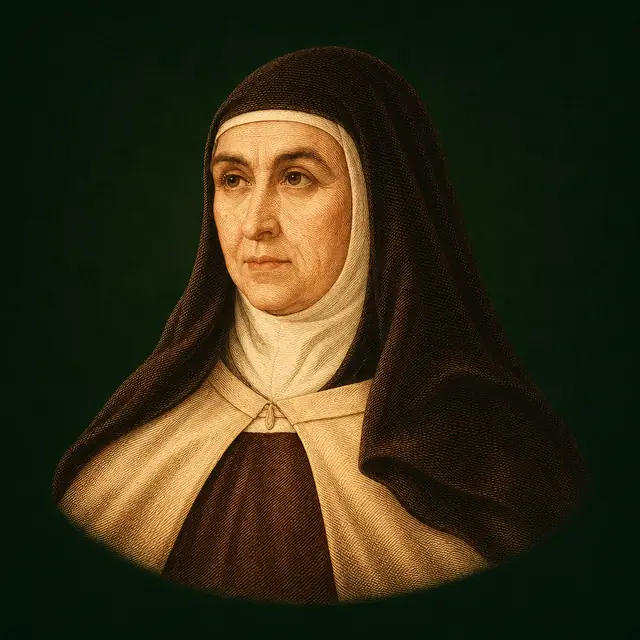
Who was Teresa of Ávila, and what is truly known of them?
What is known
Spanish Carmelite nun, born at Ávila. She entered the convent of the Incarnation there in 1535, and after years of illness, and of prayer that she found hard, she founded in 1562 the small house of St Joseph, where the old rule of the order was kept in poverty and enclosure. She founded seventeen such convents in all, on journeys across Castile and Andalusia, and with John of the Cross she carried the reform to the friars. At her confessors’ bidding she wrote her Life, The Way of Perfection and The Interior Castle (1577), which maps prayer as seven dwelling places. The Inquisition examined the Life and did not condemn it. She was declared a saint in 1622 and, in 1970, a Doctor of the Church.
The teaching
Taught from her own books, above all The Book of Her Life, The Way of Perfection and The Interior Castle.
The castle and the waters, in brief
Teresa pictures the soul as a castle of clear crystal with seven dwelling places, God in the innermost and prayer the door, and in her Life she teaches the growth of prayer as four ways of watering a garden, from drawing water by hand to the rain that God sends. Both are taught in full on The Christian contemplatives. What follows is her plainer teaching, the counsel she gave her nuns for the daily practice of prayer.
Prayer is friendship
Mental prayer, she says, is nothing else than an intimate sharing between friends: taking time often to be alone with the one we know loves us. It needs no learning and no special gifts. Whoever has begun it should never give it up, however badly they think they are living, for it is the way back; and she begs whoever has not begun it, for the love of God, not to go without so great a good.
Three things needed
For those who pray together she asks three things above all: love for one another, detachment from every created thing, and true humility, which, though she names it last, is the chief of them and holds the others in it. Without these, she warns, long hours of meditation lead nowhere.
A determined determination
Those who would walk this road must begin with a great and very determined determination not to stop until they reach the end, come what may, whatever it costs, whoever complains, even if they die on the way or the whole world sinks. She asks for the resolve once, at the start, and then for patience, since God leads souls by different roads and in his own time.
Recollection
Her own way into prayer is recollection. The soul gathers its powers and goes within itself, where the King dwells in his palace. There is no need to go up to heaven to speak with him, or to raise the voice: he is near, and he hears. She does not ask her nuns to think much or to make long and subtle reflections; she asks only that they look at him, as one looks at a friend. A picture of Christ, or a good book, helps the beginner to gather the mind, and she herself could not begin to pray without a book for many years.
Vocal prayer said well leads to the same place. The Way of Perfection ends with the Our Father, phrase by phrase, and teaches that one who says it slowly, knowing to whom she is speaking, may find God raising her to contemplation through the very words.
Never leave the humanity of Christ
She came to see as a mistake the counsel that, in high prayer, one should leave behind every bodily image, even of Christ. The humanity of Christ is the door and the companion; with so good a friend present, and so good a captain who went first into suffering, everything can be borne. Even in the highest dwelling places the soul keeps him in view.
Love, not thinking
The important thing is not to think much but to love much, and so to do whatever most awakens love. Love itself is not great delight but a firm resolve to please God in everything. The thoughts may run on like the clapper of a mill while the will rests in God; she counsels not to be troubled by them or to fight them, but to let them run and come back to love.
Among the pots and pans
Work and obedience do not take a soul away from God. If obedience keeps you busy with outward things, she tells her daughters, and it is in the kitchen, the Lord walks among the pots and pans, helping you within and without. The proof of prayer is in how one lives, and the surest sign that the love of God is real is the love of one's neighbour.
Judging favours by their fruit
She teaches her nuns not to desire visions, raptures or any special favour, and to judge whatever comes by its fruit: what comes from God leaves humility, peace, strength for virtue and a wish to serve, and what does not leaves unrest and self-regard. She wanted such things examined by learned confessors, and trusted learning more than piety without it.
She warns too against a weakness that passes for rapture. Some sisters, worn down by long prayer, vigils and penances, fall into a heavy absorption for hours and take it for a gift from God. It is weakness of the body, she says, and she ordered such sisters to sleep and eat well and to cut down their prayer and penance until their strength returned.
Humility is walking in truth
Humility is walking in truth: seeing ourselves as we are, with nothing good of our own and with all the good that God gives. The room of self-knowledge must never be left, yet no one should stay in it alone, for the soul learns its own lowliness best by looking at the greatness of God.
The lines found in her breviary give the whole in a few words: let nothing disturb you, let nothing frighten you; all things pass; God does not change; patience obtains everything; whoever has God lacks nothing; God alone suffices.
Orders and memberships
A Carmelite nun from 1535 and founder of the reform that became the Discalced, or barefoot, Carmelites, an order of the Catholic Church. No secret order has any part in her life.
The legend
That she rose from the ground in prayer: the account is her own and her sisters’, and she wrote that it frightened her and that she begged to be spared it before others. The heart shown at Alba de Tormes with a wound, as proof of the angel’s spear she describes, is a relic’s claim and not a record.
Their works
- The Interior CastleBook, 1577
Written in a few months at her confessors’ bidding, it pictures the soul as a castle of clear crystal with seven dwelling places, through which prayer leads inward to the room where God lives. It is her fullest map of the life of prayer and the best known of her books.
Ask the Oracle about it - The Book of Her LifeBook, finished 1565, printed 1588
Her account of her childhood, her long illness, her hard years of prayer and the graces that followed, written for her confessors and read by the Inquisition, which did not condemn it. Its chapters on the four ways of watering a garden are a classic teaching on prayer.
Ask the Oracle about it - The Way of PerfectionBook, about 1566, printed 1583
Written for the nuns of St Joseph at Ávila, it teaches love of one another, detachment and humility, and closes with a long commentary on the Lord’s Prayer. It is the most practical of her books.
Ask the Oracle about it - The Book of the FoundationsBook, 1573 to 1582, printed 1610
The story of the convents she founded across Castile and Andalusia, with the journeys, the lawsuits, the patrons and the sisters she met on the road, told with humour and sharp sense. It shows the mystic as a tireless founder.
Ask the Oracle about it - LettersLetters, 1546 to 1582
Some four hundred and fifty of her letters survive, to bishops, the king, her family, her prioresses and John of the Cross. They are lively and warm, full of business and illness and affection.
Ask the Oracle about it
How the house tells a life
This life is told from the record, with what is documented, what is legend and what was forged kept apart. A membership in an order is stated only where documents show it. A person’s chart explains none of their deeds.
The arts it feeds
Lives near it in time
Thinkers and teachers
Meister EckhartMarsilio FicinoJohannes ReuchlinPico della MirandolaNiccolò MachiavelliIgnatius of LoyolaJohn of the CrossTycho BraheGiordano BrunoFrancis BaconTommaso CampanellaJohannes KeplerThe whole tree

